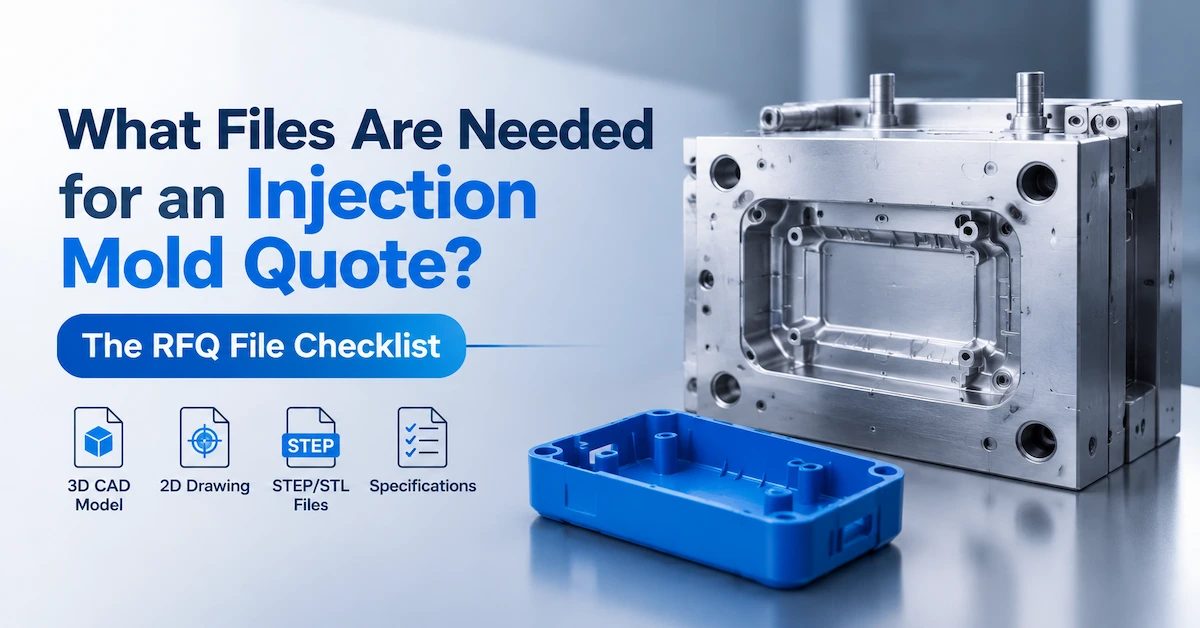
The minimum package for a reliable injection mold quote is a controlled 3D CAD model, a dimensioned 2D drawing, the current revision, material and color requirements, expected volume, critical dimensions, finish, assembly information, sample expectations, packaging needs, and the target schedule. A 3D file shows the part geometry, but it does not always define what the supplier must hold, inspect, approve, or deliver. A 2D drawing and written RFQ scope turn design intent into quotation assumptions.
This is the practical meaning of injection mold quotation requirements. The buyer is giving the mold supplier enough information to assess the tooling route, cavity strategy, material, production assumptions, inspection scope, sampling plan, and exclusions. When those inputs are missing, the quote can rest on assumptions that later become change orders, schedule extensions, or quality disputes.
Buyers searching for the phrase files needed for injection mold quote are usually asking which decisions must be made before a supplier can price the tool responsibly. The answer is a controlled package, with unknowns clearly marked instead of hidden.
DX Molding's public custom molding services page lists 2D/3D drawings, STEP/STL files, physical samples, material requirements, target quantity, finish, color, and tolerance as project inputs. It also describes a workflow from requirements and file review through DFM, quotation and production-plan confirmation, mold making, trial molding, inspection, and production delivery. The exact steel, cavity count, machine, price, capacity, inspection documents, and delivery dates remain project-specific and should be confirmed in the quotation.
Why a 3D File Alone Does Not Produce a Comparable Quote
A 3D CAD model is the most useful starting point for geometry review, but it is not a complete commercial specification. CAD may not identify critical dimensions, cosmetic zones, material assumptions, or mating-part relationships. Two suppliers can quote the same model while pricing different interpretations of the finished part.
One supplier may assume standard cosmetic marks, a non-critical boss, or an adjustable snap fit. Another may include extra inserts, a different gate, or a wider inspection scope. Both prices can be internally consistent while being commercially incomparable.
Your RFQ should therefore separate three kinds of information:
- Released design data: the geometry, dimensions, material, and features that are approved for quotation.
- Performance and acceptance data: what the part must do, fit, look like, survive, or connect to.
- Commercial and program data: expected volumes, sampling needs, packaging, delivery location, schedule, and responsibility boundaries.
This separation helps the supplier identify what can be priced now and what requires engineering review. It also protects the buyer from treating a preliminary quote as a final commitment when the design is still changing.
The Minimum Injection Mold RFQ Checklist
A useful injection mold RFQ checklist is short enough for a supplier to review and detailed enough to prevent silent assumptions. The following package is a practical baseline for an OEM project, a startup preparing its first tool, or a contract manufacturer comparing mold routes.
| RFQ input | What to provide | Why the supplier needs it | What may remain open |
|---|---|---|---|
| 3D CAD | Native CAD where possible, plus STEP or another neutral format; identify the released file name and revision. | Reviews part geometry, parting direction, undercuts, inserts, ribs, bosses, wall transitions, and mold layout. | Final parting line, gate location, slides, lifters, and cooling concept. |
| 2D drawing | Dimensioned drawing with datums, tolerances, critical characteristics, notes, and revision history. | Defines what must be held and how the finished part will be measured. | Inspection method for dimensions that are not yet functionally defined. |
| Material | Resin family and proposed grade, filler, flame rating, food or medical requirement, and approved alternatives. | Material affects shrinkage, processing, appearance, wear, strength, and price. | Final grade, supplier, colorant, COA, and lot-traceability documents. |
| Color and finish | Color reference, texture or gloss requirement, visible zones, logo details, and acceptable gate or ejector marks. | Sets cosmetic tooling and approval assumptions. | Physical master sample, texture plate, or final appearance limit sample. |
| Volume | Initial order, annual forecast, peak demand, part variants, and expected reorder pattern. | Supports cavity count, runner strategy, mold robustness, and production economics. | Forecast confidence and final capacity plan. |
| Assembly | Mating parts, fasteners, PCBs, seals, connectors, clips, and functional fit requirements. | Prevents a part from being quoted as acceptable when it only fits in isolation. | Availability of final mating components for validation. |
| Samples | Existing part, prototype, benchmark, or approved appearance sample; state whether it is for geometry, fit, or appearance. | Clarifies what cannot be understood from CAD or a drawing alone. | Whether the sample is a reference or the production master. |
| Schedule | Tooling release, T1 sample date, approval date, pilot build, mass-production date, and shipping destination. | Allows the supplier to align engineering, tooling, sampling, corrections, and production planning. | Approval turnaround and design-change response time. |
| Packaging | Part separation, protective film, labels, carton requirements, quantity per pack, and export destination. | Prevents damage, contamination, mix-ups, and unpriced secondary handling. | Final packaging artwork and carrier instructions. |
The table is a buyer-side checklist, not a promise that every project needs the same tooling arrangement. A simple non-cosmetic component may need fewer inputs than a visible enclosure with tight assembly requirements. The supplier should still identify which fields are confirmed, which are assumed, and which must be resolved during DFM.
1. Send a Controlled 3D CAD Package
The first file in a 2D 3D mold quote package should be a clearly identified 3D model. Use a file name that includes the part number and revision, such as PART-1042_Rev-C, and keep the same revision in the RFQ email, drawing, sample label, and purchase documents. Do not send several similar models without identifying which one controls the quote.
What the 3D model should show
- The complete part geometry, including ribs, bosses, clips, snap features, holes, seals, and cosmetic surfaces.
- Any areas that are intentionally thick, flexible, hollow, textured, polished, or hidden behind another component.
- Design intent for shutoffs, sealing lands, draft-sensitive faces, and assembly interfaces.
- Separate bodies or reference geometry for inserts, overmolded components, or parts that are not included in the mold.
- The coordinate system and, when relevant, the preferred pull direction or assembly orientation.
DX Molding's Services page says buyers can send CAD files, 2D drawings, STEP/STL files, dimensioned sketches, or early concepts for review. STEP and STL are useful for communication, but an STL mesh may not preserve editable feature information. For a production quote, provide the most complete controlled model available and identify any conversion that could affect geometry.
How to handle unfinished geometry
If the design is not released, do not present it as final. Mark the file as preliminary and list the open decisions: wall thickness, draft, parting line, snap fit, connector location, texture, or material. Ask the supplier to price the current design as a feasibility estimate and to list the assumptions that must be confirmed before steel is cut. This is more useful than hiding uncertainty inside a single “final” quote.
2. Include a 2D Drawing That Defines Acceptance
The 2D drawing converts a visual 3D model into a measurable product. Include overall and functional dimensions, datums, tolerances, geometric requirements, material notes, surface requirements, and revision history. Identify which dimensions control fit, sealing, alignment, movement, or an electrical or mechanical interface.
Separate critical dimensions from reference dimensions
Not every dimension deserves the same inspection method or tooling investment. Identify critical-to-function dimensions and explain what they control. A connector opening may control mating force, a seal groove leakage, and a mounting boss screw engagement.
State the revision and change authority
Include the revision number, release date, change description, and the person or organization authorized to approve changes. If the 3D model and 2D drawing conflict, state which document controls or require the supplier to stop and ask. A quote based on Rev-B should not silently become a tool built from Rev-C because the newest file was attached later in an email thread.
3. Define Resin, Grade, Color, and Material Evidence
“ABS,” “nylon,” or “clear plastic” is often not enough for a commercial quote. The exact grade can change shrinkage, mold-flow behavior, drying requirements, surface appearance, strength, chemical resistance, flame performance, and material cost. List the preferred resin manufacturer and grade when known, along with filler content, glass orientation concerns, flame rating, recycled-content requirement, food-contact requirement, medical or regulatory requirement, and approved alternatives.
When the grade is not finalized, say so. Use a controlled phrase such as “PC grade under engineering review; quote with the proposed grade and identify the cost and processing impact of alternatives.” The supplier can then separate a current estimate from an approved material commitment. Do not ask for a fixed price while leaving material selection open if the material could change the tool design, shrinkage compensation, drying process, or inspection plan.
Color and appearance inputs
A color name such as “blue,” “black,” or “Pantone blue” may be a starting point, but appearance acceptance normally needs a physical reference, an approved color chip, or a defined color measurement method. State whether the color is molded-in, painted, printed, plated, or created by a secondary process. Identify visible surfaces and the acceptable level of weld lines, flow marks, gate vestige, ejector marks, gloss variation, and parting-line mismatch.
4. Explain Volume, Variants, and the Production Route
Annual volume influences whether a single-cavity or multi-cavity mold is sensible, whether a hot runner is worth evaluating, how much maintenance access matters, and whether the tool should serve one part or several variants. Give the initial order quantity, realistic annual demand, peak demand, forecast horizon, seasonal pattern, and number of variants.
Also distinguish between a tooling-only purchase and a mold-plus-production program. A mold quote may cover a reusable asset and sampling, while a production quote may include material procurement, machine setup, molding, trimming, inspection, packaging, and delivery. If both are required, request separate line items so the commercial scope is visible.
| Volume information | What the buyer should state | Decision it supports |
|---|---|---|
| Initial launch quantity | Pieces required for pilot, launch, customer validation, or first shipment. | Sampling route, initial production plan, and timing. |
| Annual demand | Expected annual units by part number, not only a total program number. | Cavity count, cycle economics, maintenance and capacity discussion. |
| Peak demand | Largest expected monthly or quarterly release and seasonality. | Production loading and buffer-stock planning. |
| Variants | Color, material, geometry, handedness, or customer-specific versions. | Interchangeable inserts, separate tools, color change, and inspection scope. |
| Reorder model | Blanket order, forecast release, scheduled batches, or irregular replenishment. | Packaging, inventory, material purchasing and production planning. |
A forecast is not a guarantee; it makes the tooling recommendation and quote assumptions explicit.
5. Add Mating Parts, Samples, and Functional Expectations
A molded component is rarely approved by itself. Send mating housings, lids, connectors, fasteners, seals, printed circuit boards, shafts, tubes, or other interface parts when they affect fit. If the physical parts cannot be shipped, provide their controlled CAD, key dimensions, and the functional requirement they impose.
State what the supplier should validate at sampling:
- Fit with the mating part, including insertion force, snap engagement, screw seating, or alignment.
- Sealing or compression behavior where a gasket, O-ring, or flexible feature is involved.
- Movement, retention, clearance, and interference through the full operating range.
- Appearance on the assembled product, not just on a flat inspection table.
- Compatibility with downstream operations such as ultrasonic welding, printing, painting, plating, adhesive bonding, or assembly.
6. Specify Surface Finish, Texture, and Cosmetic Zones
Surface requirements affect mold machining, polishing, texturing, parting-line placement, draft, ejection, and sample approval. Mark cosmetic zones on the 3D model or drawing. Identify high-visibility faces, customer-facing areas, sealing surfaces, grip surfaces, logo locations, and hidden surfaces. Use a texture reference, gloss target, approved sample, or surface standard when the appearance is important.
Do not write only “high quality finish.” Replace it with an acceptance statement such as “visible A-surface to match the approved texture reference; no sink, burn, short shot, or flow mark in the marked zone; gate vestige limited to the hidden side.” The exact wording should reflect the product and be agreed with the supplier before quotation.
Cosmetic requirements should also identify acceptable manufacturing marks. A gate vestige on an internal face may be acceptable; the same mark on a transparent cover may not be. An ejector mark can be harmless on a hidden rib but unacceptable on a hand-held exterior. This information helps the supplier price the right gate, ejection, polishing, and inspection approach.
7. State Sampling, Inspection, and Documentation Expectations
A quote should explain what sample stage is included and what evidence the buyer expects. Use T0 or T1 only when the supplier and buyer share the same definition. State sample quantity, material, color, cavity identification, measurement report, visual approval process, and correction loops included or excluded.
For a first RFQ, ask the supplier to separate:
- Tool design review and DFM output.
- Initial mold trial and sample delivery.
- Dimensional inspection and report format.
- Correction work after sample feedback.
- Final approval conditions and production release.
DX Molding's Services page describes trial molding, inspection, sample approval, and production delivery as stages in its OEM/ODM workflow. That published workflow supports asking for a stage-based quotation. It does not, by itself, define a universal sample quantity, report template, correction limit, or approval deadline for every project. Put those details in the RFQ and confirm them in the supplier's quotation.
8. Include Packaging, Delivery, and Production Location Details
Packaging is often omitted from mold RFQs because buyers think only about steel. That omission creates problems when the quote is actually for molded parts. State whether the request is for the mold, molded samples, production parts, or all three. For parts, define individual protection, separators, bags, labels, cartons, quantity per carton, pallet requirements, moisture control, and export documentation.
State the delivery destination and shipping term required by your purchasing process. If the mold will be shipped to another production location, provide the target machine information, mold base constraints, maximum mold dimensions, ejection and water connections, controller requirements, and acceptance tests. A tool intended to run in one factory may require changes before it can run reliably on another machine.
How Missing Inputs Become Quote Exclusions and Change Orders
The most expensive RFQ mistake is not always a high initial price. It is a low price built on unspoken exclusions. Missing information tends to surface in predictable places:
| Missing input | Likely quotation assumption | Possible later impact |
|---|---|---|
| No 2D critical dimensions | Supplier quotes general dimensional control. | Additional inspection, mold correction, or fit failure. |
| No material grade | Supplier selects a common resin family. | Different shrinkage, processing, strength, color, or material cost. |
| No volume forecast | Single-cavity or basic tool is assumed. | Tool replacement, capacity shortage, or higher unit cost. |
| No mating parts | Part is assessed in isolation. | Assembly interference, leakage, retention issue, or redesign. |
| No cosmetic map | Standard gate and ejector marks are accepted. | Visible defects, texture rework, or new tooling features. |
| No sample plan | One trial and informal approval are assumed. | Dispute over T1 scope, reports, correction loops, or release. |
| No packaging requirement | Bulk packing is assumed. | Damage, contamination, relabeling, and unpriced labor. |
| No schedule definition | “Lead time” means tool completion or first sample. | Missed launch date despite technically meeting the quoted date. |
These are not reasons to delay every RFQ until every detail is perfect. They are reasons to show uncertainty openly. A supplier can quote a preliminary design with assumptions, options, and exclusions. The buyer can then decide what must be resolved before tooling and what can remain an engineering task.
How to Request a Quote That Buyers Can Compare
Send the same controlled package to each supplier. Use one file-transfer folder with numbered subfolders for CAD, drawings, materials, samples, quality, packaging, and commercial requirements. Include an RFQ cover sheet that lists the part number, revision, requested scope, response deadline, and contact for technical questions.
Ask every supplier to return the same quote fields
- Tooling price and what the price includes.
- Sampling price, sample quantity, material, and trial stage.
- Production part price at the stated volumes and quantity breaks.
- Recommended cavity count, runner concept, and major tooling assumptions.
- Steel recommendation and any heat treatment, coating, or surface treatment included.
- DFM deliverable, Mold Flow scope if required, inspection reports, and sample approval records.
- Lead-time definition, starting event, buyer dependencies, and correction-loop assumptions.
- Packaging, shipping, export documentation, and production location.
- Exclusions, optional items, change-order rates, and quotation validity.
This format prevents the buyer from comparing one supplier's mold-only price with another supplier's mold-plus-sampling package. It also makes it easier to move from technical review to the DX Molding services workflow, where project requirements, files, DFM, quotation, tooling, trials, inspection, and delivery are treated as connected stages.
For a quotation review, prepare the current 3D model, 2D drawing, material and finish requirements, target quantity, and any mating parts or samples. A supplier can then identify manufacturability risks and separate confirmed scope from items that need engineering clarification before tooling.
Questions to Answer Before You Send the RFQ
Is a 3D CAD file enough to request an injection mold quote?
It is enough for an initial feasibility review, but usually not enough for a comparable final quotation. Add the current revision, 2D drawing, material, finish, volume, critical dimensions, assembly requirements, sampling expectations, and schedule. If those items are not available, label the request as preliminary and ask the supplier to list assumptions.
Do I need both 2D and 3D files for a mold quote?
For a production-intent RFQ, both are recommended. The 3D file communicates geometry and the 2D drawing defines dimensions, tolerances, datums, notes, and inspection intent. A supplier may start from STEP or STL, but the buyer should identify the released model and resolve any conflict between the files.
What material information should be included?
Provide the resin family, proposed grade, filler, color, performance requirements, approved alternatives, and any regulatory or certification documentation required for the project. If the grade is not final, state that clearly and request a quote showing the assumption and the impact of alternatives.
Should the RFQ include annual volume or only the first order?
Include both. The first order helps plan launch production, while annual and peak demand influence cavity count, runner selection, maintenance, capacity, and unit economics. List volume by part number and variant rather than giving only a total program estimate.
What samples should be sent with the RFQ?
Send an existing part, prototype, benchmark, appearance master, mating component, or physical reference when it explains something the CAD cannot. Label the purpose of each sample. A sample used for geometry reference is not automatically an approved material or cosmetic standard.
How should cosmetic requirements be communicated?
Mark visible surfaces and provide a texture, gloss, color, logo, or approved physical reference. Define acceptable gate vestige, ejector marks, weld lines, flow marks, parting lines, and sink marks by zone. “High quality finish” is too vague for a reliable commercial scope.
Should mold trials and inspection reports be included in the quote?
Yes, state the required sample stage, quantity, material, cavity identification, dimensional report, visual review, correction loops, and final approval condition. Suppliers use terms such as T0 and T1 differently, so define what each stage means for your project.
What causes an injection mold quotation to change after approval?
Common causes include a revised CAD model, a different material grade, newly identified critical tolerances, added cosmetic requirements, a higher volume target, extra cavities, a changed production machine, new mating-part constraints, additional inspection, or packaging and secondary operations that were not in the original scope.
Can a supplier quote an early-stage concept without final CAD?
Yes, but the result should be treated as a feasibility estimate or budgetary quote. DX Molding's Services page says product ideas, sketches, and early concepts can be sent for initial review. The final tooling quote should be refreshed after the geometry, material, volume, finish, and acceptance requirements are released.
What should be written in the RFQ if some information is unknown?
Keep the field visible and mark it “to be confirmed.” Then ask the supplier to state the assumption, provide an option or range, and explain what would change the price or schedule. Explicit uncertainty is easier to manage than a hidden assumption inside a low quote.
Conclusion
A reliable injection mold quote starts with a controlled information package. Send the current 3D CAD model and 2D drawing, identify the revision, define material and appearance, mark critical dimensions, explain the mating assembly, state initial and annual volume, describe the sample and inspection plan, and include packaging, delivery, production location, and schedule requirements. When a field is not finalized, label it as an assumption instead of allowing each supplier to guess differently.
The objective of an RFQ is not to produce the lowest isolated number. It is to create a quotation that the buyer can compare, approve, and convert into a tooling and production plan without avoidable exclusions. For an OEM project, you can send your drawings, samples, specifications, or early concept through the DX Molding custom molding services page for an engineering review of the required files, manufacturing risks, quotation scope, and next project inputs.