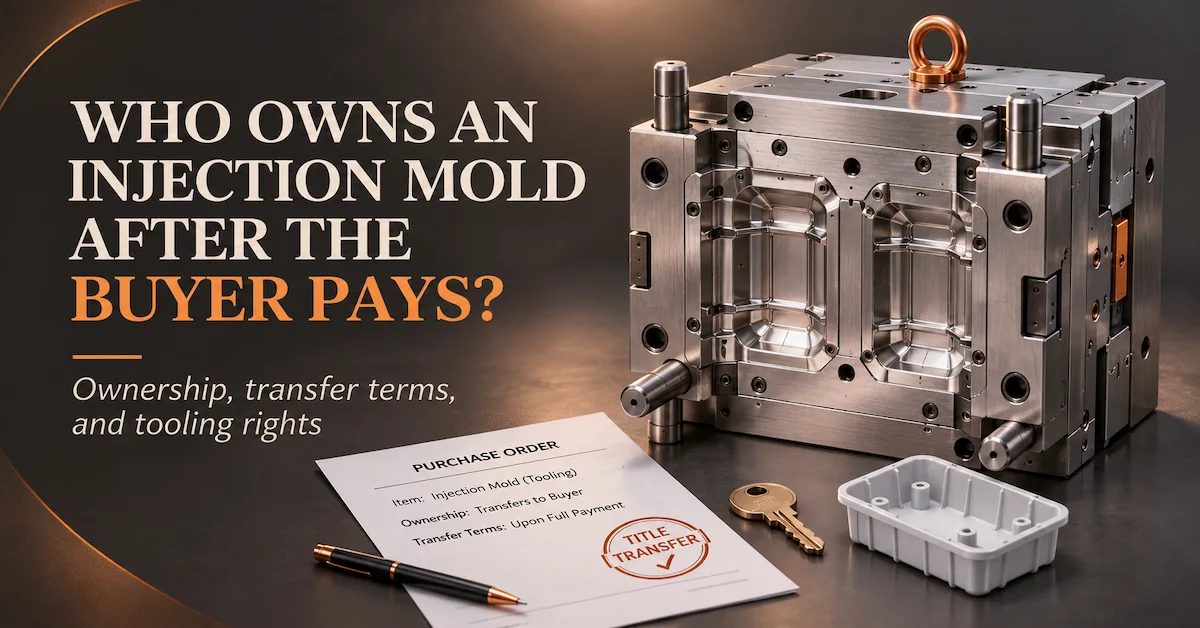
Paying a tooling invoice does not, by itself, answer who owns the injection mold. Ownership depends on the purchasing documents, the event that transfers title, the assets identified as part of the purchase, and the law governing the agreement. A useful injection mold ownership agreement should say whether the buyer owns the physical mold, when that ownership begins, where the mold will be kept, who may use or modify it, which engineering files are included, and how the buyer can retrieve or transfer the tool.
The contract should also separate ownership of the physical mold from ownership or permitted use of product CAD, mold design files, machining data, electrodes, standard-component information, improvements, samples, fixtures, and inspection records. Those rights do not become identical merely because one tooling payment was made. For a cross-border project, the buyer's legal team should review the tooling ownership contract, governing law, language priority, confidentiality, intellectual-property terms, remedies, and dispute-resolution procedure before the purchase order is released.
This guide is for procurement directors, OEM founders, engineering managers, legal teams, and supply-chain teams outsourcing tooling to China. It is procurement guidance rather than legal advice. DX Molding is operated by Shenzhen DongXin Technology Co., Ltd., a Shenzhen-based manufacturer whose public pages describe plastic and silicone molds, molded parts, OEM/ODM development, tooling documentation, trials, maintenance, modification, and export support. Its website does not publish a standard ownership contract, so project rights must be confirmed in writing through the DX Molding contact page.
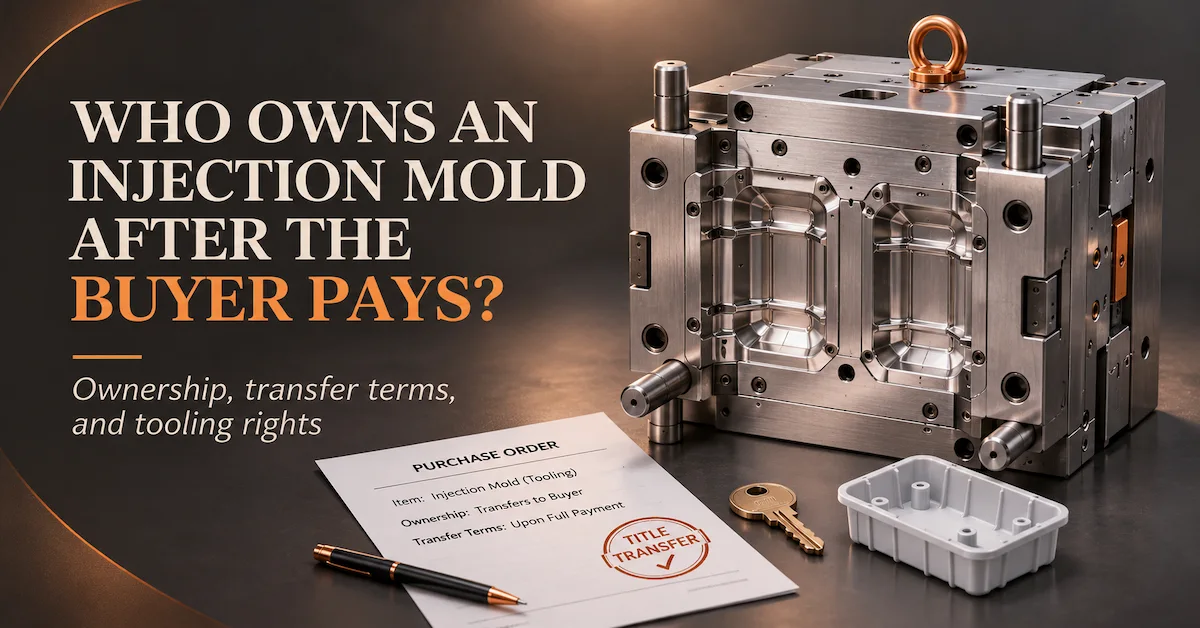
Physical Mold Ownership Is Not the Same as Engineering-Data Ownership
An injection mold is not one undivided deliverable. The physical tool can include the mold base, core and cavity inserts, slides, lifters, cooling components, ejector system, hot-runner components, sensors, connectors, interchangeable inserts, and project-specific fixtures. The project also produces digital and documentary assets. Each item may have a different owner, creator, license, delivery obligation, and transfer restriction.
The buyer should therefore avoid a clause that says only “the mold belongs to the customer after payment.” That sentence leaves unanswered whether the buyer receives a complete, transferable asset or merely the right to have parts produced from a tool stored at the supplier. A practical agreement uses an asset schedule.
| Asset | Question the agreement should answer | Evidence to identify it |
|---|---|---|
| Physical injection mold | Who holds title, when title transfers, and whether the buyer can remove or transfer the mold? | Tool number, photographs, plate engraving, dimensions, weight, cavity count, and asset register. |
| Buyer product CAD and drawings | Who owns the files supplied by the buyer, and for what limited purpose may the supplier use them? | Part numbers, revisions, file register, and confidentiality classification. |
| Mold assembly and component drawings | Are these deliverables, licensed for maintenance, or retained as supplier know-how? | File format, drawing list, revision, BOM, and delivery milestone. |
| Electrode, CAM, and machining data | Must the supplier preserve or deliver this data, and can another toolmaker use it? | Named file types, retention period, and permitted-use clause. |
| Standard and proprietary components | Can replacements be purchased by the buyer or receiving factory? | Manufacturer, model, specification, supplier reference, and spare-parts list. |
| Fixtures, gauges, and approved samples | Are they buyer-owned assets, supplier production aids, or separately priced items? | Asset ID, calibration or approval status, storage location, and return terms. |
| Trial, inspection, and process records | Which records must be delivered, retained, or transferred with the mold? | Drawing revision, resin, cavity ID, report number, and record-retention rule. |
This separation is particularly important for ODM projects. The buyer may own its original product requirements while the supplier creates mechanical design or tooling know-how during development. The agreement should identify background IP brought into the project, project-specific results created during the work, and any pre-existing supplier methods that are licensed rather than assigned. Legal counsel should adapt those concepts to the actual jurisdiction and commercial model.
What Should an Injection Mold Ownership Agreement Contain?
The agreement does not have to be a standalone document. The terms may sit in a master supply agreement, tooling purchase agreement, purchase order, tooling specification, or signed project appendix. The documents must work together without conflicting definitions. If the purchase order says “buyer-owned tooling” but the supplier quotation excludes drawings and transfer work, the parties still have a gap.
1. Identify the parties and the exact tooling asset
Use the legal names and addresses of the buyer, contracting supplier, toolmaker, and any separate molding factory. Do not assume the company receiving payment is the same entity machining or storing the mold. Assign a unique tool number and connect it to the buyer part number, mold revision, cavity configuration, and approved tooling specification. Require durable ownership identification on the mold where technically appropriate and permitted by the design.
2. Define the title-transfer event
The contract should state the exact event that transfers ownership. Possible commercial structures include transfer after full tooling payment, transfer in proportion to milestone payments, transfer after final acceptance, or retention of title until all agreed amounts are paid. None should be assumed. The agreement should also explain what happens to work in progress, purchased steel, components, and unfinished tooling if the project is suspended or the supplier fails before final acceptance.
Payment, possession, acceptance, and title are different concepts. The buyer may pay in full while the supplier keeps physical possession for ongoing molding. The buyer may accept T1 parts without accepting the tool as complete. The parties may transfer title before the mold is shipped. Each event should have its own definition and evidence.
3. State where the mold will be stored and used
Name the approved storage and production location. If the supplier may move the mold to another site or subcontract production, define whether written buyer approval is required. Specify access for inspection, inventory confirmation, maintenance review, or customer audit. The asset register should show the current location, tool condition, last production date, maintenance status, and responsible contact.
4. Restrict unauthorized use
A buyer-owned mold should not be treated as available capacity for another customer's parts. The agreement should prohibit unauthorized production, copying, sampling, reverse engineering, display, photography, or disclosure, subject to counsel's review. Address excess parts, scrap, rejected parts, runners, trial pieces, and samples because they can reveal product geometry or enter an unauthorized supply channel.
5. Define modification authority and revision control
State who can request, approve, and pay for mold modifications. Require a controlled engineering-change record identifying the affected CAD revision, reason, scope, price, schedule, validation requirement, and impact on interchangeable components. Emergency repairs needed to protect the mold may require a separate authorization route from product-design changes. The supplier should not permanently change buyer-owned tooling from an informal message without traceable approval.
6. Allocate maintenance, repair, and preservation duties
Clarify routine cleaning, lubrication, rust prevention, storage, preventive maintenance, wear-part replacement, damage investigation, and major refurbishment. State who pays for normal wear, production misuse, customer-requested changes, and damage caused by storage or handling. Define the evidence required before assigning responsibility, such as maintenance logs, shot records, photographs, process records, and a joint condition report.
DX Molding's public production and quality support page lists maintenance and preservation guidance, wearing-spare-parts lists, overhaul solutions, modification evaluation, technical documents, and anti-rust export packaging. These are relevant capabilities to discuss, but they do not establish ownership or a universal maintenance obligation. The project quotation and contract must name the deliverables actually included.
7. Define transfer and retrieval rights
The agreement should say whether the buyer may move the tool, what notice is required, whether undisputed invoices must be paid first, and which handover services are chargeable. Define a reasonable release process, condition inspection, packing standard, document package, loading responsibility, and cooperation with the receiving factory. Also address whether the supplier may assert any right to retain the tool; counsel should review this point under the governing law.
Does Full Payment Automatically Transfer Mold Ownership?
The procurement answer is: do not rely on payment alone. A tooling invoice proves that a payment was requested and made; it may not identify all purchased assets, the transfer date, possession rights, data rights, or release conditions. A contract should connect each payment milestone to measurable deliverables and state whether title changes at that milestone.
| Milestone | Possible deliverable | Ownership question to resolve |
|---|---|---|
| Tooling deposit | Approved project start, steel order, initial design work. | Does the buyer acquire rights in purchased material or work in progress? |
| Mold-design approval | Approved assembly concept, component plan, and design revision. | What design files or use rights are delivered at this stage? |
| First trial | T0/T1 samples, trial record, issue list, and inspection data. | Does trial payment affect title, or only authorize correction work? |
| Final acceptance | Approved samples, closed issue list, agreed validation evidence. | Is acceptance the title-transfer event, and what defects survive acceptance? |
| Final payment | Paid tooling balance and completed delivery package. | Does title transfer now even if the mold stays at the supplier? |
| Shipment or production release | Packed export mold or authorization for routine part production. | Who bears storage, transit, insurance, and damage risk after this point? |
The agreement should avoid treating “paid,” “accepted,” “delivered,” “released,” and “transferred” as interchangeable words. Define them. If the mold remains at the supplier for production, the supplier can possess and operate a buyer-owned asset under agreed conditions. If the mold will be exported, ownership can be defined separately from the practical transfer process.
How Should Intellectual Property and Confidentiality Be Handled?
Physical ownership does not automatically settle intellectual-property ownership. Product drawings, industrial design, inventions, confidential know-how, mold-design files, process settings, and supplier methods can involve different rights. A tooling ownership contract should not attempt to solve this with one sentence saying “all IP belongs to buyer” without defining what “all” includes and whether the supplier can legally transfer it.
Separate background IP from project results
Background IP is information or technology a party owned or controlled before the project. Project results are created during the engagement. The agreement should identify buyer background data, supplier background methods, jointly developed results, and project-specific deliverables. It should state whether rights are assigned, licensed, limited to a purpose, or excluded.
Control access to confidential information
Define confidential information to include drawings, samples, specifications, pricing, forecasts, test data, customer identities, design changes, and production records where appropriate. Limit access to personnel and approved subcontractors who need the information for the project. State how information may be stored, transmitted, backed up, returned, or destroyed, and which confidentiality duties survive termination.
Address supplier-created mold data precisely
Buyers often assume payment includes native mold CAD, electrode files, machining programs, and process know-how. Suppliers may view some of those files as proprietary manufacturing data. Resolve the difference before ordering. List the exact deliverables and file formats. If full ownership is not commercially available, define the license and minimum data needed for maintenance, repair, spare-part sourcing, and transfer.
Who Controls Mold Changes After Ownership Transfers?
Ownership does not mean every employee, buyer affiliate, or molding operator may change the tool. Uncontrolled polishing, welding, insert replacement, gate changes, texture repair, cooling modifications, or hot-runner work can invalidate earlier samples and create disputes about quality responsibility.
Use a change-control process with five gates:
- Request: identify the product revision, problem, and required outcome.
- Feasibility: evaluate the tool area, material, dimensions, appearance, life, and production impact.
- Authorization: approve scope, price, schedule, responsibility, and drawing revision in writing.
- Validation: define trial conditions, sample quantity, inspection, assembly, and approval criteria.
- Record update: revise mold drawings, BOM, maintenance history, photographs, and asset status.
This protects both parties. The buyer retains control of its asset and product requirements; the supplier avoids responsibility for unapproved changes made elsewhere. DX Molding's support page states that its project scope can include modification feasibility, quotation, lead-time follow-up, and compatibility assessment. Whether those items are included for a specific mold must be confirmed in the project agreement.
How Should Storage, Maintenance, and Damage Risk Be Allocated?
A buyer-owned mold may remain at a supplier for years. The agreement should define more than a storage address. Set inspection intervals, preservation steps, inactive-tool treatment, restart checks, record retention, and notification when wear or damage is found. If storage becomes chargeable after an inactive period, specify the start date, fee mechanism, notice, and buyer options.
Damage responsibility should follow evidence rather than assumption. Distinguish normal wear, predictable replacement of wear components, corrosion from inadequate preservation, damage during production, damage during unauthorized use, transit damage, force-majeure events, and buyer-requested modification. State whether insurance is required, who is named or protected, and how a claim affects repair, replacement, and production continuity. These clauses need legal and insurance review.
Plan Transfer and Exit Rights Before a Problem Occurs
The best time to negotiate mold release is before the deposit, not when production is already late. Define transfer rights for ordinary business decisions, supplier performance problems, insolvency risk, program relocation, product discontinuation, merger, or contract termination. The release procedure should work even when the parties disagree on unrelated invoices; legal counsel should establish the appropriate safeguards and remedies.
Keep the ownership article and operational transfer plan separate. This article defines who has the right to request release and what assets should follow the tool. The existing injection tooling supplier transfer guide covers destination machine compatibility, trial evidence, spares, documentation, and shipment readiness. Both should be referenced in the procurement package without duplicating their primary intents.
Minimum exit package
- Current mold identification, photographs, condition report, and location.
- Approved mold assembly drawing and included component drawings.
- Current BOM, standard-part references, hot-runner information, and spare-parts list.
- Cooling, ejection, electrical, hydraulic, locating, lifting, and machine-interface details.
- Trial history, approved samples, material, process records, inspection data, and open-issue list.
- Maintenance, repair, welding, texture, coating, and modification history.
- Agreed packing, rust protection, loading, freight, insurance, and receiving inspection.
What Happens When the Product Program Ends?
End-of-program handling should not be decided by silence. Define how long an inactive mold will be stored, how the supplier will notify the buyer, and what choices the buyer has. Options may include continued paid storage, return, transfer, authorized destruction, recycling, or written abandonment. For destruction, agree on approval authority, removal of ownership plates, handling of confidential geometry, and documentary evidence.
Also address digital retention. Product files, mold data, trial records, inspection reports, quotations, and samples may have different retention periods and confidentiality obligations. The buyer may need records for service parts or product liability after routine production ends, while the supplier may need to remove data it no longer has a lawful or contractual reason to keep. Qualified counsel should align these requirements with applicable law and the buyer's record policy.
Buyer Checklist Before Signing a Tooling Ownership Contract
| Check | Required decision | Evidence before approval |
|---|---|---|
| Contracting entity | Identify buyer, payee, toolmaker, molder, storage site, and approved subcontractors. | Legal names, addresses, contacts, and signed documents. |
| Asset identity | Define exactly which mold, inserts, fixtures, gauges, spares, and samples are purchased. | Tool number, asset schedule, drawings, photographs, and engraving requirement. |
| Title | Define when and how physical ownership transfers. | Milestone language connected to invoices and acceptance records. |
| Data and IP | Separate buyer CAD, supplier background know-how, project results, and delivered mold data. | File register, assignment or license language, and permitted uses. |
| Use restrictions | Control production, copying, sampling, disclosure, and subcontracting. | Confidentiality and authorized-use clauses. |
| Location and access | Name the approved site and buyer inspection rights. | Asset register, access procedure, and relocation approval rule. |
| Changes | Name authorized approvers and validation requirements. | Engineering-change workflow and revision history. |
| Maintenance | Allocate preservation, routine maintenance, wear, repair, and refurbishment. | Maintenance plan, logs, shot record, and condition reporting. |
| Transfer | Define notice, release conditions, charges, documents, packing, and cooperation. | Handover list and destination acceptance plan. |
| Program end | Define storage, return, transfer, destruction, and digital-record retention. | Notice schedule, approval authority, and destruction evidence. |
| Legal framework | Choose governing law, contract language, remedies, and dispute resolution. | Review and approval by qualified legal counsel. |
How DX Molding Fits the Ownership Discussion
DX Molding is the brand used by Shenzhen DongXin Technology Co., Ltd., founded in 2007 and based in Shenzhen, China. Its public company profile describes custom plastic injection molds, plastic molding, liquid silicone injection molds, solid silicone compression molds, CNC machining, and OEM/ODM development for global customers. The published service workflow covers file review, DFM, quotation planning, mold design and machining, trials, inspection, sample approval, production, packaging, and delivery.
Those capability statements establish the manufacturer, products, processes, location, market, and project stages relevant to an ownership discussion. They do not establish a standard DX Molding ownership policy, guaranteed transfer condition, or automatic entitlement to every engineering file. Buyers should request project-specific written confirmation covering the physical mold, technical documents, storage, maintenance, modification, confidentiality, and transfer rights.
Frequently Asked Questions
Who owns an injection mold after the buyer pays?
The answer depends on the signed commercial documents and governing law. The contract should identify the title-transfer event, physical asset, storage location, use restrictions, data rights, maintenance duties, and transfer procedure. Do not treat the invoice alone as a complete ownership agreement.
Does mold ownership after payment include CAD files?
Not automatically. Product CAD supplied by the buyer, supplier-created mold CAD, electrode data, CAM files, drawings, BOMs, and process know-how may have different ownership or license terms. List the required files, formats, revisions, permitted uses, and delivery milestones.
Should the mold carry the buyer's name or asset number?
A durable ownership plate or engraved asset number can help identify the tool, provided it does not interfere with safety, function, maintenance, or agreed standards. The contract should connect the marking to an asset register and photographs; a label alone does not replace clear title language.
Can a supplier use a buyer-owned mold for another customer?
The agreement should expressly address authorized use. Buyers commonly seek restrictions on unauthorized production, sampling, copying, disclosure, and subcontracting. The exact wording and remedies require legal review.
Can the buyer move the mold to another factory?
Only the contract and applicable law can answer the right to transfer. Define notice, payment conditions, release timing, handover documents, packing, condition inspection, and cooperation. Separately verify that the destination machine and production process can operate the tool.
Who pays for injection mold maintenance?
Allocate routine care, wear parts, major repairs, misuse, corrosion, storage damage, and customer-requested changes separately. Require maintenance and condition records so responsibility can be determined from evidence.
Who may approve mold modifications?
Name authorized buyer and supplier representatives. Each change should record the product revision, tool scope, cost, schedule, validation, and document updates. Emergency preservation work can use a separate approval route.
What happens if the supplier closes or becomes insolvent?
Plan this scenario with qualified counsel before ordering. The agreement may need asset identification, location records, access and release procedures, restrictions on liens or disposal, insurance, and remedies appropriate to the jurisdiction. A practical backup also includes current drawings, BOMs, maintenance records, and approved samples.
What should happen to the mold when production ends?
Define the inactivity notice, storage period, fees, return, transfer, authorized destruction, recycling, and digital-record retention. Require written buyer authorization and evidence before a buyer-owned tool is destroyed.
Is an injection mold ownership agreement legal advice?
No generic checklist can replace legal advice. Procurement and engineering teams can define the asset and operating requirements, but qualified counsel should review title, IP, confidentiality, governing law, remedies, insolvency, tax, customs, and dispute-resolution terms.
Conclusion
An injection mold ownership agreement should convert a tooling payment into a precise asset and rights framework. It must identify the mold, define when title transfers, separate the physical tool from engineering data and IP, control use and modifications, allocate maintenance and damage responsibility, establish storage and access, and provide a workable transfer and end-of-program process. The agreement should be reviewed by the buyer's legal team and supported by an asset schedule, file register, approval records, and maintenance history.
For a project-specific discussion, send the part number, current drawings, intended production location, tooling scope, required technical files, ownership expectations, and transfer strategy through the DX Molding contact page. The engineering and commercial teams can clarify the proposed tooling deliverables and support scope; your legal counsel should then convert the agreed commercial position into enforceable contract language.