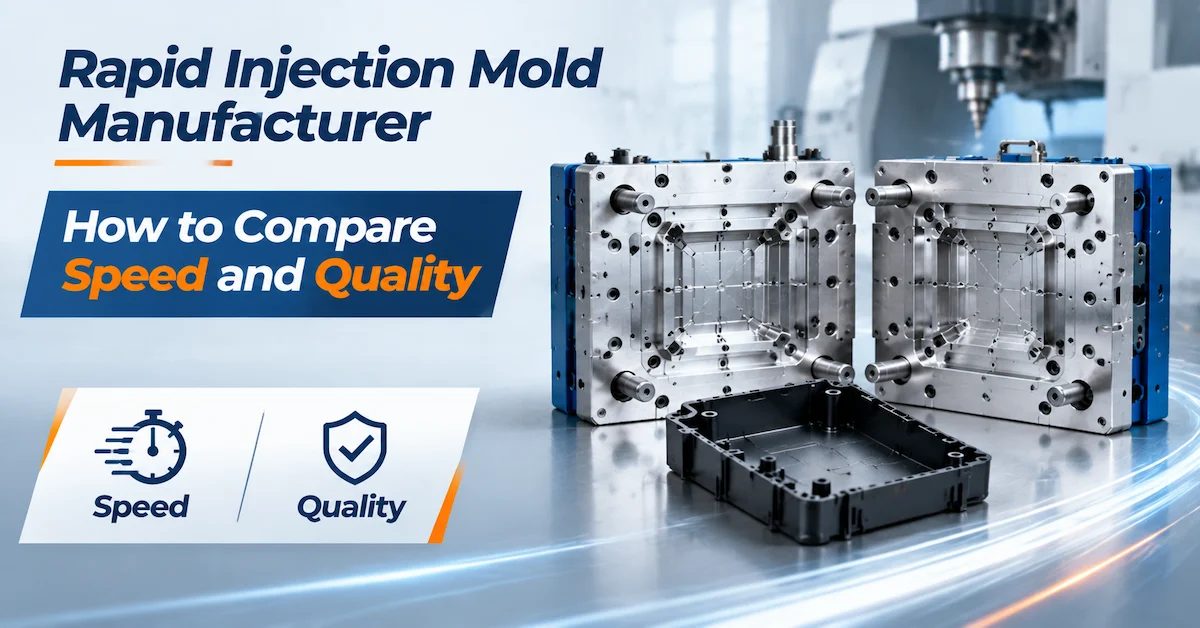
What Should a Rapid Injection Mold Manufacturer Actually Deliver?
A rapid injection mold manufacturer should shorten avoidable waiting time without removing the engineering, trial, inspection, and correction steps that make a tool production-ready. The real comparison is not simply which supplier promises the fewest calendar days. It is whether the supplier can review the product quickly, freeze the right decisions, start the correct tooling route, provide visible progress, run representative trials, close defects, and hand over a mold that can be installed and maintained at the intended production site.
Fast tooling is usually purchased for a reason: a product launch date, a customer sample, a pilot build, a replacement tool, a design validation build, or a production gap. That urgency makes missing information more expensive. A rushed mold can reach T0 quickly and still create a longer project because the resin was not frozen, the gate was placed on a cosmetic face, the machine interface was wrong, or the first samples were not measured against the assembly requirement.
This guide helps OEM engineers, procurement teams, product managers, and quality staff compare rapid tooling suppliers. It separates engineering response, mold manufacturing, sample approval, modification, and production readiness. DX Molding's public pages describe custom mold design, CNC and EDM machining, trial molding, inspection, plastic molding, and OEM/ODM development. Those published capabilities are relevant to a fast project, but the final lead time, capacity, material, tolerance, price, trial scope, and acceptance criteria must be confirmed for the specific RFQ.
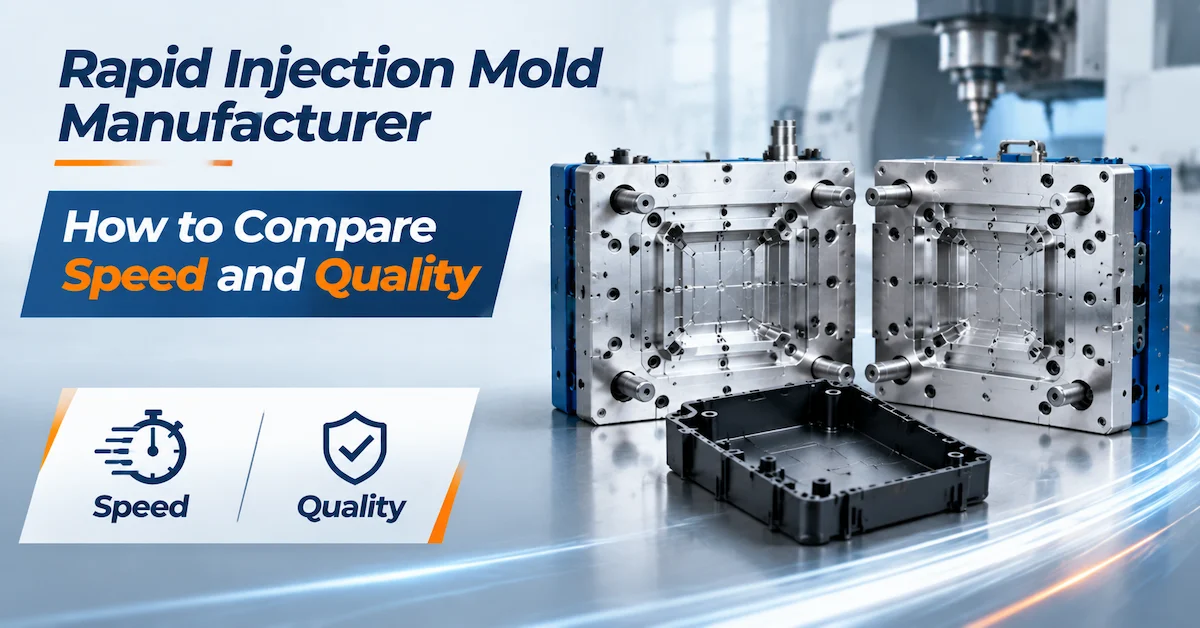
Rapid Injection Mold Manufacturer or Rapid Tooling Service?
The phrase “rapid injection mold manufacturer” can describe different deliverables. One supplier may provide a prototype mold only. Another may build a production-intent tool and also mold parts. A third may quote a tool but exclude design review, T1 modifications, inspection, spare parts, or transfer documentation. Before comparing speed, define what is included.
| Possible route | What it may prioritize | Buyer risk to clarify |
|---|---|---|
| Prototype or bridge tooling | Early samples, market testing, design validation, or a short production window. | Tool life, surface durability, replacement strategy, and whether the geometry can transfer to a later production mold. |
| Production-intent mold | Repeatable parts, defined volume, stable quality, and longer maintenance life. | Whether the quoted timing includes T1/T2 work, inspection, spare parts, and production-release evidence. |
| Tooling plus molded parts | One supplier coordinating mold development, sampling, and ongoing plastic production. | Ownership, process responsibility, MOQ, material control, packaging, and the boundary between tooling acceptance and part approval. |
| Replacement or transfer tool | Recovering supply after wear, a supplier change, or an overseas production move. | Compatibility with the existing part, machine, resin, inspection baseline, and maintenance documentation. |
A fast supplier should explain which route it is quoting and why. If the project is a bridge tool, do not compare its price and life directly with a hardened production mold. If it is a replacement tool, do not accept a new design assumption simply because it appears faster. The mold must reproduce the approved product and fit the production process that will actually use it.
How to Define “Fast” Before Requesting a Quote
Lead time becomes comparable only after the start and finish points are defined. “Four weeks” may mean four weeks from deposit to a mold assembled for internal inspection, while the buyer expects four weeks to approved T1 parts delivered to a production site. Both statements can be technically true and commercially misleading.
Separate the timing milestones
- RFQ response: time to review files, identify risks, ask questions, and return a feasible proposal.
- Design freeze: time from approved quotation or purchase order to controlled product and mold design approval.
- Steel cutting: the point at which approved geometry and tooling route are released to machining.
- Tool assembly: time to machine, fit, assemble, wire, connect, and dry-cycle the mold.
- T0: the first meaningful trial used to reveal filling, release, mechanism, appearance, and dimensional risks.
- T1 or sample approval: a later trial after corrections, inspection, assembly review, and agreed acceptance decisions.
- Production release: the point at which the tool, process, samples, documentation, and open actions meet the customer's release criteria.
Ask every supplier to show these milestones in one schedule. Identify what pauses the clock: late CAD changes, unresolved material selection, missing mating parts, delayed feedback, texture approval, customer inspection, and modifications after T0. A supplier that cannot define its endpoint may be selling an early internal completion date rather than a usable production result.
Use a schedule with assumptions
A credible rapid-tooling schedule should state the assumed part revision, material, cavity count, mold base, runner system, surface finish, mechanisms, inspection plan, machine, and feedback time. It should identify whether weekends, shipping, texture, heat treatment, outsourced components, and customer approval are included. Speed is easier to manage when the buyer can see what would change the date.
DX Molding's Services page presents a workflow from requirements and file review through DFM and risk assessment, quotation and production-plan confirmation, mold design and machining, trial molding and inspection, sample approval, and production, packaging, and delivery. This is a useful framework for a fast project because it distinguishes the stages. It is not a universal delivery promise; request a project schedule with the actual assumptions.
What Makes a Rapid Injection Mold Manufacturer Fast Without Creating Rework?
Fast delivery is usually created before machining starts. The supplier must reduce waiting, duplicate communication, and late design changes while preserving the checks that prevent defects. The most useful capability is not a vague claim of speed; it is a workflow that converts complete input into decisions quickly and records those decisions.
Fast engineering response
The first review should identify risks that could change the mold route or schedule: insufficient draft, uneven wall thickness, deep ribs, undercuts, difficult shutoffs, thin steel, poor gate access, unbalanced cavities, limited cooling, ejection on cosmetic surfaces, tight tolerances, or undefined assembly features. A short list of specific issues is more useful than a generic statement that the part is moldable.
Give the supplier the controlled 3D model, 2D drawing, resin grade, annual quantity, surface requirement, color, critical dimensions, mating components, target milestone, and main unresolved concern. DX Molding's published services page lists CAD, STEP/STL files, physical samples, material requirements, target quantity, finish, color, and tolerance as project inputs. A complete package is one of the buyer's strongest tools for improving response speed.
Fast decision ownership
Every rapid project needs named owners for product CAD, material, mold design, DFM, sample approval, dimensional inspection, and engineering changes. A supplier cannot move quickly if a gate decision waits with purchasing, a resin decision waits with the material team, and a sample disposition waits with a customer who has not received inspection data. Put the approval route and response time into the project plan.
Fast access to the right manufacturing process
A supplier may shorten time through internal design, CNC, EDM, fitting, polishing, standard mold-base selection, and trial coordination. But the route still has to suit the part. A simple two-plate tool with a hidden gate may move quickly; a multi-cavity tool with slides, lifters, hot runner, texture, tight shutoffs, and complex cooling has more decisions and more opportunities for rework. The supplier should show which features drive the schedule instead of applying one speed claim to every mold.
How Product Design Affects Rapid Mold Delivery
The product model is often the largest schedule variable under the buyer's control. A rapid injection mold manufacturer can machine quickly, but it cannot safely compress the time needed to resolve an unstable product definition. A part that changes after steel cutting may require cavity welding, new inserts, texture repair, re-polishing, a new trial, or a new customer approval.
Features that commonly slow tooling
- Unresolved parting-line location on a visible or sealing surface.
- Undercuts requiring slides, lifters, collapsible cores, or manual inserts.
- Deep narrow ribs, thin shutoffs, fragile steel, or difficult EDM details.
- Large panels with uneven wall thickness, warpage sensitivity, or strict flatness.
- Transparent, high-gloss, textured, or color-sensitive cosmetic surfaces.
- Multi-cavity tools with tight cavity-to-cavity balance or different variants.
- Threads, sealing lands, connector interfaces, snap fits, and tolerance-sensitive assembly points.
- Late changes to material, filler, flame rating, fastener, PCB, gasket, or mating part.
Some risks can be reduced through design action before tooling. A feature may be reoriented to the opening direction, a thick boss may be cored, a cosmetic gate may move to an internal surface, or a tolerance may be assigned to a functional datum. The goal is not to remove every complex feature. It is to make the product requirement and manufacturing consequence explicit before the schedule begins.
For a design with several changes still open, consider a staged route: prototype or soft tooling for functional learning, followed by production-intent tooling after high-risk interfaces are frozen. This can be faster overall than cutting a production mold around assumptions and paying for repeated modifications.
Tooling Choices That Change Speed, Cost, and Risk
A fast quote should show the tooling choices that control the schedule. Buyers should not accept a low date without knowing whether it is based on a simple tool, limited inspection, an assumed material, or a reduced correction scope.
| Tooling decision | Why it can improve speed | What the buyer must confirm |
|---|---|---|
| Standard mold base | Can reduce design and procurement time when the part fits an available standard. | Size, strength, machine compatibility, cooling access, lifting, and maintenance. |
| Single cavity | Simplifies balance, sampling, and correction for a one-part project. | Demand, part cost, future volume, and whether cavity expansion is practical. |
| Multi-cavity | May improve output after the tool is balanced and approved. | Cavity consistency, filling balance, inspection scope, corrections, and schedule. |
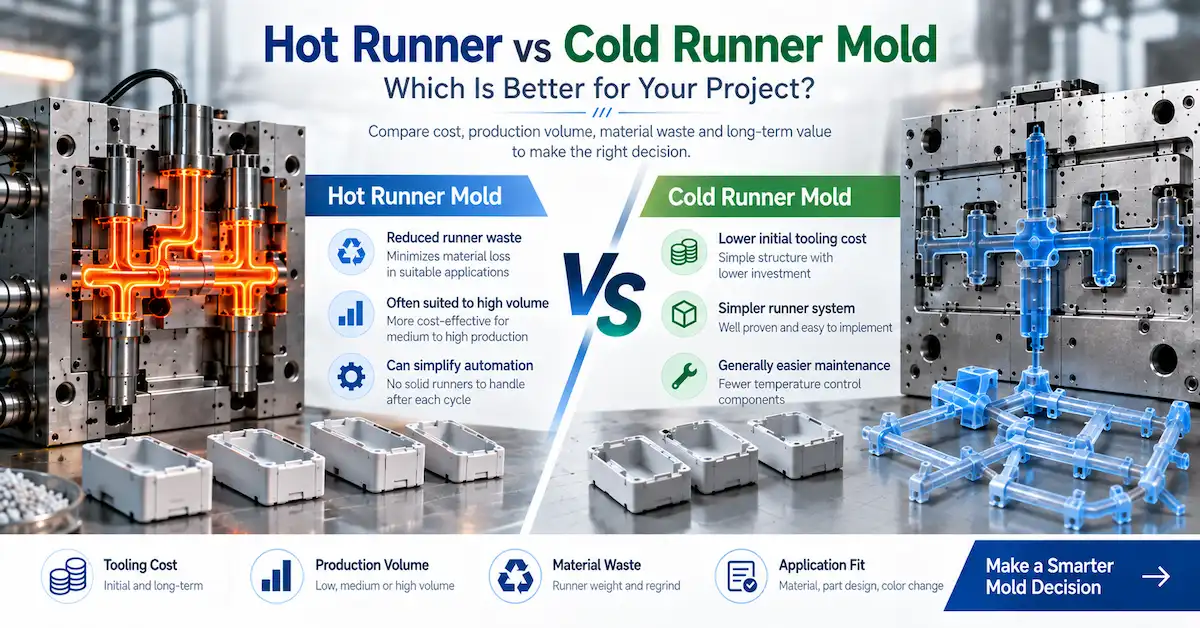
| Cold runner | May reduce hot-runner component and setup decisions for suitable parts. | Runner waste, gate design, regrind policy, appearance, cycle, and material cost. |
| Hot runner | May reduce runner waste or support production for the right geometry. | Controller, lead time, maintenance, gate quality, service parts, and validation. |
| Replaceable inserts | Can isolate wear, variants, or a high-risk detail for correction. | Seating, witness, alignment, cooling, handling, and assembly time. |
| Slides or lifters | Allow a required undercut or internal feature to remain. | Travel, locking, wear, return, maintenance, collision clearance, and release quality. |
DX Molding's published plastic injection mold information lists single- and multi-cavity options, hot- and cold-runner options, CNC and EDM machining, polishing, CAD support, and P20, H13, S136, and custom steel options. These are published options, not an automatic recommendation for a rapid project. The quotation should explain the proposed combination and its effect on speed, life, quality, maintenance, and future changes.
Rapid Tooling Must Still Include DFM and Mold Quality Checks
Removing DFM or quality checks rarely removes risk; it moves risk into T0, production, or the customer's assembly line. A rapid injection mold manufacturer should explain which checks are accelerated, which are unchanged, and which are excluded. The buyer can then decide whether the shortened route is acceptable.
Minimum DFM review for a fast project
- Draft, wall thickness, ribs, bosses, fillets, undercuts, slides, lifters, and release direction.
- Parting line, shutoffs, gates, runners, vents, weld lines, air traps, and gate witness.
- Cooling layout, hot spots, ejection, vacuum, cosmetic marks, and mechanism access.
- Resin grade, shrinkage, filler, color, surface texture, transparent or high-gloss requirements.
- Critical dimensions, datums, assembly interfaces, seals, connectors, fasteners, and functional tests.
- Cavity count, machine interface, production location, maintenance, spares, and transfer needs.
DX Molding's public Supports page lists DFM review, material consultation, filling, packing, cooling, and warpage analysis, mold design, trial reports, dimensional inspection, CMM data, process records, CPK/AQL support, and maintenance information. Confirm the exact report, sample quantity, measurement points, and acceptance criteria in the project scope. A capability list is not the same as an automatic deliverable.
Fast does not mean “approve the first sample”
T0 should expose risks that remain after the design and tool are built. Check fill, short shot, flash, sink, weld lines, burns, warpage, release, gate marks, ejector marks, mechanisms, dimensions, and assembly. T1 should show what changed and whether the correction addressed the cause. If a supplier offers a first-sample date but does not state how T0 defects will be corrected, the schedule is incomplete.
Define the difference between an engineering sample and an approved production sample. A sample may check basic shape while still failing color, texture, dimensional capability, flatness, assembly, or appearance. State which defects can remain open at each stage and who decides whether another trial is required.
How to Compare Rapid Injection Mold Manufacturer Quotations
Compare quotations by deliverable and risk, not by the headline date. Two suppliers can quote the same number of days while including different design review, mold steel, cavity count, runner system, texture, trial parts, inspection, modification, and shipping scope.
| Quotation field | Question to ask | Why it affects comparison |
|---|---|---|
| Start date | Does the clock start at RFQ, purchase order, deposit, CAD approval, or material confirmation? | Different start points make identical dates represent different commitments. |
| End date | Is the endpoint tool assembly, T0, T1, approved samples, or production release? | Only a defined endpoint supports a launch plan. |
| Design scope | Are DFM, mold-flow review, mold layout, and product changes included? | Unresolved design work can reappear as modification time and cost. |
| Tool construction | What cavity, runner, steel, mechanisms, surface, and spare strategy is quoted? | Construction affects schedule, life, repair, and part quality. |
| Trial and correction | How many trials, samples, corrections, and inspection records are included? | A fast T0 is not the same as approved parts. |
| Customer input | What files, approvals, decisions, and response times are required? | Unclear dependencies create schedule disputes. |
| Handoff | Are CAD, BOM, maintenance, steel, trial, inspection, packaging, and transfer records included? | A tool that cannot be maintained or moved creates long-term risk. |
Do not use “rush” as a substitute for a recovery plan. If the product is late, ask the supplier to identify the critical path, parallel activities, decision deadlines, recovery actions, and quality controls that will not be skipped. A credible supplier can say what can be compressed and what cannot.
For a project-specific quote, send controlled CAD, drawings, resin, volume, surface, tolerance, target date, and sample requirements through DX Molding's custom molding services workflow. If the same supplier will also produce the molded parts, review its plastic molding production scope separately from the tooling quote. Complete input makes it easier to distinguish a real schedule from a preliminary marketing date.
When a Rapid Injection Mold Manufacturer Is the Wrong Choice
Rapid tooling is not automatically the best route. It can be unsuitable when the product is still changing, safety or regulatory requirements are unresolved, the resin grade is not selected, production volume justifies another cavity strategy, or the customer cannot provide timely feedback.
Warning signs before placing the order
- The supplier promises a fixed date without asking for CAD, resin, quantity, surface, tolerances, or mating parts.
- The quotation does not identify whether the date ends at T0, T1, or approved production samples.
- The supplier avoids showing the mold concept, parting line, gates, cooling, ejection, or mechanisms.
- The price excludes modifications although the part has complex geometry or tight assembly interfaces.
- The buyer has not assigned an approver for DFM, material, samples, and engineering changes.
- The fast route relies on unapproved resin, simplified inspection, or prototype tooling for a production requirement.
- The tool will be transferred but no machine, connection, documentation, or sample baseline is defined.
In these cases, stabilize the product first, run a focused prototype, or select a supplier with a broader engineering and production role. A supplier that challenges an unrealistic schedule with specific reasons may be more useful than one that accepts every date without a risk review.
RFQ Checklist for a Fast Injection Mold Project
Use the following checklist before sending the request. It reduces the back-and-forth that makes a rapid project slow.
| RFQ package | Include | Buyer decision enabled |
|---|---|---|
| Product definition | Controlled 3D CAD, 2D drawing, revision, units, datums, CTQs, and open changes. | Whether the supplier can start design without guessing. |
| Material | Resin grade, filler, color, flame or food/medical requirement, and approved alternates. | Whether shrinkage, processing, surface, and documentation are stable. |
| Production plan | Prototype quantity, annual demand, cavity target, machine, destination, and launch milestone. | Whether bridge or production-intent tooling is appropriate. |
| Assembly and appearance | Mating parts, fasteners, seals, connectors, cosmetic map, texture, gate limits, and inspection standard. | Whether the mold protects function and appearance. |
| Quality and trials | T0/T1 requirements, samples, dimensions, CMM or gauge method, appearance, assembly, and acceptance criteria. | Whether “fast delivery” ends with usable approved parts. |
| Commercial scope | Tool ownership, files, spares, maintenance, packaging, shipping, MOQ, production, and change responsibility. | Whether quotations can be compared on total value. |
Include one sentence describing the real urgency: customer sample, pilot build, replacement tool, launch date, or supply recovery. The supplier can then propose a schedule around the critical event rather than optimizing an arbitrary number of calendar days.
Frequently Asked Questions
What is a rapid injection mold manufacturer?
A rapid injection mold manufacturer is a tooling supplier that organizes engineering, design, machining, assembly, trial, and feedback to reduce avoidable time before usable molded parts are approved. The label does not define a universal lead time or prove production readiness. Evaluate scope, endpoint, assumptions, and evidence behind the schedule.
How fast can an injection mold manufacturer deliver a mold?
There is no reliable universal answer. Timing depends on part size and geometry, resin, surface, cavity count, steel, mechanisms, runner system, inspection, texture, customer feedback, and whether the endpoint is mold completion, T0, T1, or production approval. DX Molding's public FAQ presents a reference range for some standard projects, but complexity and size affect timing; request a project-specific schedule.
Does rapid tooling mean lower mold quality?
Not necessarily. Speed can come from complete inputs, early risk decisions, standard components, parallel work, and clear approvals. Quality becomes vulnerable when material confirmation, DFM, movement checks, inspection, correction, or maintenance documentation are skipped. Ask which steps are accelerated and which remain mandatory.
Can a rapid injection mold be used for mass production?
Sometimes, depending on tool construction, resin, volume, cavity count, surface, mechanisms, maintenance, and the definition of acceptable parts. A prototype or bridge mold should not automatically be treated as a high-volume production tool. Ask the supplier to state life, limitations, replacement strategy, and production assumptions.
What is the difference between T0 and T1?
T0 is generally an early trial used to reveal filling, release, mechanism, appearance, dimensional, and tooling risks. T1 is a later trial after corrections or process changes and should provide stronger evidence for approval. The exact meaning and records should be written into the project plan.
What files help a rapid mold supplier respond faster?
Send the controlled 3D model, 2D drawing, resin grade, color and filler, quantity, surface and texture, CTQs, mating parts, assembly requirements, machine or destination, target milestone, and trial criteria. Mark open decisions and identify the main schedule risk. Complete information reduces clarification loops.
Should I choose the supplier with the shortest quoted lead time?
No. Compare endpoint, assumptions, construction, trial scope, inspection, modification responsibility, documentation, and customer response requirements. The shortest preliminary date can become the longest project if it excludes T1 correction or starts before the product is stable.
How can I reduce injection mold delivery time without skipping quality?
Freeze product and material early, provide complete RFQ files, assign decision owners, approve the mold concept quickly, use suitable standard components, separate prototype from production intent, and agree on T0/T1 evidence before machining. Reserve time for corrections; a schedule with no modification path is not robust.
What should a rapid tooling quotation include?
It should identify start and end dates, product and material assumptions, cavity and runner concept, steel and mechanisms, design and DFM scope, trial and inspection scope, correction rules, customer inputs, shipping, files, spares, maintenance, ownership, and exclusions. These fields let procurement compare real deliverables.
Conclusion
Choosing a rapid injection mold manufacturer should be a decision about controlled speed, not a race to cut steel. Define the endpoint, freeze product and resin, provide complete files, assign decision owners, select a tooling route that matches the part, and require DFM, movement, T0/T1, inspection, correction, and handoff evidence. Compare quotations by scope and assumptions rather than accepting the smallest number of calendar days.
A credible fast project shows which activities can run in parallel, which decisions control the critical path, what the customer must approve, what happens when T0 reveals a problem, and when the tool is genuinely ready for production. This gives procurement a fair comparison and engineering a better chance of meeting the launch date without creating a fragile mold or unstable molded part.
Need a rapid tooling schedule for a real project? Send your controlled CAD, 2D drawing, resin grade, quantity, surface requirements, critical dimensions, target milestone, and sample-approval criteria through the DX Molding contact page. The team can review manufacturability, tooling scope, trial requirements, and a project-specific production route.