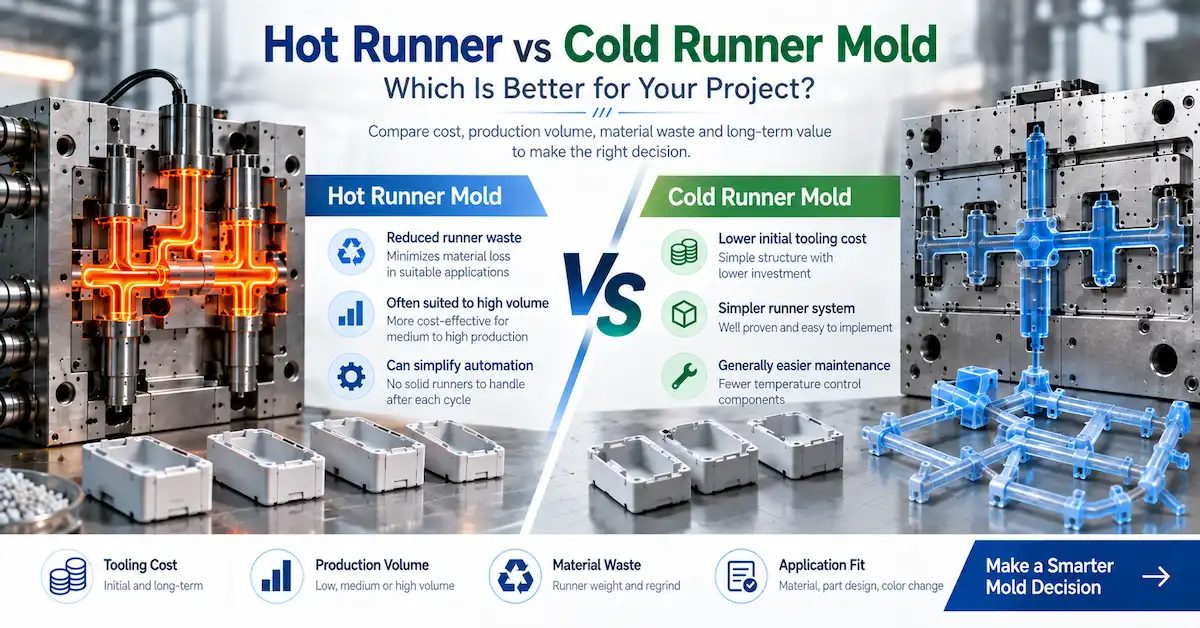
Hot Runner vs Cold Runner Mold: Which Is Better?
The answer is not simply “hot runner is better for high volume” or “cold runner is cheaper.”
For an OEM buyer, hot runner vs cold runner mold—which is better should be decided by the total production program:
-
Annual production volume
-
Resin cost
-
Runner weight
-
Number of cavities
-
Part size
-
Gate requirements
-
Color-change frequency
-
Material thermal sensitivity
-
Automation requirements
-
Mold maintenance capability
-
Expected tool life
-
Production location
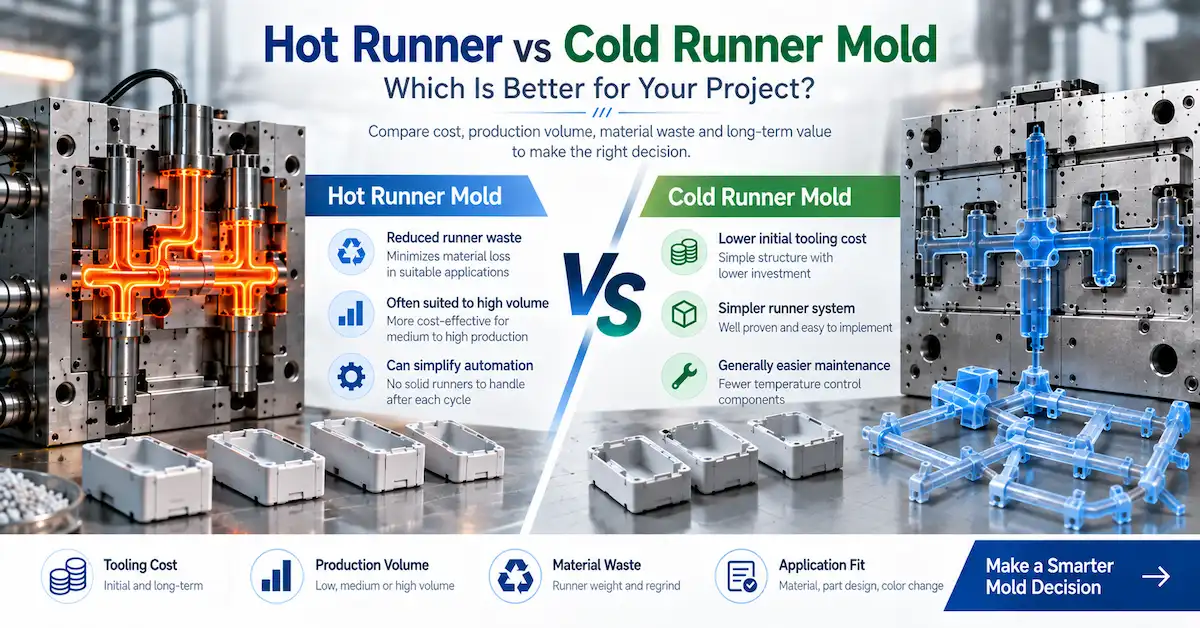
A hot runner can reduce or eliminate conventional cold-runner scrap in suitable applications, but it also adds heaters, nozzles, manifolds, electrical components, temperature control, and maintenance requirements.
A cold runner usually offers a simpler tooling system and lower initial complexity, but every cycle may create runner material that must be removed, reused, recycled, or discarded.
The correct decision is therefore not:
Which mold technology is more advanced?
It is:
Which runner system produces the lowest practical cost per acceptable part while meeting the required quality, output, maintenance, and production conditions?
DX Molding offers both hot- and cold-runner options within its custom plastic injection mold manufacturing capabilities, allowing the runner strategy to be matched to the actual project rather than selected as a fixed standard.
Quick Answer: When Is Hot Runner Better, and When Is Cold Runner Better?
For buyers who need a fast decision framework:
| Project Condition | Hot Runner Often Deserves Evaluation | Cold Runner Often Deserves Evaluation |
|---|---|---|
| Very high annual volume | ✓ | |
| Expensive resin | ✓ | |
| Large runner-to-part ratio | ✓ | |
| Multi-cavity production | ✓ | ✓ |
| Automated production | ✓ | |
| Low initial tooling budget | ✓ | |
| Low or uncertain volume | ✓ | |
| Frequent color changes | Depends | ✓ |
| Thermally sensitive resin | Depends | ✓ |
| Simple part | Depends | ✓ |
| Easy local maintenance required | ✓ | |
| Limited hot runner support at destination | ✓ | |
| Runner material can be reused economically | Depends | ✓ |
| Cosmetic gate control needed | ✓ | Depends |
This table is a starting point—not a substitute for DFM and production-cost analysis.
For buyers already considering a hot-runner-specific tooling program, DX Molding's hot runner mold manufacturer guide covers system architecture, valve gates, manifolds, resin compatibility, and supplier qualification in greater depth.
What Is the Main Difference Between Hot Runner and Cold Runner Molds?
The fundamental difference is what happens to the plastic inside the runner system.
Cold Runner Mold
In a conventional cold-runner system, plastic fills the runner and gate together with the molded part.
The runner cools and solidifies during each cycle.
After the mold opens, the process normally produces:
-
Finished molded part
-
Solid runner
-
Gate connection or gate vestige
The runner then needs to be:
-
Separated
-
Reground where appropriate
-
Recycled
-
Reprocessed
-
Or discarded
Hot Runner Mold
A hot runner uses heated components to keep plastic inside the feed system molten between cycles.
The system may include:
-
Heated manifold
-
Nozzles
-
Heaters
-
Thermocouples
-
Temperature controller
-
Thermal gates or valve gates
Because the feed material remains molten, a conventional solid cold runner is generally reduced or eliminated depending on the system design.
That difference changes the economics of material consumption, mold construction, maintenance, and production.
Do Not Compare Mold Price Alone
One of the most common sourcing mistakes is comparing:
Cold Runner Mold Price vs Hot Runner Mold Price
without comparing the operating cost after the mold enters production.
Hot-runner tooling normally involves greater initial investment because it contains more components and requires more engineering.
But a cheaper cold-runner mold may generate runner material during every cycle for years.
The correct comparison is:
Tooling Investment + Runner Cost + Cycle Cost + Labor + Maintenance + Downtime + Scrap Risk
over the intended program life.
How Does Production Volume Change the Decision?
Production volume is usually one of the strongest economic drivers.
Low-Volume Production
Suppose a product only requires occasional production or a relatively small annual quantity.
In that situation, the material saved by eliminating runners may take a long time to recover the additional hot-runner investment.
A simpler cold-runner mold may therefore be more commercially rational.
High-Volume Production
Now consider a product produced continuously over several years.
Even a relatively small amount of runner material per cycle can accumulate across hundreds of thousands or millions of parts.
Under those conditions, a hot-runner investment may become easier to justify.
The buyer should evaluate lifetime volume, not only the first purchase order.
Use Runner Weight to Compare the Real Material Cost
A useful sourcing calculation is the runner-to-part ratio.
For example:
-
Part weight: 40 g
-
Cold runner weight: 20 g
-
Runner-to-part ratio: 50%
This means every 40 g finished component requires another 20 g of plastic to fill the cold runner.
If the runner cannot be reused directly, that can have a significant effect on material economics.
By contrast, consider:
-
Part weight: 200 g
-
Cold runner weight: 8 g
The relative runner loss is much smaller.
In this second case, eliminating the runner may provide less financial benefit.
A Useful Buyer Question
Instead of asking:
How much more does a hot runner mold cost?
ask:
How many kilograms of runner material will the cold-runner design generate over the expected production life?
That question connects mold design directly to production economics.
A Simple Hot Runner Break-Even Calculation
Buyers can perform an early screening calculation before committing to a more detailed analysis.
Assume:
-
Annual production: 500,000 parts
-
Runner weight: 15 g per shot
-
One part per shot
-
Resin cost: $4/kg
-
Runner cannot be economically reused in the final product
-
Additional hot runner tooling investment: $18,000
Annual runner material:
500,000 × 15 g = 7,500 kg
Annual theoretical runner material value:
7,500 kg × $4 = $30,000
In this simplified example, the material value potentially associated with the cold runner is greater than the additional hot-runner investment.
That does not automatically prove the hot runner is the better solution.
The actual calculation must also consider:
-
Regrind allowance
-
Runner recycling value
-
Hot runner maintenance
-
Heater replacement
-
Controller cost
-
Downtime
-
Cycle time
-
Scrap rate
-
Resin behavior
-
Mold life
But the example demonstrates why comparing only the mold quotation can be misleading.
Resin Cost Can Change the Economics Dramatically
Material price affects how quickly runner savings become meaningful.
Lower-Cost Commodity Resin
For inexpensive materials and modest production volume, the financial penalty of a cold runner may be manageable.
Higher-Cost Engineering Resin
When the project uses more expensive engineering plastics, runner material can become a larger part of the unit-cost calculation.
Examples of project conditions that deserve closer evaluation include:
-
High-cost engineering resin
-
Glass-filled material
-
Specialty compounds
-
Flame-retardant materials
-
Color-matched compounds
-
Materials with restricted regrind allowance
The buyer should calculate the value of material lost or downgraded, not only its weight.
Can Cold Runner Material Be Reused?
Sometimes.
But “we can regrind the runner” should not automatically be treated as zero waste.
The buyer should ask:
-
Is regrind permitted for this product?
-
What regrind percentage is allowed?
-
Does the material degrade after repeated thermal history?
-
Will recycled material change color or appearance?
-
Does the customer prohibit regrind?
-
Does regrind affect mechanical requirements?
-
What equipment and labor are needed?
-
How is contamination prevented?
A cold-runner system can remain economically attractive when runner material can be managed safely and consistently.
But the real value of regrind should be verified rather than assumed.
Which System Is Better for Multi-Cavity Molds?
Both systems can support multi-cavity tooling.
However, cavity count makes runner design increasingly important.
Multi-Cavity Cold Runner
A multi-cavity cold-runner mold can provide strong production output with relatively straightforward tooling.
The engineering team still needs to manage:
-
Runner balance
-
Gate balance
-
Filling
-
Packing
-
Runner size
-
Cooling
-
Degating
As cavity count increases, the runner network may also become larger.
Multi-Cavity Hot Runner
A hot-runner manifold can feed multiple cavities without producing the same conventional solid runner system.
This may become attractive for high-volume applications.
However, more cavities can also mean:
-
More nozzles
-
More heating zones
-
More electrical components
-
More balance requirements
-
Higher maintenance complexity
The decision should therefore combine cavity count with volume, part weight, resin, runner weight, and maintenance.
DX Molding discusses these issues further in its high-volume injection mold manufacturer guide.
Does Hot Runner Always Reduce Cycle Time?
No.
This claim should be treated carefully.
A hot runner eliminates the need to cool and eject a conventional cold runner, which can support cycle optimization in some projects.
But actual cycle time also depends on:
-
Part wall thickness
-
Part cooling
-
Mold temperature
-
Resin
-
Packing
-
Ejection
-
Machine performance
-
Cooling-channel design
The molded part still needs to cool sufficiently before ejection.
A poor cavity cooling design will not become efficient simply because the mold uses a hot runner.
DX Molding's injection mold design guide explains why runner strategy, cooling, ejection, cavity layout, and machine requirements should be reviewed together.
Which Is Better for Automation?
Hot-runner molds can simplify certain automated production cells because there may be no solid cold runner to separate after each cycle.
This can reduce the need for:
-
Runner separation
-
Runner handling
-
Granulation
-
Additional material movement
However, automation decisions still depend on:
-
Part ejection
-
Robot handling
-
Gate vestige
-
Inspection
-
Packaging
-
Insert loading
-
Cycle requirements
Cold-runner molds can also be automated effectively.
The difference is that the automation system may need to manage both parts and runner material.
Which System Is Better for Cosmetic Parts?
Neither runner type guarantees better appearance.
Appearance depends strongly on gate design and processing.
Hot Runner Options
Depending on the system, hot runners may support:
-
Thermal gates
-
Valve gates
-
Multiple gate locations
-
Sequential gating in suitable applications
These options can give engineers greater flexibility over how resin enters a large or cosmetic component.
Cold Runner Options
Cold-runner designs can also support different gating strategies.
For example, a three-plate mold may provide additional pinpoint-gate flexibility compared with a simple two-plate cold-runner structure.
Buyers comparing gate options can review DX Molding's three plate mold supplier guide.
The better choice depends on:
-
Gate mark acceptance
-
Weld-line position
-
Filling length
-
Flow direction
-
Cosmetic zone
-
Part size
-
Resin
Which System Is Easier to Maintain?
Cold runners generally have an advantage in simplicity.
Cold Runner Maintenance
A conventional cold-runner mold does not require the same heated manifold and nozzle system.
That can simplify:
-
Troubleshooting
-
Spare-parts planning
-
Local repair
-
Mold transfer
Hot Runner Maintenance
A hot-runner system adds components such as:
-
Heaters
-
Thermocouples
-
Wiring
-
Nozzles
-
Manifold
-
Valve-gate components where applicable
Failures can require specialized troubleshooting.
For long-term programs, buyers should ask:
-
Which hot runner brand is used?
-
Are spare heaters available locally?
-
Are thermocouples standardized?
-
Is the controller compatible with the production plant?
-
How quickly can replacement nozzles be sourced?
-
Will wiring diagrams be supplied?
This matters especially when the mold will be exported.
Which Is Better When the Mold Will Be Transferred Overseas?
The answer depends heavily on the destination plant.
A hot-runner mold built in China and operated overseas should be designed around the final molding environment.
Buyers should verify:
-
Hot runner controller compatibility
-
Voltage
-
Electrical connectors
-
Thermocouple standard
-
Spare heaters
-
Spare nozzles
-
Wiring documentation
-
Local service availability
-
Injection machine compatibility
A cold-runner mold normally reduces this thermal-system dependency.
For customers prioritizing easy local maintenance or operating the mold in a plant with limited hot-runner support, that simplicity may be valuable.
DX Molding's injection tooling transfer guide covers additional issues buyers should confirm when tooling will run at another production facility.
Which System Is Better for Frequent Color Changes?
Cold runners often deserve serious consideration when frequent color changes are part of the production plan.
Hot runner systems contain molten resin within internal channels.
When changing from one color to another, the system may require:
-
Purging
-
Additional material
-
Additional time
-
Careful temperature control
Some hot runner designs handle color changes better than others, but it should be discussed during system selection.
For a product that changes color frequently, the buyer should ask:
-
How much resin remains in the manifold?
-
How long does purging typically take?
-
Are dead spots likely?
-
Is the material prone to degradation?
-
How often will colors change?
A cold runner may be operationally simpler even if it generates more solid runner material.
What About Thermally Sensitive Materials?
Hot runners keep plastic at elevated temperature inside the feed system.
That means resin thermal behavior matters.
Some materials tolerate this process window well.
Others may be more sensitive to:
-
Long residence time
-
Excessive temperature
-
Degradation
-
Discoloration
-
Additive damage
The tooling supplier should evaluate:
-
Resin processing window
-
Nozzle design
-
Manifold temperature
-
Residence time
-
Shot size
-
Production interruptions
A hot runner should not be chosen only because of production volume if the material introduces a significant thermal risk.
Hot Runner vs Cold Runner for Low-Volume Projects
For lower-volume programs, cold runners frequently remain attractive because of:
-
Lower initial system complexity
-
Lower tooling investment
-
Easier maintenance
-
Simpler troubleshooting
Examples may include:
-
Early product launches
-
Market-testing programs
-
Lower-volume industrial components
-
Replacement parts
-
Products with uncertain demand
In these situations, preserving capital can be more important than optimizing material consumption to the last gram.
Hot Runner vs Cold Runner for High-Volume Projects
High-volume programs deserve a more detailed hot-runner evaluation.
Potential drivers include:
-
High annual volume
-
Expensive resin
-
High runner weight
-
Multi-cavity tooling
-
Automation
-
Long program life
But even high-volume production does not automatically require a hot runner.
The supplier still needs to evaluate:
-
Material
-
Gate configuration
-
Maintenance
-
Tooling budget
-
Mold destination
-
Process risk
What About Two-Plate and Three-Plate Molds?
A common misunderstanding is treating:
Two plate = cold runner
and
Hot runner = a different mold type
These terms describe different aspects of mold design.
A two-plate mold describes the basic opening architecture.
It can use:
-
Cold runner
-
Hot runner
A three-plate mold is typically associated with cold-runner layouts that provide additional gate and runner separation flexibility.
DX Molding explains this distinction in its two plate mold manufacturer guide.
For buyers, runner selection and mold-opening architecture should be reviewed as connected but separate engineering decisions.
Compare Hot Runner and Cold Runner by Total Cost
A practical sourcing comparison should include more than mold price.
| Cost Factor | Cold Runner | Hot Runner |
|---|---|---|
| Initial tooling investment | Usually lower | Usually higher |
| Runner material | Produced each cycle | Reduced/eliminated depending on design |
| Regrind handling | May be required | Lower runner-handling demand |
| Temperature controller | Usually unnecessary for runner | Required |
| Electrical spare parts | Limited | More important |
| Maintenance complexity | Lower | Higher |
| Color change | Often simpler | May require more purging |
| Automation | Runner handling may be needed | Can simplify runner management |
| Long-term material savings | Lower | Potentially higher |
| Local repair | Often simpler | Depends on hot runner support |
The buyer should estimate each factor over the planned production life.
A Better Selection Formula for OEM Buyers
Instead of asking only:
Hot runner vs cold runner mold—which is better?
evaluate the following five groups.
1. Production Economics
Ask:
-
Annual volume?
-
Program life?
-
Resin cost?
-
Runner weight?
-
Regrind allowance?
2. Part Engineering
Ask:
-
Part size?
-
Wall thickness?
-
Flow length?
-
Gate restrictions?
-
Cosmetic requirements?
-
Cavity count?
3. Material Behavior
Ask:
-
Thermal sensitivity?
-
Fiber content?
-
Color changes?
-
Degradation risk?
4. Manufacturing Operations
Ask:
-
Automation?
-
Cycle target?
-
Available maintenance skills?
-
Machine compatibility?
-
Production country?
5. Commercial Risk
Ask:
-
Initial tooling budget?
-
Expected product life?
-
Demand certainty?
-
Cost of downtime?
-
Spare-parts availability?
The runner system that performs best across these categories is usually the better commercial decision.
Hot Runner vs Cold Runner Buyer Decision Matrix
Use this matrix during RFQ comparison.
| Buyer Priority | Hot Runner | Cold Runner |
|---|---|---|
| Lowest initial tooling cost | △ | ✓ |
| Lowest conventional runner waste | ✓ | △ |
| Simple mold maintenance | △ | ✓ |
| Very high production volume | ✓ | Depends |
| Low production volume | Depends | ✓ |
| Expensive material | ✓ | Depends |
| Frequent color change | Depends | ✓ |
| Easy overseas support | Depends | ✓ |
| High automation potential | ✓ | ✓ |
| Simple tool construction | △ | ✓ |
| Advanced gate control | ✓ | Depends |
| Limited regrind allowance | ✓ | △ |
✓ = often favorable
△ = requires closer evaluation
No decision should be made from this table alone. DFM, resin, machine, part geometry, and production economics still need to be reviewed.
What Should Your Mold Supplier Calculate Before Recommending a Runner System?
A supplier should be able to explain why the proposed system fits your project.
At minimum, ask for discussion around:
-
Part weight
-
Runner weight
-
Cavity count
-
Annual quantity
-
Resin
-
Resin cost
-
Regrind policy
-
Gate strategy
-
Cycle target
-
Mold life
-
Color-change needs
-
Automation
-
Destination factory
-
Maintenance requirements
If a supplier recommends hot runner for every high-volume project—or cold runner for every cost-sensitive project—the recommendation may be too simplistic.
DFM Should Decide Runner Strategy Before Steel Cutting
Runner selection should be part of early mold engineering.
During DFM, the team should review:
-
Part geometry
-
Flow path
-
Wall thickness
-
Gate location
-
Cosmetic surfaces
-
Weld-line risk
-
Air traps
-
Cavity count
-
Resin
-
Production volume
DX Molding's engineering and DFM support evaluates manufacturing risks before mold machining so that gate, runner, cooling, ejection, and tooling decisions can be reviewed before steel cutting.
When Should Mold Flow Analysis Be Considered?
Not every mold requires advanced simulation.
However, mold flow analysis can become useful when the runner decision interacts with significant filling risk.
Examples include:
-
Large parts
-
Long flow paths
-
Thin walls
-
Multiple gates
-
Multi-cavity tools
-
Weld-line-sensitive parts
-
Warpage-sensitive components
-
Complex hot runner systems
The objective should be to answer a real engineering question—not to add simulation to the project simply because it sounds more advanced.
Common Mistakes Buyers Make
Mistake 1: Choosing Hot Runner Because It Sounds More Advanced
More complex is not automatically better.
The system must create enough operating value to justify the additional investment and maintenance.
Mistake 2: Choosing Cold Runner Only to Reduce Mold Price
A lower tooling quotation may create higher lifetime material and handling costs.
Mistake 3: Ignoring Runner Weight
Production volume alone does not reveal the economics.
A large runner can make material savings important much sooner.
Mistake 4: Assuming All Regrind Has Full Value
Regrind may be restricted, degraded, contaminated, or unsuitable for the final product.
Mistake 5: Ignoring Destination-Factory Maintenance
A sophisticated hot runner is not helpful if the final production plant cannot support it reliably.
Mistake 6: Separating Runner Selection From Gate Design
Gate and runner systems work together.
Appearance, filling, weld lines, packing, and part geometry should be reviewed as one engineering problem.
What Should Be Included in the RFQ?
To receive a meaningful runner-system recommendation, provide:
-
3D CAD
-
2D drawing
-
Resin
-
Resin cost if commercially relevant
-
Part weight if known
-
Annual production volume
-
Program duration
-
Cavity target
-
Cosmetic requirements
-
Gate restrictions
-
Regrind limitations
-
Color-change frequency
-
Production location
-
Injection molding machine information if known
-
Automation requirements
-
Mold-life target
If some items are unknown, mark them as open questions.
A supplier can then compare both systems against actual project requirements.
How DX Molding Supports Runner-System Selection
DX Molding designs and manufactures custom plastic injection molds with hot- or cold-runner configurations according to product geometry, resin, volume, cavity count, quality requirements, and production strategy.
The project workflow can also include:
-
DFM
-
Runner and gate review
-
Mold design
-
CNC
-
EDM
-
Cooling design
-
Trial molding
-
Dimensional inspection
-
Production optimization
-
Plastic injection molding
Buyers planning to keep tooling and molded-part production with one supplier can also review DX Molding's plastic injection molding services.
Frequently Asked Questions
Is a Hot Runner Mold Better Than a Cold Runner Mold?
Not universally. A hot runner may be better when material savings, high volume, automation, or gate requirements justify the additional tooling and maintenance complexity. A cold runner may be better when simplicity, lower initial investment, easy maintenance, or low production volume are more important.
Is Hot Runner Tooling Always More Expensive?
Initial tooling investment is generally higher because the system includes heated components, temperature control, and additional engineering. Total lifetime production cost can still be lower in suitable applications.
Does a Hot Runner Eliminate All Plastic Waste?
It can significantly reduce conventional cold-runner material, but molded-part scrap, startup waste, purging, and other process losses can still occur.
Can Cold Runner Material Be Recycled?
Sometimes. Regrind suitability depends on resin, product requirements, quality specifications, material history, contamination control, and customer requirements.
Which System Is Better for High-Volume Production?
Hot runner systems often deserve evaluation for high-volume programs, especially when runner waste or expensive resin is significant. The final decision should still consider maintenance, resin, gate requirements, and tooling economics.
Which System Is Better for Low-Volume Production?
Cold runner tooling is often attractive because of lower initial complexity and easier maintenance, especially when runner material is not a major cost driver.
Is a Hot Runner Better for Multi-Cavity Molds?
It can be attractive because heated manifolds can feed multiple cavities without a conventional solid runner. However, the mold also gains additional thermal, balancing, control, and maintenance requirements.
Which Runner System Is Better for Frequent Color Changes?
Cold runners can be simpler for frequent color changes. Hot runner color changes may require additional purging depending on the manifold, resin, nozzle design, and previous color.
Does Hot Runner Mean Faster Cycle Time?
Not automatically. It can eliminate runner cooling, but actual cycle time is also controlled by part cooling, wall thickness, resin, machine settings, and ejection.
How Can I Decide Which Runner System Fits My Project?
Provide the mold supplier with CAD, resin, annual quantity, part and runner weight estimates, cavity count, gate requirements, regrind policy, color-change frequency, mold destination, and production expectations. The system should then be selected based on total production economics.
Conclusion
For hot runner vs cold runner mold—which is better, the correct answer depends on total production economics, not technology preference. Hot runners can reduce runner waste and suit certain high-volume programs, while cold runners can provide lower complexity, easier maintenance, and better economics for many lower-volume or flexible-production projects.
For a project-specific runner-system comparison, send your CAD, resin, annual volume, cavity target, gate requirements, and mold destination to DX Molding for a tooling evaluation.