What Does “Low Cost” Actually Mean When Buying an Injection Mold?
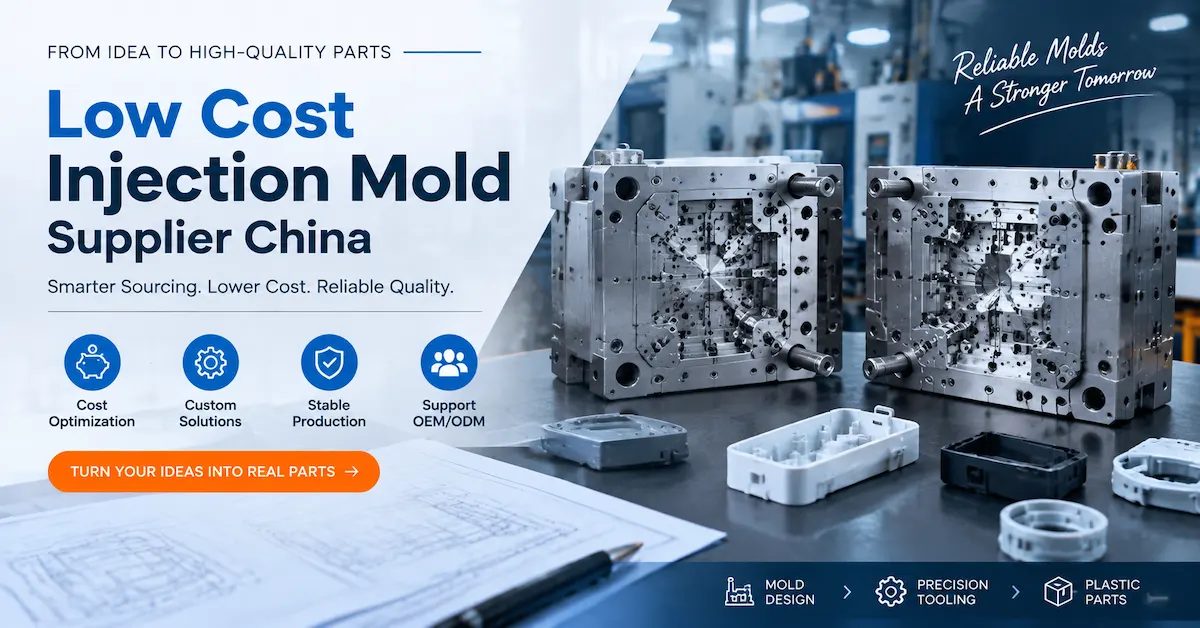
A low cost injection mold supplier China should reduce unnecessary project cost without removing the engineering, tooling or validation work your part actually needs. The objective is not simply to receive the lowest number on a quotation. It is to obtain a mold that can produce acceptable parts at a commercially sensible total cost.
A very low tooling price can come from several legitimate reasons: a simpler mold structure, lower expected production volume, fewer cavities, a cold-runner design, a standard mold base or reduced documentation requirements. It can also come from missing scope, weaker steel assumptions, limited trials, excluded spare parts or a quotation prepared before the supplier fully understands the product.
Those situations look similar on a price sheet but create very different purchasing risks.
DX Molding is operated by Shenzhen DongXin Technology Co., Ltd., which was founded in 2007 and provides custom plastic molds, molded plastic parts and OEM/ODM project support. Its current workflow covers engineering review, mold development, trials and production support.
For OEM buyers, a better definition of low cost is:
the lowest reasonable total cost for producing the required part under the agreed conditions.
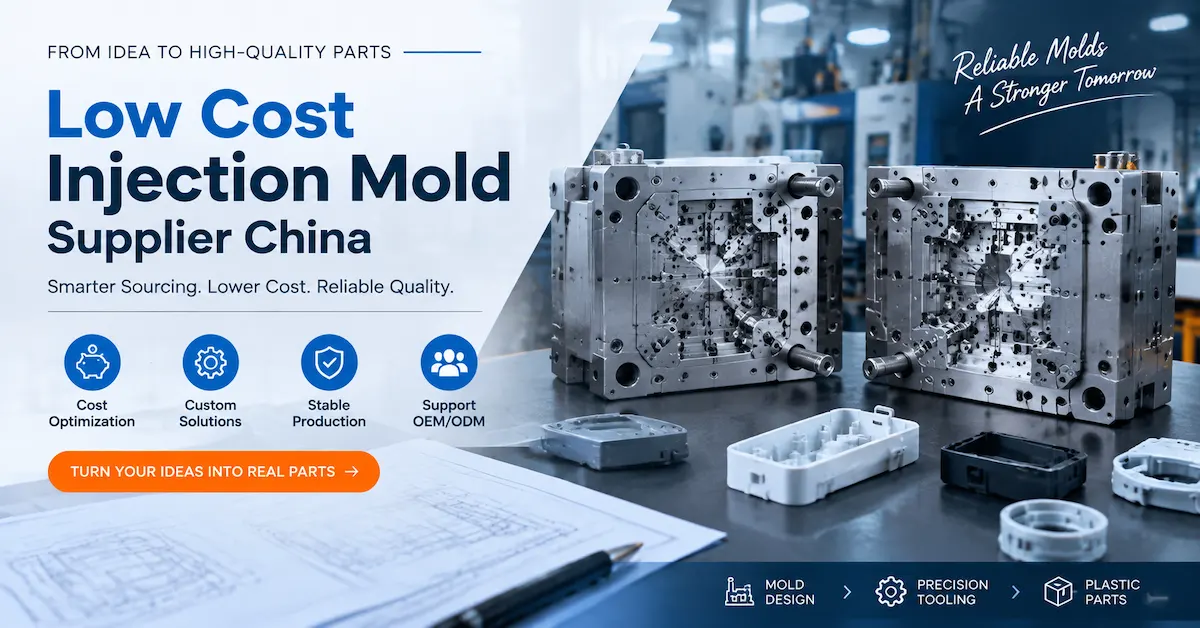
Which Buyers Should Look for a Low Cost Injection Mold Supplier China?
Cost-sensitive tooling is relevant to startups, product brands, industrial buyers, sourcing companies and established OEMs that need custom plastic parts but still have a defined tooling budget.
The sourcing strategy depends on the program. A startup launching a new enclosure may need a relatively simple production tool until demand becomes clearer. A consumer brand with stable repeat orders may justify a larger upfront tooling investment if it lowers unit production cost. An industrial customer buying a mold for its own factory may care more about transfer documentation, spare parts and machine compatibility than a buyer who keeps production with the mold maker.
A low cost injection mold supplier China is most useful when the buyer can explain where cost can be simplified and where it cannot.
For example, reducing cavity count may be acceptable when annual volume is modest. Eliminating a necessary slide is not acceptable if the part geometry requires that movement. Choosing a simpler runner system may make sense for some programs. Removing the dimensional inspection needed to approve a critical interface does not solve the real purchasing requirement.
The supplier should help distinguish cost optimization from scope removal.
Start With the Part, Volume and Production Route
The same plastic component can require very different tooling depending on expected quantity and production arrangement.
Before comparing China mold quotations, define the resin, approximate annual volume, key dimensions, appearance requirements and whether the tool will remain with the supplier or be shipped to another molding factory.
DX Molding’s plastic injection mold offering includes single- and multi-cavity tooling, hot- and cold-runner options, and mold steels such as P20, H13 and S136. Its published page also gives general tolerance and mold-life ranges, but those website figures should be treated as capability references rather than automatic commitments for every project.
Review DX Molding Plastic Injection Mold capabilities
A low-volume product may not need the same tooling construction as a component expected to run for hundreds of thousands of cycles. Conversely, selecting a low-investment mold for a large repeat program can shift cost into maintenance, downtime or replacement tooling later.
Prepare an RFQ That Makes Low-Cost Quotes Comparable
A useful RFQ should make each supplier quote the same technical and commercial scope. The table below is a buyer specification framework, not a set of universal DX Molding project specifications.
| RFQ Item | What to Define | Why It Affects Cost |
|---|---|---|
| Product files | Current 3D CAD and controlled 2D drawing | Geometry drives tooling complexity |
| Resin | Exact grade or defined candidate | Affects shrinkage, wear and processing |
| Quantity | Launch volume and annual forecast | Influences cavity count and mold life |
| Critical dimensions | Functional tolerances and datums | Determines machining and inspection effort |
| Appearance | Visible surfaces, texture and acceptable marks | Affects gate, polishing and parting decisions |
| Undercuts | Side holes, clips and locking features | May require slides, lifters or inserts |
| Runner system | Supplier proposal or buyer requirement | Changes tooling and production economics |
| Mold destination | Supplier factory or buyer’s molding site | Changes interface and handover requirements |
| Trials | Required T0/T1/T2 or agreed validation stages | Determines included sampling work |
| Documents | DFM, drawings, BOM and inspection reports | Prevents scope disputes later |
| Spare parts | Required inserts, pins or hot-runner items | Affects long-term maintenance cost |
| Modification terms | Correction vs buyer design change | Controls unexpected later charges |
A quote prepared from only a photo and approximate dimensions may be fast, but it is difficult to compare professionally.
DX Molding accepts drawings, samples and project requirements for technical review before tooling.
Send DX Molding your mold RFQ and CAD files
Use DFM to Save Money Before Steel Is Cut
The cheapest mold modification is often the one that never needs to happen.
DFM—Design for Manufacturing—can identify geometry that makes the tool unnecessarily complicated. DX Molding’s support scope includes review of draft, wall thickness, fillets, undercuts, assembly interference, sink risk and warpage, as well as gate and mold-flow considerations.
A side undercut provides a simple example. If the feature is functionally necessary, a slide or another mold action may be justified. If the product engineer can redesign that feature without affecting use, the mold may become simpler and less expensive.
The important point is timing.
If that discussion happens before mold design is frozen, it is design optimization. If it happens after machining, it may become rework.
A capable low cost injection mold supplier China should therefore explain why a feature is expensive and whether a lower-cost alternative changes product function, appearance or production reliability.
Cost reduction should be a technical conversation, not only a purchasing negotiation.
Compare Mold Structure Before Comparing Prices
Two quotations can differ substantially because the suppliers are not proposing the same mold.
| Tooling Approach | Potential Cost Advantage | Main Trade-Off | When to Evaluate It |
|---|---|---|---|
| Single-cavity mold | Lower initial tooling investment | Lower output per cycle | Moderate or uncertain demand |
| Multi-cavity mold | Lower potential unit production cost | Higher tooling and validation complexity | Stable repeat demand |
| Cold-runner mold | Simpler system in suitable applications | Runner material and removal | Projects where runner economics remain acceptable |
| Hot-runner mold | Can reduce cold-runner waste | Higher tooling, controls and maintenance | Higher-volume suitable programs |
| Manual insert solution | May avoid a complex automatic mold action | Adds operator handling | Low-volume projects where labor and consistency are acceptable |
| Automated slide/lifter solution | Reduces manual intervention | Adds mold components and maintenance | Repeat production with necessary undercuts |
The lowest initial tooling price is not automatically the lowest-cost production route.
A low cost injection mold supplier China should connect its mold proposal to your quantity forecast. A single-cavity cold-runner tool may be commercially sensible for one project and expensive for another once cycle time, runner material and labor are included.
DX Molding’s existing China sourcing guide also warns buyers to compare mold structure and total project scope instead of one headline tooling figure.
Read the Injection Molding Factory China sourcing guide
Do Not Reduce Tool Steel to a Brand Name
Steel selection affects tooling cost, but “use cheaper steel” is not a complete sourcing strategy.
Ask what steel is proposed for the core, cavity and wear components, then connect that recommendation to the expected resin, production quantity, finish and maintenance plan.
DX Molding publishes P20, H13 and S136 among its custom mold material options. Its support information also describes mold-life planning according to expected shot volume and recommends different tooling materials according to the project.
The cost discussion should therefore include the expected production program.
A mold designed for a modest launch quantity does not automatically need the same construction as tooling expected to operate for years of repeat production. On the other hand, specifying a lower-cost steel without discussing wear, polishing, corrosion or resin additives can create later maintenance costs.
Ask the supplier to state the assumption behind its material choice.
Check What Is Included in Mold Trial and Correction
A low mold price can become expensive when every trial or correction creates a new charge.
Define what the quotation includes before the purchase order is released.
DX Molding’s support page describes T0/T1/T2 trial reports, dimensional inspection, appearance-defect records, CMM data where applicable, modification follow-up and molding-parameter records. The actual package for a project should still be confirmed in the quotation.
Review DX Molding trial and quality support
The buyer should also distinguish two situations clearly.
A supplier correction is work required because the tool does not meet the previously approved requirement. A buyer design change occurs when the customer changes geometry or requirements after approval.
These are not the same commercial event.
A low-cost supplier relationship becomes much easier to manage when both are defined before tooling starts.
Evaluate Quality by the Dimensions That Matter
Trying to inspect every feature with the same intensity can increase cost without improving the product.
Instead, identify the characteristics that control function.
For an electronics housing, connector location or PCB mounting bosses may be critical. For a snap-fit product, engagement geometry may matter more than a non-functional exterior dimension. For an appearance part, the cosmetic surface may require its own acceptance reference.
DX Molding’s company information describes incoming material inspection, mold inspection, first article validation, in-process control, final inspection and packaging review within its quality workflow.
A buyer seeking a low cost injection mold supplier China should ask how the supplier will verify the characteristics that actually justify spending inspection time.
This approach is different from simply demanding the tightest tolerance everywhere.
Compare Total Project Cost, Not Only Tooling Price
Consider a hypothetical comparison.
Supplier A quotes a mold at $12,000. Supplier B quotes $15,000.
At first glance, Supplier A is 20% cheaper.
Now assume—purely for illustration—that Supplier A’s scope excludes a $1,200 hot-runner controller, $900 in additional inspection and $1,500 in required modifications that Supplier B already included.
Supplier A’s comparable project cost becomes:
$12,000 + $1,200 + $900 + $1,500 = $15,600.
Supplier B remains $15,000 under those assumptions.
This example is not DX Molding pricing. It simply shows why quotation scope matters.
A professional cost comparison can be expressed as:
Tooling + required engineering + trials + modifications + production cost + maintenance + logistics + quality risk.
That gives buyers a better way to evaluate a low-price offer without assuming that higher or lower price automatically means better quality.
How Does Part Production Change the Cost Comparison?
If the supplier will also mold the finished parts, tooling cost is only one part of the commercial decision.
DX Molding’s plastic molding service covers custom injection-molded components, including materials such as ABS, PP, PE, PVC, nylon and PC, together with secondary operations such as trimming, polishing and assembly.
Review custom plastic molding options
For a mold-and-parts project, compare the tooling price together with part price, runner material, cycle assumption, packing, inspection and reorder quantities.
A cheaper mold combined with a higher cycle cost may become less attractive over a long production program. A more expensive mold may also fail to justify its investment if demand remains low.
The correct calculation depends on realistic volume.
Check China Supplier Communication and Mold Ownership Early
Cost problems are not always technical.
They can also come from unclear responsibility.
Before choosing a low cost injection mold supplier China, confirm who owns the mold after payment, where it will be stored, whether it can be transferred, which drawings and spare-part records are included, and how later changes are approved.
DX Molding’s supplier-selection content recommends that buyers clarify mold ownership, transfer, trial and documentation requirements before paying a tooling deposit.
Review the injection mold supplier selection checklist
A lower quotation has less value if the buyer later discovers that essential files, components or transfer work were never included.
Plan Lead Time by Milestone, Not One Number
A statement such as “25-day mold lead time” does not explain what happens at the end of those 25 days.
Is that the first trial? Approved samples? Final mold shipment?
A better schedule separates requirement review, DFM, mold design, machining, assembly, first trial, modification, re-trial, sample approval and delivery.
DX Molding’s support workflow runs through requirement review, engineering and DFM, mold manufacturing, trial molding, mass production, final inspection and delivery.
When comparing lower-cost China suppliers, ask which customer approvals can stop the schedule and which correction cycles are included.
A realistic timeline is usually more valuable than an aggressive number with undefined assumptions.
How OEM and ODM Scope Changes Tooling Cost
For an OEM project, the buyer may already have approved product geometry and need only DFM, tooling and production.
An ODM project may require additional industrial design, mechanical structure work, prototypes and development iterations before tooling.
DX Molding’s service scope includes product design review, mechanical structure support, custom plastic molds and OEM/ODM development.
Review DX Molding OEM/ODM and tooling services
Do not compare an ODM quotation with a tooling-only quotation as if they contain the same work.
This is especially important when searching for a low cost injection mold supplier China, because the cheapest offer may simply exclude product-development work that another supplier has included.
Send a Cost-Focused RFQ Instead of Asking for the Cheapest Mold
A useful inquiry should contain the current CAD files, material requirement, quantity forecast, critical dimensions, surface requirements, expected mold location and the main cost concern.
If budget is important, say so directly—but explain what can and cannot change.
For example, the buyer can state that annual volume is modest and a simple tool is preferred, but critical assembly dimensions cannot be relaxed. Another project may allow a different gate location but require automated production.
That information allows engineering to optimize cost around real priorities.
Send DX Molding your project details for review rather than requesting a generic lowest mold price. Contact DX Molding for a tooling quotation
Frequently Asked Questions
1. Is a Low Cost Injection Mold Supplier China Always Lower Quality?
No. A lower price can result from simpler tooling, lower overhead, a different cavity strategy or a more appropriate specification. The important question is whether the quote still includes the engineering, materials, trials and documentation your project requires.
2. Why Do Injection Mold Quotations From China Vary So Much?
Different suppliers may assume different steels, cavity counts, runner systems, mold life, trial scope, components and documentation. Before comparing total prices, confirm that the technical scope is equivalent.
3. What Is the Cheapest Injection Mold Structure?
There is no universal cheapest structure because part geometry determines what is feasible. A straightforward single-cavity cold-runner mold may have lower initial investment than a multi-cavity hot-runner tool, but it may also have different production economics.
4. Can I Reduce Mold Cost by Using Cheaper Steel?
Possibly, but the decision should consider resin, expected shot quantity, surface requirements and maintenance. A less expensive steel is useful only when it still fits the actual production program.
5. Should I Choose a Single-Cavity Mold to Save Money?
A single-cavity tool may reduce initial tooling investment, especially for modest or uncertain volumes. For larger repeat orders, however, unit production economics may justify additional cavities. Compare both scenarios against realistic demand.
6. Does DX Molding Support Low-Cost Tooling Options?
DX Molding provides custom injection mold design and manufacturing with different mold steels, cavity layouts and runner configurations. The appropriate lower-cost approach should be evaluated from the actual drawing, resin, quantity and quality requirements rather than selected from one fixed budget mold package.
7. What Should Be Included in an Injection Mold Quote?
At minimum, the buyer should understand the mold structure, steel, cavity count, runner system, trial scope, inspection, included corrections, documentation and delivery scope. Any exclusions that could affect later cost should be stated.
8. How Can I Avoid Hidden Tooling Costs?
Use a controlled RFQ, request an itemized scope and define the difference between supplier corrections and customer engineering changes. Clarify spare parts, controllers, inspection, packaging and transfer requirements before placing the order.
9. Is Buying an Injection Mold From China Worth It?
China can be commercially attractive for projects where engineering, mold making, trials and production can be coordinated effectively. The decision should be based on total project cost, supplier capability, communication and quality control—not location or tooling price alone.
10. What Should I Send for a More Accurate Mold Price?
Send current CAD files, material, annual volume, critical dimensions, appearance requirements, intended production location and required reports. Clearly mark open engineering questions instead of forcing assumptions into the RFQ.
Conclusion
Choosing a low cost injection mold supplier China should not mean choosing the lowest number on a quotation sheet. A useful low-cost sourcing strategy removes unnecessary tooling complexity while protecting the features, materials, validation and documentation that the product actually needs.
OEM buyers should compare mold structure, steel, cavity count, runner system, DFM, trial scope, inspection, modification terms and later production cost on the same basis. A quote is genuinely economical only when its assumptions are visible and its total project cost remains competitive after sampling, corrections, production and maintenance are considered.
DX Molding supports custom plastic mold development and molded-part production from engineering review through tooling and production. For a project-specific cost discussion, send your CAD files, material, volume and critical requirements to DX Molding so the tooling proposal can be evaluated against the actual product rather than a generic “cheap mold” target.