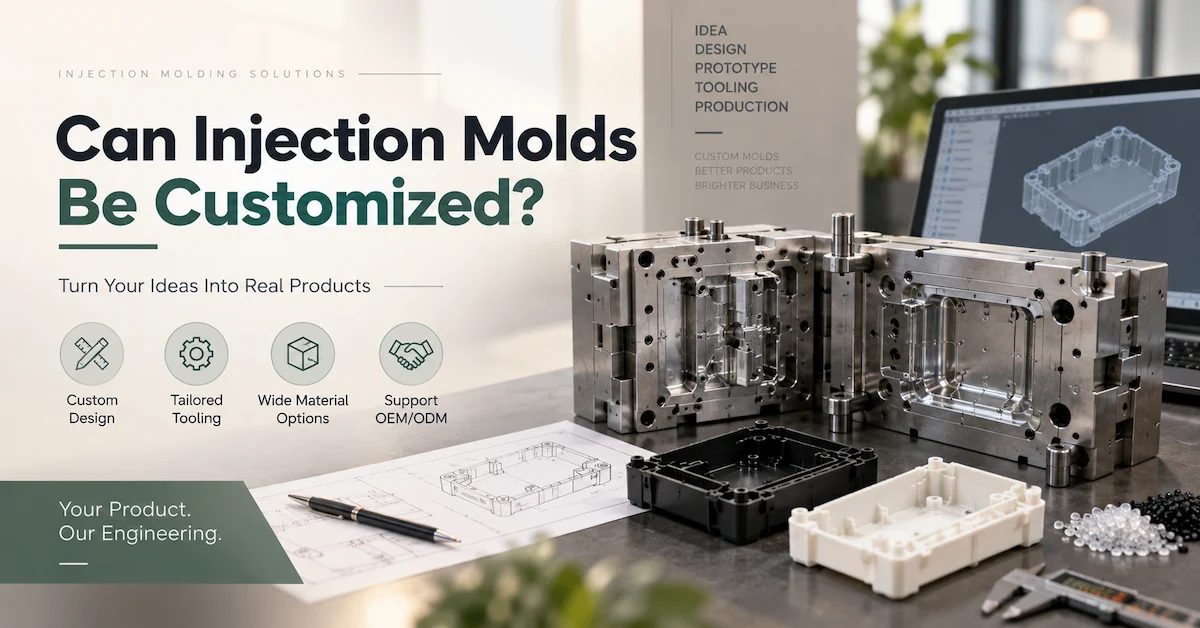
Can Injection Molds Be Customized?
Yes. Injection molds can be customized extensively, but the useful question for an OEM buyer is not simply whether customization is possible. It is which mold features need to change to produce your specific plastic part reliably and economically.
A custom injection mold can be engineered around the product geometry, plastic resin, expected quantity, cosmetic requirements, critical dimensions, cavity count, gate and runner system, cooling, ejection, inserts, slides, lifters and the injection molding machine that will run the tool.
That does not mean every requested feature should automatically be added.
Customization should solve a defined product or production requirement. A more complicated mold can increase tooling investment, maintenance and validation work without adding value if the product does not actually need that complexity.
DX Molding supports custom plastic injection molds, molded plastic components and OEM/ODM projects from engineering review through tooling and production. The company’s current service workflow begins with product and manufacturability review before tooling manufacture.
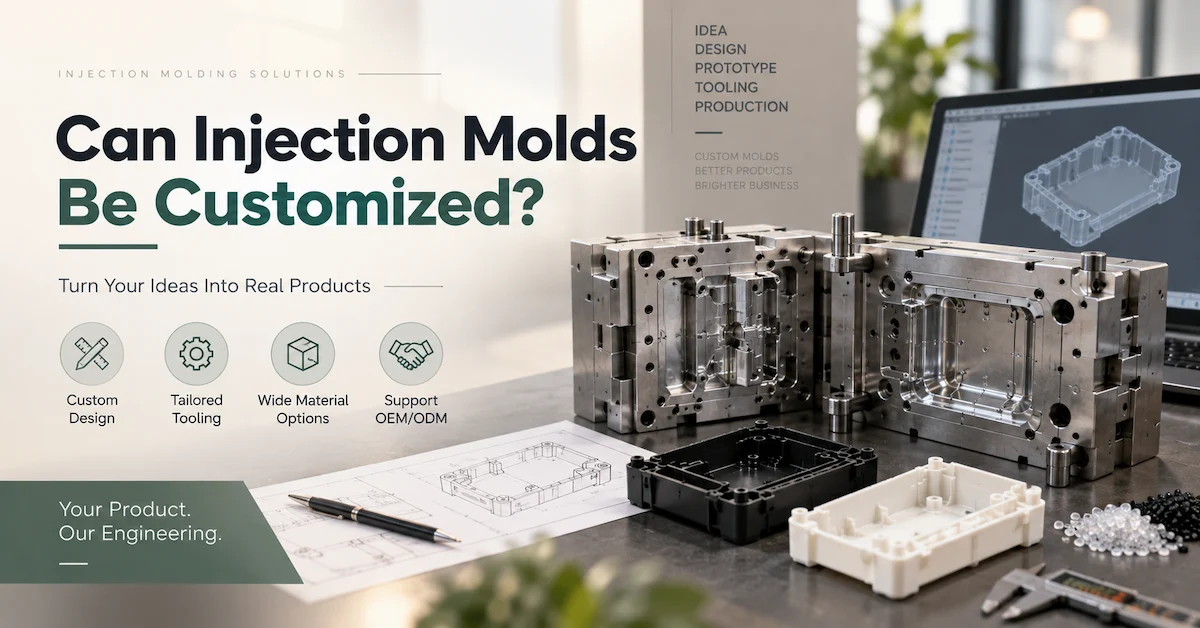
What Parts of an Injection Mold Can Be Customized?
Almost every major mold system can be adapted to a specific project. The table below is a buyer-oriented specification framework rather than a universal DX Molding configuration.
| Mold Area | What Can Be Customized | Why Buyers May Need It |
|---|---|---|
| Cavity and core | Product geometry, inserts, local replaceable areas | Reproduce proprietary product design |
| Cavity count | Single or multiple cavities | Match required production output |
| Parting line | Split direction and location | Control tooling structure and visible seam |
| Gate | Type, position and number | Influence filling, appearance and trimming |
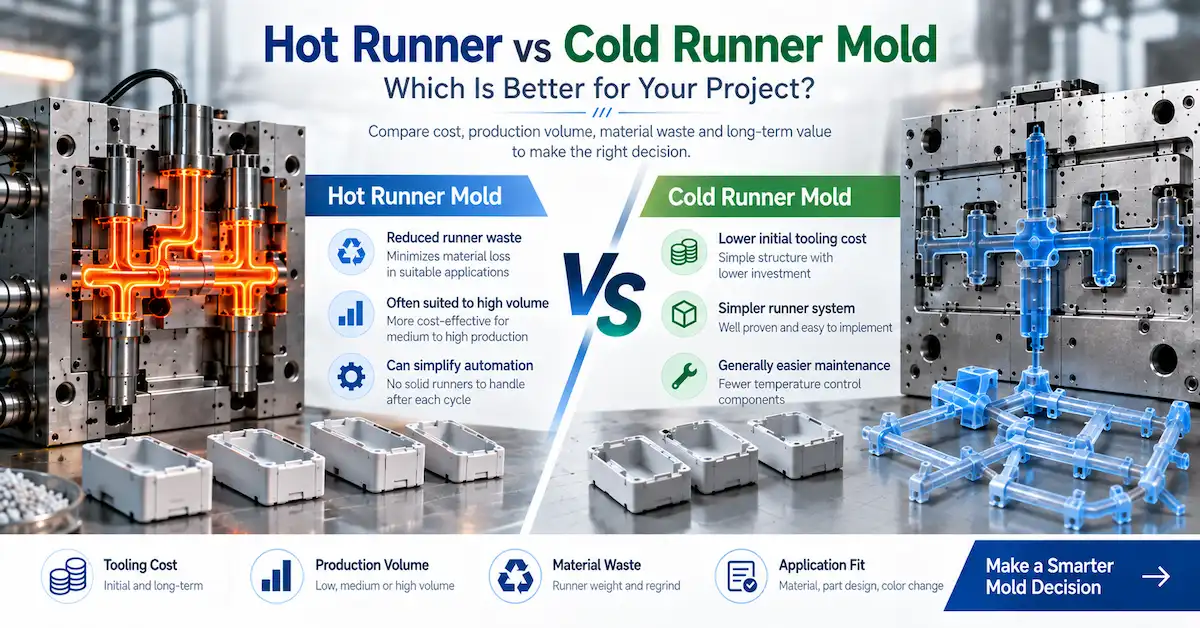
| Runner | Cold runner, hot runner or project-specific layout | Balance investment, material use and production |
| Slides and lifters | Side actions and angled release mechanisms | Produce undercuts, holes and locking features |
| Ejection | Pin, sleeve, stripper or project-specific arrangement | Remove parts without unacceptable damage |
| Cooling | Channel layout and local cooling strategy | Support cycle time and dimensional stability |
| Mold steel | Core, cavity and wear-component materials | Match production volume, resin and finish |
| Surface | Polishing, texture and defined cosmetic finish | Match product appearance |
| Inserts | Replaceable, wear or variant-related inserts | Support maintenance or selected revisions |
| Machine interfaces | Mold size, locating, ejection and relevant connections | Match intended molding equipment |
| Documentation | Drawings, BOM, trial and handover records | Support production, maintenance and transfer |
The right level of customization depends on the product. A simple cover may need a straightforward mold, while an enclosure with side connectors, internal clips and appearance-sensitive surfaces can require a more involved tool.
When Do OEM Buyers Actually Need a Custom Injection Mold?
A custom mold becomes relevant when the plastic component cannot be sourced as a standard molded product and must follow the buyer’s own geometry or functional requirements.
This often applies to electronics housings, appliance components, consumer products, industrial parts, mounting components and other OEM plastic parts.
Custom tooling is particularly useful when the buyer controls requirements such as mating geometry, internal PCB mounting, connector openings, screw bosses, clips, proprietary appearance or specific assembly relationships.
However, production tooling may be premature when the fundamental product is still changing.
If PCB dimensions, battery layout, connector location or core mechanical structure remain unsettled, it can be more economical to resolve those decisions before freezing the mold.
DX Molding’s custom molding and product-development services cover product concepts, mechanical structure review, DFM, mold development and manufacturing support, allowing the tooling scope to be matched to the project stage.
What Information Is Needed to Customize an Injection Mold?
The quality of a custom mold proposal depends heavily on the information supplied by the buyer.
Sending a STEP file and asking for “best price” gives the toolmaker very little information about production priorities.
A stronger RFQ defines both the part and the production objective.
| Buyer Input | What to Define | Mold Decision It Supports |
|---|---|---|
| 3D CAD | Current approved geometry | Cavity and core design |
| 2D drawing | Critical dimensions, tolerances and datums | Tooling and inspection priorities |
| Resin | Exact grade or material requirement | Shrinkage, flow and tooling decisions |
| Annual quantity | Launch, base and forecast volume | Cavity and tool-life strategy |
| Mating parts | Housings, PCB, fasteners, connectors | Assembly validation |
| Cosmetic areas | Visible surfaces and finish requirements | Gate, parting and ejection planning |
| Undercuts | Side holes, hooks, clips and locking features | Slides, lifters or redesign |
| Mold destination | Supplier production or buyer factory | Machine-interface and transfer requirements |
| Quality requirements | Dimensional, appearance and functional criteria | Trial and inspection plan |
| Open questions | Unresolved product decisions | Prevents assumptions becoming specifications |
If something is unknown, mark it as open for engineering review.
That is more useful than supplying an invented tolerance, resin or mold-life target simply because a quotation form has an empty field.
How Is the Product Geometry Customized Into the Mold?
The cavity and core reproduce the main external and internal shape of the component, but mold customization goes beyond copying CAD geometry.
The tooling engineer must decide how the part can be formed and removed.
Parting Line
The parting line defines where mold sections separate.
For a hidden industrial component, the line may have limited cosmetic importance. For a consumer-facing enclosure, its location can influence the visual quality of the finished product.
Ask the supplier to show the proposed parting line on the product model before mold approval.
Undercuts
Side holes, hooks and locking features can prevent a part from releasing in a simple opening direction.
Depending on geometry, the solution may involve:
- A slide.
- A lifter.
- A removable insert.
- Another mold mechanism.
- Product redesign.
The best solution is not automatically the most complicated one.
DX Molding’s complex injection mold guide discusses why slides, lifters and inserts should exist because they solve a real product requirement, not simply because advanced tooling is possible.
Can the Gate and Runner System Be Customized?
Yes.
Gate and runner design is one of the most important mold customization decisions because it affects how plastic enters and fills the cavity.
A project can require different gate locations or runner strategies depending on resin, part geometry, appearance, cavity count and production volume.
A cosmetic housing, for example, may restrict where a gate mark is acceptable. A multi-cavity component requires additional attention to how each cavity receives material.
Buyers should ask:
Where will material enter the part?
Where are flow fronts expected to meet?
Will the gate leave a visible mark?
How will the runner be handled?
Why was this runner system proposed for this production volume?
Do not specify a hot runner simply because it sounds more advanced. Likewise, do not insist on a cold runner only because the initial tooling cost may be lower.
The decision should consider the full production program.
Can Cavity Count Be Customized for Production Volume?
Yes. A mold can be designed with one or multiple cavities when the product and manufacturing conditions allow it.
Increasing cavity count can increase output per molding cycle, but it also changes tooling size, runner design, cooling, machine requirements, validation and maintenance.
This makes cavity count a commercial as well as technical decision.
Consider an OEM product with uncertain first-year demand. A simple cavity strategy may limit early investment.
For a mature component with stable repeat orders, additional cavities may improve production economics.
The comparison should therefore connect:
Annual demand → Cycle assumptions → Available machine → Cavity count → Production cost
DX Molding’s existing high-volume injection mold guide explains why buyers should evaluate cavity balance, cycle time, maintenance and actual forecast together rather than requesting the maximum possible cavity count.
Can Cooling and Ejection Be Customized?
Yes, and both deserve attention before steel cutting.
Cooling Customization
Cooling channels can be designed around the cavity, core, inserts and local areas that require additional thermal control.
The goal is not simply to add more water lines.
Buyers should ask how the proposed cooling arrangement relates to:
- Thick sections.
- Deep bosses.
- Large surfaces.
- Dimensional stability.
- Expected cycle.
- Maintenance access.
Uneven thermal behavior can contribute to dimensional differences or deformation, so cooling should be considered together with product geometry.
Ejection Customization
The ejection system must remove the molded component from the tool.
Ejector pins, sleeves, stripper arrangements or other solutions may be used depending on the part.
For appearance-sensitive components, mark where ejector evidence is acceptable.
An ejector location that is completely acceptable on an internal surface may be unacceptable on the front of a consumer product.
DX Molding’s injection mold design guide covers parting, gating, cooling and ejection as decisions that OEM buyers should review before manufacturing begins.
Can Mold Steel Be Customized?
Yes.
DX Molding lists options including P20, H13 and S136 for its custom plastic injection mold programs. The appropriate selection still depends on the individual project.
Tool steel decisions can be influenced by:
- Expected production quantity.
- Plastic resin.
- Fillers or abrasive content.
- Cosmetic finish.
- Wear requirements.
- Corrosion considerations.
- Maintenance plan.
Do not turn the steel name into a shortcut for mold quality.
The most expensive material is not automatically necessary for every program, while a lower-investment steel may not be suitable for a demanding long-life tool.
Ask which material is proposed for the core, cavity and high-wear areas, and why.
What Cannot Be Customized Without Engineering Trade-Offs?
Customization does not remove the physical limits of injection molding.
A buyer may request extremely thin walls, no draft, deep undercuts, no visible gate, zero deformation, very tight tolerances everywhere and the lowest possible mold cost at the same time.
Those goals can conflict.
This is where DFM becomes important.
A useful DFM process asks whether a requirement is:
Functionally necessary — changing it would affect how the product works.
Commercially important — it affects appearance, branding or customer acceptance.
Manufacturing preference — there may be several acceptable solutions.
Unnecessary complexity — the feature adds cost without supporting a meaningful requirement.
A strong custom mold proposal does not simply answer every request with “yes.” It identifies trade-offs early enough for the buyer to make an informed decision.
How Do Different Levels of Mold Customization Compare?
The following table is a purchasing framework rather than fixed DX Molding product packages.
| Customization Level | Typical Characteristics | Main Buyer Priority | Main Risk to Review |
|---|---|---|---|
| Straightforward custom mold | Proprietary geometry, simple opening, limited moving components | Control initial tooling scope | Future demand may outgrow initial strategy |
| Production-focused custom mold | Optimized cavity, cooling, runner and maintenance plan | Repeat manufacturing economics | Higher initial investment |
| Complex custom mold | Slides, lifters, inserts or difficult geometry | Produce necessary advanced features | Maintenance and engineering complexity |
| Multi-cavity custom mold | Multiple identical cavities | Higher output | Cavity consistency and machine requirements |
| Transfer-ready custom mold | Interfaces and documentation defined for another factory | Successful mold handover | Destination-machine mismatch |
| Mold + parts program | Tool stays with supplier for ongoing production | Simplified supply-chain handoff | Ownership and repeat-order controls |
Customization should therefore be selected around the actual business model rather than treated as one premium option.
Can an Existing Injection Mold Be Customized Later?
Often, yes—but feasibility depends on the requested change and current mold construction.
Some changes may involve replacing or modifying an insert.
Other changes may require adding steel, removing additional material, changing slides, altering gates or rebuilding a major mold section.
In some cases, producing a new tool may be more practical than extensively modifying the old one.
Before changing an existing mold, provide:
- Current mold drawings if available.
- Existing molded samples.
- Current product drawing.
- Revised product drawing.
- Known mold condition.
- Proposed production quantity.
DX Molding’s support services include modification feasibility and project follow-up. The actual modification scope still needs to be assessed against the specific mold.
How Should a Customized Injection Mold Be Validated?
A customized tool should be approved using the requirements that justified its design.
If the mold includes a slide because of a side opening, check both slide operation and the molded feature.
If special cooling was introduced for dimensional stability, check the relevant dimensions during trials.
If the gate was moved to protect a cosmetic surface, examine that appearance requirement.
A practical validation package can connect:
Drawing revision → Material → Cavity → Trial conditions → Inspection → Assembly → Approval
DX Molding’s support scope includes trial and dimensional inspection activities, but the exact reports required should be agreed for the project rather than assumed from a general service description.
For a multi-cavity tool, identify the cavities during validation so one successful part is not mistaken for evidence that every cavity behaves identically.
How Does Customization Affect Mold Lead Time?
More customization can increase engineering and manufacturing work, but complexity alone does not determine the entire schedule.
A practical timeline separates:
Product review → DFM → Mold design → Approval → Machining → Fitting → Trial → Modification → Re-trial → Final approval
A simple tool may move quickly through design but still wait for buyer approval.
A complex tool may require more engineering but proceed efficiently when requirements are well controlled.
DX Molding’s custom manufacturing workflow places requirement review and DFM before tooling and trial activities.
The buyer should therefore ask for milestone dates rather than only one “mold lead time” number.
How Does Injection Mold Customization Affect Cost?
Customization affects cost when it changes the amount of engineering, machining, mold materials, purchased components, assembly, validation or maintenance involved.
Major cost drivers can include:
| Cost Driver | Why It Changes Tooling Cost |
|---|---|
| Product geometry | Difficult geometry may require more machining or mechanisms |
| Cavity count | More cavities increase tooling and validation requirements |
| Slides/lifters | Add components, fitting and maintenance |
| Runner system | Changes mold hardware and production economics |
| Tool steel | Different production objectives require different materials |
| Surface finish | Polishing and texture add processing requirements |
| Precision requirements | Critical tolerances can increase machining and inspection |
| Cooling | More involved layouts require additional engineering and machining |
| Validation | Additional trials and measurements add project work |
| Documentation | Export or transfer programs may need more handover information |
This is why a custom mold should not be priced using only part dimensions.
The lowest quotation may represent a genuinely efficient solution—or simply a different scope.
Compare the proposed tool feature by feature.
How Does OEM/ODM Change Mold Customization?
In a mature OEM project, the buyer typically controls the product design and asks the supplier to develop tooling around the approved geometry.
In an ODM or early-development project, the manufacturing partner may become involved earlier in product appearance, mechanical structure and prototype decisions.
DX Molding describes its service scope as supporting both complete customer drawings and earlier product concepts, with industrial design, mechanical structure and manufacturability review available for suitable projects.
Regardless of project type, define who approves:
Product geometry, material, critical dimensions, DFM changes, mold design, sample results and production release.
The phrase “fully customized” should not replace a controlled approval process.
What Should You Send DX Molding for a Custom Mold Review?
Prepare your current CAD model, 2D drawing where available, resin, forecast volume, critical dimensions, cosmetic requirements, mating components and intended production arrangement.
Also explain the customization objective.
For example:
“We need this side opening but are open to changing the clip geometry.”
“We need the exterior surface free of visible gate marks.”
“The initial volume is low, but we need a path to higher production later.”
“The tool must eventually run in our own molding factory.”
Those statements help the engineering team understand why customization is required.
Send DX Molding your drawings and custom tooling requirements to begin a project-specific review.
Frequently Asked Questions
1. Can Injection Molds Be Fully Customized?
Yes, injection molds can be extensively customized around part geometry, cavity count, gates, runners, cooling, ejection, inserts, moving mechanisms and production equipment. However, every requested feature still needs to be evaluated for manufacturability, cost and production value.
2. Can the Same Mold Produce Different Product Versions?
Sometimes. Replaceable inserts or selected mold features may support localized variants, but the feasibility depends on how much geometry changes. Color-only changes are different from dimensional or structural changes, so the variants should be reviewed individually.
3. Can Injection Mold Cavities Be Customized?
Yes. Cavity geometry is developed around the product, and cavity count can also be selected according to production requirements. More cavities can increase output but also increase mold size, balancing, inspection and maintenance requirements.
4. Can a Mold Be Customized for a Specific Injection Machine?
Yes. Tool dimensions, opening requirements, ejection interfaces and other machine-related details can be reviewed against the intended production equipment. Export or transferable molds should have these requirements defined early.
5. Can Gates and Runners Be Customized?
Yes. Gate position and runner configuration are project-specific decisions influenced by resin, product geometry, appearance, cavity count and production economics.
6. Can Mold Steel Be Customized for Different Production Volumes?
Yes. Mold materials can be selected according to production quantity, resin, finish and wear conditions. The decision should be based on the actual project rather than assuming one premium steel is necessary for every mold.
7. Can Existing Injection Molds Be Modified?
Many existing molds can be modified, but feasibility depends on the new geometry and current mold structure. Some changes can be handled through inserts, while major revisions may require extensive rework or a new mold.
8. Does More Mold Customization Always Improve Product Quality?
No. Customization is useful when it solves a defined product or manufacturing requirement. Unnecessary mold mechanisms can increase cost and maintenance without improving the finished component.
9. How Much Does a Customized Injection Mold Cost?
There is no universal custom mold price. Cost depends on geometry, cavities, material, runner system, moving components, finish, precision requirements, trials and documentation. A meaningful quotation requires actual project information.
10. How Can I Get an Accurate Custom Injection Mold Quote?
Provide the latest CAD files, material, quantity forecast, critical dimensions, appearance requirements, mating components and production arrangement. Clearly identify which requirements are fixed and which remain open for engineering review.
Conclusion
So, can injection molds be customized? Yes—extensively. Cavity geometry, cavity count, mold steel, gates, runners, inserts, slides, lifters, cooling, ejection, surface finish and machine interfaces can all be engineered around a specific OEM project.
The more important purchasing question is which customization creates real value.
Successful tooling should follow a controlled path:
Product requirement → DFM → Custom mold strategy → Design approval → Manufacturing → Trial validation → Production
This keeps custom tooling focused on the functions, appearance and production requirements that actually matter instead of adding complexity for its own sake.
DX Molding supports custom plastic injection mold design, tooling and molded-part production for OEM/ODM projects. Send DX Molding your CAD files, resin, volume forecast and customization requirements to evaluate which mold features should be customized for your product.