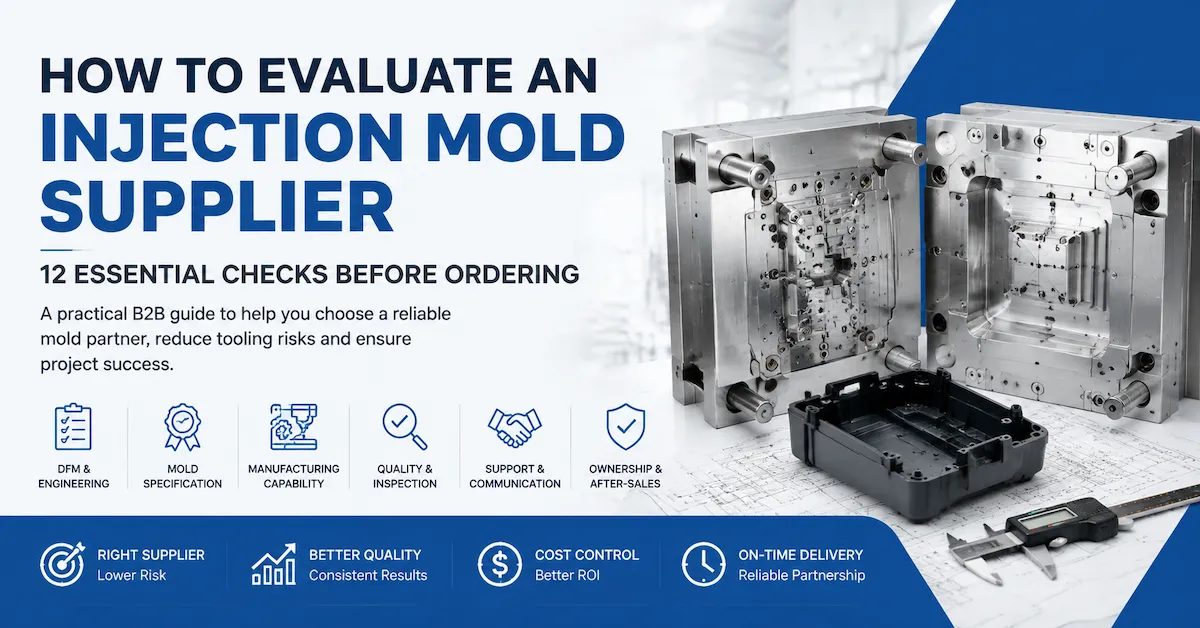
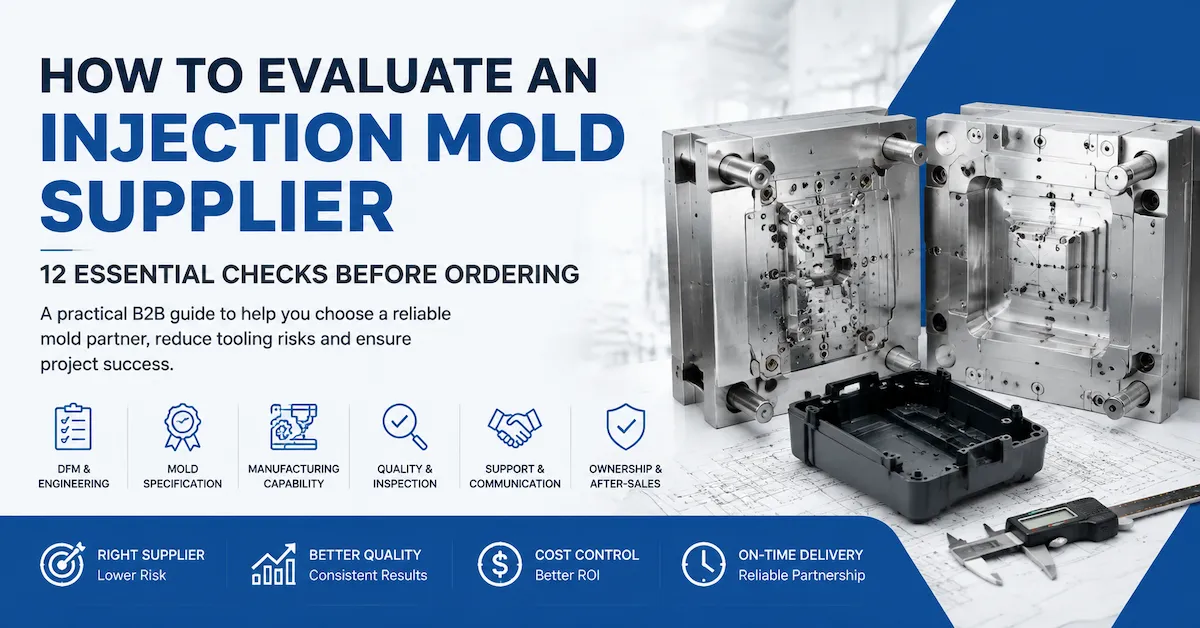
Choosing an injection mold supplier should not begin with the question, “Who has the lowest tooling price?”
A better question is:
Which supplier can turn your part design into a mold that repeatedly produces acceptable parts under the agreed production conditions?
For B2B buyers, the answer depends on much more than CNC machining capability. A reliable injection mold supplier should be able to review manufacturability before steel is cut, define the tooling specification, control machining and assembly, validate molded samples against measurable requirements, document changes, and support the mold after approval.
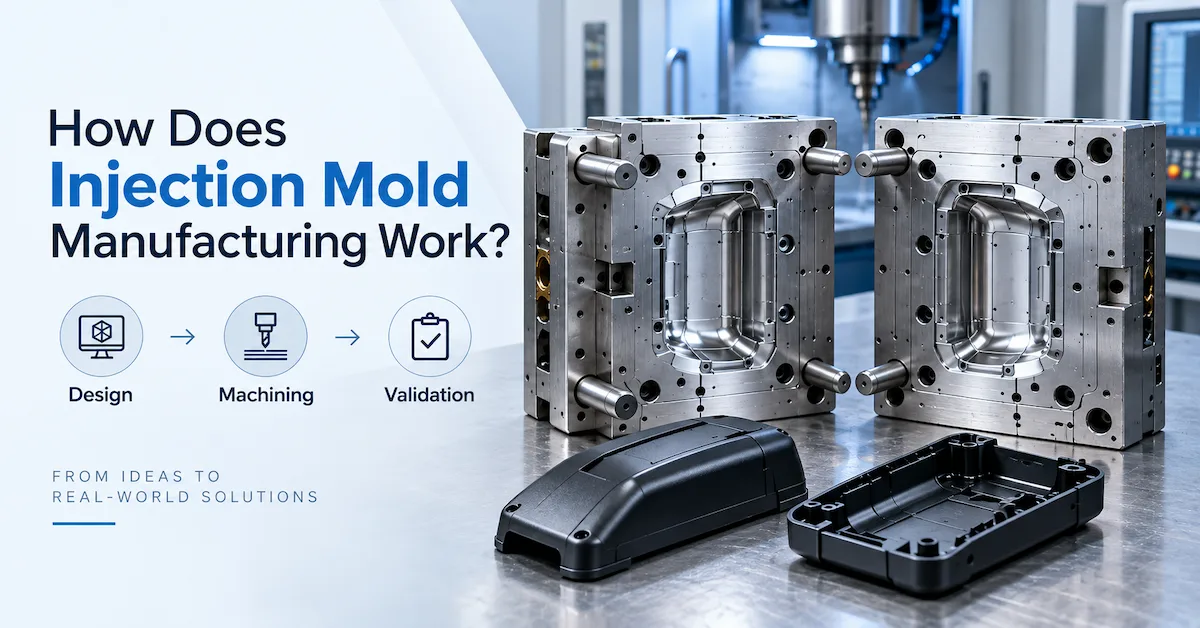
DongXin's current project workflow follows this type of sequence: project-file review, DFM and manufacturing-risk assessment, quotation and tooling planning, mold design and machining, trial molding and inspection, followed by production and delivery.
This guide gives procurement teams, product engineers, sourcing managers and OEM buyers a practical checklist for evaluating an injection mold supplier before a tooling purchase order is released.
What Should an Injection Mold Supplier Actually Be Responsible For?
An injection mold supplier is not simply a company that machines steel.
For a custom plastic project, the supplier may need to coordinate several technical stages:
- Product and drawing review
- Design for Manufacturing (DFM)
- Mold structure planning
- Tool-steel selection
- Core and cavity machining
- CNC and EDM processing
- Mold fitting and assembly
- Cooling and ejection design
- Trial molding
- Sample measurement
- Tool modification
- Final mold approval
- Production support
- Mold maintenance or transfer support
The exact scope depends on whether the buyer needs only tooling or both tooling and molded-part production.
DongXin currently supports custom plastic molds from engineering review through mold manufacturing and trial optimization, as well as plastic molding for customers who need molded parts after tooling approval.
That distinction should be clarified before comparing quotations.
A supplier offering an export mold only and a supplier responsible for tooling plus mass production may be quoting two very different project scopes.
1. Does the Supplier Review the Part Before Quoting the Mold?
This is one of the first filters buyers should use when evaluating an injection mold supplier.
A supplier cannot develop a meaningful tooling strategy from a product photograph and overall dimensions alone.
For a more accurate RFQ, prepare as much of the following information as possible:
| RFQ Information | Why the Supplier Needs It |
|---|---|
| 3D CAD / STEP file | Understand complete part geometry |
| 2D drawing | Identify tolerances and critical dimensions |
| Plastic material | Evaluate shrinkage and processing requirements |
| Estimated annual volume | Plan mold durability and cavity strategy |
| Surface requirement | Plan polishing, texture and parting lines |
| Color requirement | Support material and appearance planning |
| Assembly conditions | Identify functional and mating dimensions |
| Application environment | Understand temperature, chemical or load requirements |
| Target quantity | Evaluate production strategy |
| Target schedule | Plan engineering and tooling sequence |
A professional supplier should also identify what information is still missing before finalizing the mold specification.
Red Flag: A Final Quote With Almost No Technical Questions
Fast quotations can be useful during preliminary sourcing.
But if a supplier gives what appears to be a final mold price without asking about:
- resin,
- annual quantity,
- critical tolerance,
- appearance,
- assembly,
- expected production,
- or application requirements,
you should ask what assumptions are included in the quotation.
Otherwise, two suppliers may appear to quote the “same mold” while actually proposing completely different tooling standards.
2. What Does the Supplier's DFM Review Actually Cover?
“Free DFM” appears on many mold supplier websites.
The more important question is:
What is actually included in that DFM review?
A useful Design for Manufacturing review should identify manufacturing risks before the mold design is finalized.
Typical review points include:
- Draft angle
- Wall thickness
- Ribs and bosses
- Fillets and radii
- Undercuts
- Parting-line location
- Gate position
- Ejection
- Potential sink marks
- Warpage risk
- Assembly interference
- Difficult-to-machine geometry
DongXin's DFM and manufacturing-risk assessment considers manufacturability issues before tooling begins, helping engineering teams identify design conditions that could affect mold construction or molding stability.
The practical value of DFM is not the report itself.
It is whether the review discovers expensive problems before steel machining begins.
A Useful Question to Ask Your Supplier
Ask:
“Can you explain how your DFM recommendation changes the mold design, molding process or part performance?”
A supplier that can explain the engineering reason behind a recommendation usually provides more value than one that simply highlights a feature in a report.
3. When Should Mold Flow Analysis Be Considered?
Not every plastic part requires an extensive simulation study.
However, mold flow analysis can become valuable when a project involves:
- Complicated filling paths
- Thin-wall sections
- Large molded parts
- Multiple cavities
- Critical cosmetic surfaces
- Tight dimensional requirements
- Difficult gate locations
- Warpage-sensitive geometry
- Uneven wall thickness
Autodesk's injection molding simulation tools are designed to help engineers evaluate filling, packing, cooling and warpage behavior before production tooling decisions are finalized.
Depending on the project, analysis may examine:
- Cavity filling
- Packing behavior
- Cooling performance
- Gate location
- Weld lines
- Air traps
- Sink-mark risk
- Warpage
- Cavity balance
The most important question is not simply whether an injection mold supplier has simulation software.
Ask:
Who interprets the simulation results, and how are those results converted into mold-design decisions?
Software can identify possible risks. Engineering judgment is still required to decide what changes should be made.
4. Is the Mold Specification Clearly Defined?
Two injection mold suppliers can receive the same 3D file and return very different quotations.
That does not automatically mean one is expensive and the other is cheap.
They may simply be quoting different tooling specifications.
Before selecting a supplier, compare the technical content behind each price.
Injection Mold Specification Checklist
| Item | What Buyers Should Confirm |
|---|---|
| Mold type | Prototype or production tooling |
| Mold steel | Project-specific material and hardness |
| Number of cavities | Single or multi-cavity |
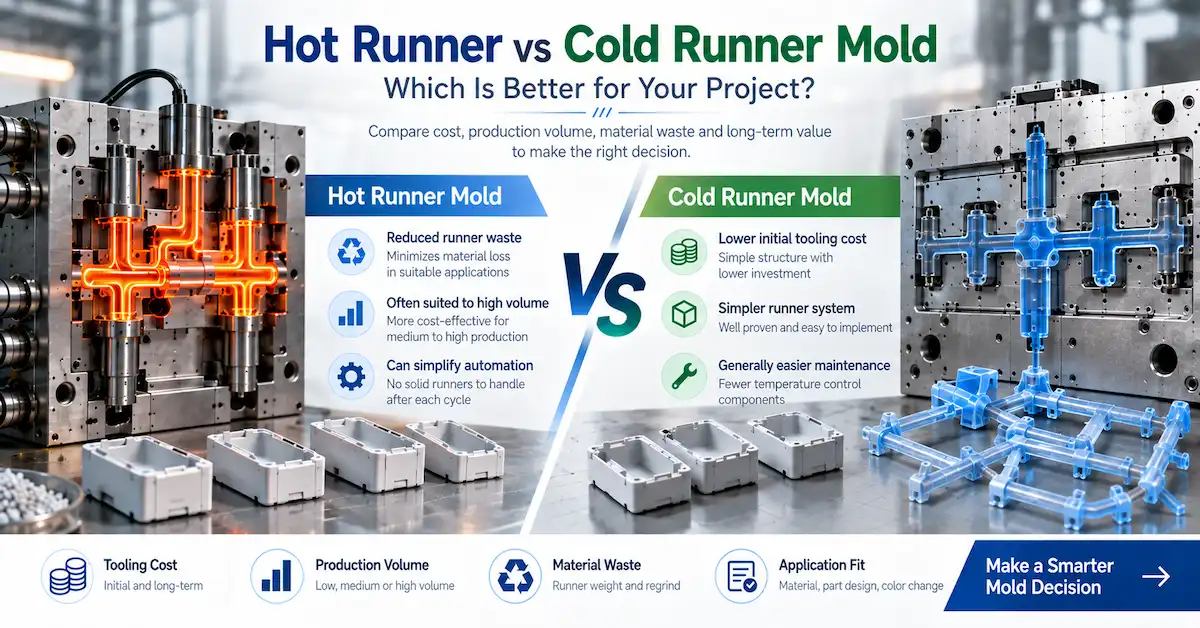
| Runner | Hot runner or cold runner |
| Mold base | Supplier or standard specified |
| Gate system | Type and location |
| Cooling | Cooling-channel strategy |
| Ejection | Pins, sleeves, lifters, sliders, etc. |
| Surface | Polish, texture or other finish |
| Production target | Expected production quantity |
| Spare parts | Included or separately quoted |
| Mold trials | Number and scope clearly defined |
| Inspection | Dimensional and appearance requirements |
| Modification | What corrections are included |
| Mold ownership | Contractually defined |
The goal is not to specify the most expensive mold.
It is to specify the right mold for the actual production requirement.
5. How Should Mold Steel Be Evaluated?
Names such as P20, H13 or S136 frequently appear in tooling quotations.
But buyers should not select an injection mold supplier simply because a familiar steel grade appears on the quotation.
Tool-material decisions should consider factors such as:
- Expected production volume
- Plastic resin
- Glass-fiber or abrasive fillers
- Corrosion risk
- Surface-finish requirement
- Dimensional stability
- Heat-treatment requirement
- Maintenance strategy
- Tooling budget
For example, a low-volume mold for a straightforward consumer part may not require the same tooling strategy as a mold expected to run high volumes of abrasive engineering resin.
Likewise, corrosion resistance may become more important for certain resins or production environments.
A capable injection mold supplier should therefore explain why a particular mold steel is being recommended.
“More expensive steel” does not automatically mean “better mold.”
The correct choice should match the material, production volume, expected tool life and part requirements.
6. Can the Supplier Control Critical Mold Manufacturing Processes?
A mold supplier does not necessarily need to perform every manufacturing operation internally.
However, buyers should understand how critical operations are controlled.
Depending on mold complexity, these processes may include:
- CNC machining
- EDM
- Wire EDM
- Grinding
- Drilling
- Polishing
- Mold fitting
- Assembly
- Trial molding
- Dimensional inspection
For complicated tooling, the most important issue is usually not whether every machine is located in one building.
It is:
Who controls the process, verifies the dimensions and takes responsibility for the finished mold?
If a supplier outsources some work, buyers can ask:
- Who approves the subcontractor?
- How are machined components inspected?
- Who controls drawing revisions?
- Who verifies critical dimensions?
- Who is responsible when a component does not meet specification?
- How are corrective actions documented?
A clear responsibility structure reduces the risk of delays and disputes during mold assembly.
7. How Will the Mold Be Tested Before Approval?
A mold that produces one acceptable sample is not automatically a production-ready mold.
Trial molding should evaluate whether the tooling and process can repeatedly produce acceptable parts.
Depending on the project, mold trials may evaluate:
- Cavity filling
- Flash
- Short shots
- Sink marks
- Weld lines
- Ejection
- Gate condition
- Warpage
- Cosmetic appearance
- Critical dimensions
- Assembly fit
- Functional performance
- Process stability
A structured trial process may progress through stages such as T0, T1 and later trials as the mold is adjusted and optimized.
Define Acceptance Criteria Before Mold Approval
Avoid an approval standard such as:
“The samples look good.”
Instead, define measurable criteria such as:
- Approved drawing revision
- Critical dimensions
- Dimensional tolerances
- Cosmetic standard
- Assembly requirements
- Functional requirements
- Approved resin
- Approved color
- Required sample quantity
- Required inspection documentation
This makes the approval process much less subjective.
It also prevents disagreements about whether a mold is actually ready for mass production.
8. Are Tolerances Defined by Drawings or Marketing Claims?
Be cautious with statements such as:
“We manufacture ultra-high-precision injection molds.”
Precision requires a measurable definition.
ISO 20457 provides a standardized framework relating to dimensional and geometrical tolerances and acceptance conditions for plastic molded parts.
That does not mean every injection molding project must use the same tolerance standard.
It does mean buyers should distinguish between:
general marketing claims about precision
and
specific tolerances defined on controlled engineering drawings.
Before placing a mold order, ask:
- Which dimensions are critical?
- Which tolerances are functional?
- Which dimensions are only reference dimensions?
- How will critical features be measured?
- What inspection equipment is required?
- At what stage will parts be measured?
- What happens if samples are outside the approved tolerance?
Over-specifying tolerances can also increase tooling and production cost unnecessarily.
For many projects, the best approach is to apply tighter tolerances only where they are functionally required.
9. What Quality Documents Can the Injection Mold Supplier Provide?
“Strict quality control” is not enough information for an industrial buyer.
A more useful discussion is:
What will actually be inspected, documented and supplied with the project?
Depending on the product and customer requirements, documents may include:
- Incoming material records
- Mold-component inspection
- First Article Inspection
- Dimensional report
- CMM report
- Mold-trial report
- Process parameters
- Engineering change records
- Final inspection
- Packaging confirmation
A structured quality workflow may include:
Incoming Inspection → Mold Inspection → First Article → In-Process Inspection → Final Inspection → Packaging Inspection → Quality Documentation
For quality-management systems more broadly, ISO 9001 provides an internationally recognized framework for quality management systems.
However, if ISO certification or another certification is a contractual requirement, buyers should verify the supplier's actual certification and scope directly.
A certification logo on a webpage should not replace proper qualification.
10. How Should Injection Mold Quotations Be Compared?
Never compare injection mold quotations only by looking at the total price.
Instead, normalize the specifications.
Injection Mold Supplier Quotation Comparison
| Comparison Item | Supplier A | Supplier B | Supplier C |
|---|---|---|---|
| Mold steel | Check | Check | Check |
| Number of cavities | Check | Check | Check |
| Runner system | Check | Check | Check |
| Mold base | Check | Check | Check |
| Cooling design | Check | Check | Check |
| Production target | Check | Check | Check |
| Critical tolerances | Check | Check | Check |
| Trial scope | Check | Check | Check |
| Inspection reports | Check | Check | Check |
| Spare parts | Check | Check | Check |
| Modification scope | Check | Check | Check |
| Mold packaging | Check | Check | Check |
| Production support | Check | Check | Check |
| Mold ownership | Check | Check | Check |
Only after these items are aligned does the tooling price become meaningful.
A lower quotation may reflect:
- Less expensive tool steel
- A simpler mold structure
- Fewer cavities
- A different runner system
- Fewer mold trials
- Less dimensional inspection
- Fewer spare components
- Different production expectations
- Different acceptance criteria
That does not necessarily make the lower-priced supplier unsuitable.
It simply means the buyer must confirm that the quotations represent equivalent tooling scopes.
For a broader evaluation of factory capability, DFM, tooling strategy and OEM cooperation, buyers can also review our plastic injection mold manufacturer guide.
11. Who Owns the Mold and Engineering Data?
This question is often overlooked during early sourcing.
Before paying a tooling deposit, buyers should clarify:
- Who owns the mold after payment?
- Can the mold be transferred to another factory?
- Who owns the mold drawings?
- Will 2D or 3D mold data be supplied?
- Is a mold BOM available?
- Are spare-part drawings available?
- Can another factory maintain the tool?
- How are engineering changes documented?
- How is an inactive mold stored?
- How long will the mold be stored?
These terms become especially important if production may later move to another injection molding facility.
For Export Molds, Also Confirm
- Mold packaging
- Anti-rust protection
- Lifting provisions
- Cooling connectors
- Mold-base standards
- Electrical connectors
- Hot-runner specifications
- Spare components
- Target molding-machine requirements
- Documentation supplied with the mold
A transferable mold should be designed not only to work at the original supplier's facility, but also to be understandable and maintainable after relocation.
12. Can the Supplier Support the Mold After the First Sample?
Tool approval is not always the end of the project.
During later production, parts may require:
- Dimensional adjustment
- Appearance improvement
- Cycle-time optimization
- Gate modification
- Ejection improvement
- Product design changes
- New inserts
- Replacement components
- Mold repair
- Preventive maintenance
- Refurbishment
- Production transfer
For that reason, supplier selection should consider the expected tooling lifecycle, not only the first T1 sample.
For long-running OEM programs, the ability to maintain and modify a mold may ultimately be more important than a small difference in initial tooling price.
A Practical Injection Mold Supplier Scorecard
Procurement teams can make the selection process more objective by using a weighted supplier scorecard.
| Evaluation Area | Suggested Weight |
|---|---|
| DFM & engineering | 20% |
| Mold design capability | 15% |
| Machining & manufacturing | 15% |
| Quality & inspection | 15% |
| Trial and validation | 10% |
| Technical communication | 10% |
| Cost transparency | 5% |
| Lead-time management | 5% |
| After-sales support | 5% |
| Total | 100% |
These weights are not universal.
For example, an automotive functional component may place greater weight on:
- engineering,
- process validation,
- dimensional control,
- and production consistency.
A simple low-volume consumer part may place greater weight on:
- tooling cost,
- flexibility,
- and lead time.
The purpose of a scorecard is not to produce a universal “best supplier.”
It is to make the buying team define what matters for the specific project.
Common Red Flags When Evaluating an Injection Mold Supplier
Red Flag 1: Quoting With Almost No Technical Questions
Fast quoting is useful.
Uninformed quoting is not.
If the supplier has not discussed resin, tolerances, quantity or product structure, ask which assumptions are included in the quotation.
Red Flag 2: DFM Feedback Comes After Tooling Starts
Important manufacturability issues should ideally be discussed before steel machining begins.
Changes become more expensive after the mold has already entered production.
Red Flag 3: The Supplier Cannot Explain the Tool Specification
A supplier should be able to explain why it selected:
- a particular mold steel,
- cavity number,
- gate type,
- runner system,
- ejection strategy,
- cooling layout,
- or slider/lifter structure.
If the supplier cannot explain these choices, the buyer has limited visibility into what is actually being purchased.
Red Flag 4: Acceptance Criteria Are Undefined
“High quality” is not an acceptance standard.
Use:
- controlled drawings,
- measurable tolerances,
- approved samples,
- cosmetic standards,
- assembly requirements,
- and documented inspection methods.
Red Flag 5: Mold Ownership Is Not Written Down
Do not wait until a future mold-transfer dispute to discuss ownership.
Define tooling ownership and engineering-data rights before placing the order.
For a broader discussion of mold partner selection and supplier reliability, see our injection mold manufacturer guide.
What Should You Send to an Injection Mold Supplier for an Accurate Quote?
A strong RFQ package normally contains:
- 3D CAD or STEP file
- 2D drawing
- Plastic resin or material requirement
- Estimated annual quantity
- Initial production quantity
- Critical dimensions and tolerances
- Surface-finish requirements
- Color requirements
- Assembly information
- Application environment
- Expected production target
- Project schedule
- Inspection-document requirements
- Any applicable compliance or certification requirements
If some information is not yet available, tell the supplier.
Do not invent specifications simply to complete the RFQ.
A competent engineering team should identify which unknowns affect mold design and which can be finalized later.
When Does an Integrated Mold and Molding Supplier Make Sense?
Some buyers only need an export mold because they already operate their own injection molding factory.
Others prefer one supplier to manage:
DFM → Tooling → Sampling → Injection Molding → Inspection → Delivery
An integrated approach can make sense when:
- The buyer does not operate its own molding facility
- Mold and molding-process optimization need to happen together
- The project requires multiple engineering iterations
- One team needs to be responsible for tooling and molded-part quality
- The product is moving directly from development into production
- The buyer wants fewer handoffs between mold maker and molder
DongXin supports plastic and silicone molding projects that can include engineering review, custom tooling, mold trials and subsequent molded-part production.
For some buyers, keeping tooling and molding under one project-management structure can reduce communication gaps between the mold-building stage and the production stage.
For other buyers, an export mold remains the better solution.
The right model depends on where the mold will ultimately run and who will be responsible for production.
FAQ About Choosing an Injection Mold Supplier
How do I choose a reliable injection mold supplier?
Start with engineering capability rather than price alone.
Evaluate the supplier's DFM capability, mold-design approach, tooling specification, machining control, inspection, mold trials, technical communication, quotation transparency, mold ownership terms and after-sales support.
Compare prices only after confirming that the suppliers are quoting comparable tooling scopes.
What information does an injection mold supplier need for a quotation?
Ideally, provide:
- 3D model
- 2D drawing
- Material requirement
- Expected annual quantity
- Critical tolerances
- Surface finish
- Color
- Assembly requirements
- Application conditions
- Production target
Better technical inputs usually lead to a more meaningful tooling quotation.
Should I choose the cheapest injection mold supplier?
Not automatically.
A cheaper mold may use different steel, fewer cavities, a different runner system, fewer trials or a different expected production target.
Compare the complete technical specification and lifecycle risk rather than the tooling price alone.
Should I request DFM before mold manufacturing?
Yes, especially for custom plastic parts.
DFM can identify potential problems involving:
- wall thickness,
- draft,
- undercuts,
- parting lines,
- gates,
- ejection,
- sink marks,
- warpage,
- and assembly.
Finding these issues before machining is generally easier than correcting them after mold construction.
Does every injection mold project need mold flow analysis?
No.
Mold flow analysis is more useful when filling, cooling, warpage, weld lines, gate location or cavity balance creates significant engineering risk.
A supplier should be able to explain why simulation is or is not necessary for the specific part.
What should be checked during an injection mold trial?
Depending on the project, review:
- filling,
- flash,
- short shots,
- sink marks,
- warpage,
- weld lines,
- ejection,
- appearance,
- critical dimensions,
- assembly fit,
- and molding stability.
Approval should be based on agreed acceptance criteria rather than appearance alone.
Who should own the injection mold?
Mold ownership should be clearly stated in the purchasing agreement.
Buyers should also clarify rights to:
- mold drawings,
- CAD data,
- BOMs,
- spare-part drawings,
- modification records,
- and future mold transfer.
This is especially important for long-term OEM programs.
Conclusion
Selecting an injection mold supplier is both an engineering decision and a supply-chain decision.
The strongest supplier is not necessarily the company with the lowest tooling quotation, the largest equipment list or the most aggressive sales promise.
A more useful evaluation asks whether the supplier's:
- DFM process,
- mold specification,
- tooling materials,
- machining control,
- trial procedure,
- dimensional inspection,
- quality documentation,
- commercial responsibilities,
- mold ownership terms,
- and long-term support
match the actual requirements of the project.
Before awarding a tooling order, confirm:
DFM responsibility → mold specification → steel and cavity strategy → machining → trials → tolerances → inspection → quotation scope → ownership → maintenance → engineering changes → production support.
Resolving these issues before tooling begins can prevent much larger technical and commercial disagreements after the mold has already been manufactured.
If you are preparing a new plastic injection mold project, you can submit your technical requirements to DongXin for project review and tooling discussion.