What Is a Custom Mold Development Service?
A custom mold development service is the engineering and manufacturing process that turns a proprietary product design, sample or early concept into tooling capable of producing repeatable molded parts. It normally begins before CNC machining and continues through DFM, mold design, manufacturing, trial molding, inspection, corrections and production approval.
For an OEM buyer, this distinction matters. Ordering a mold as if it were a standard catalog item can leave important questions unresolved: Is the part ready to tool? Which dimensions control assembly? Will an undercut require a slide? Is the proposed resin final? How many cavities make sense for the expected volume? What exactly must pass before the mold is considered approved?
DX Molding’s current custom manufacturing services cover industrial and mechanical design support, custom plastic molds, OEM/ODM product development, prototyping and manufacturing, with engineering review before tooling.
A useful mold-development program therefore connects:
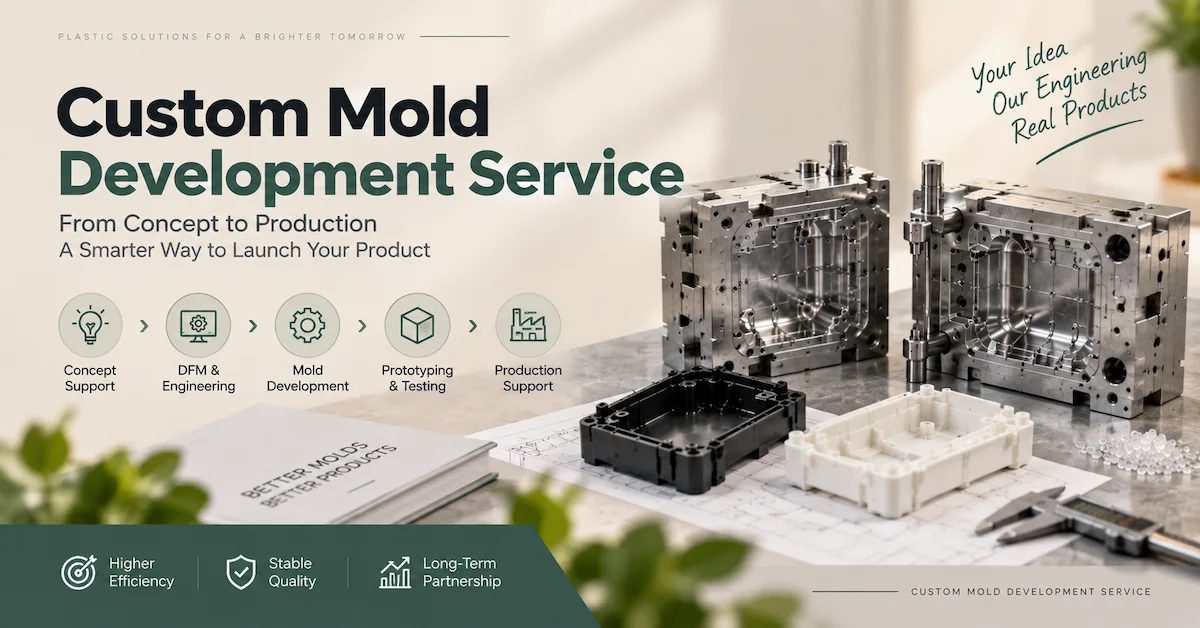
Product requirement → DFM → Development plan → Mold design → Tool manufacturing → Trial validation → Production release
The objective is not merely to finish a steel tool. It is to reduce uncertainty at each stage before more money and time are committed.
Who Needs Custom Mold Development—and Who May Not Be Ready Yet?
A custom mold development service is useful for OEM brands, product developers, electronics companies, appliance manufacturers, industrial-equipment companies and contract manufacturers creating proprietary plastic parts.
Typical starting points include a finished CAD design, an engineering prototype, a physical reference sample, an existing part that needs redesign or an early concept requiring mechanical-development support.
Not every project should immediately move into production tooling. If the basic product architecture is still changing, a development or prototype stage may be more appropriate.
For example, tooling may be premature when:
- PCB or connector locations are not finalized.
- Mating components are still being selected.
- Product dimensions change frequently.
- The intended resin has not been evaluated.
- Important functional tests have not been completed.
- Expected production volume is still too uncertain to define tooling strategy.
DX Molding states that buyers can submit 2D/3D drawings, physical samples, sketches, reference photos, material requirements, target quantity and finish or tolerance requirements for review.
The first useful output should therefore be a development decision, not automatically a mold purchase order.
Start With the Product Requirement, Not With a Mold Specification
A common sourcing mistake is beginning the discussion with mold terminology:
“We need a two-cavity hot-runner mold with S136.”
That may eventually be the correct solution, but it does not explain the product problem being solved.
A better product-development brief states:
- What the component does.
- Where it is used.
- Which surfaces customers see.
- Which other parts it connects to.
- Which dimensions affect function.
- What production volume is expected.
- What requirements cannot change.
- What remains open to engineering review.
Imagine an electronics housing with a PCB, USB opening, internal screw bosses and a visible exterior surface. The mold-development team needs to understand the complete assembly, not simply the outside dimensions of the housing.
This is where a custom mold development service adds more value than stand-alone machining. The supplier can evaluate the relationship between product geometry and tooling before manufacturing begins.
Build a Controlled Mold Development Specification
A useful project specification separates confirmed inputs from supplier proposals and unresolved decisions.
The following table can be used as an OEM development checklist. It is not a list of universal DX Molding specifications.
| Development Area | Buyer Input | Required Decision or Output |
|---|---|---|
| Product definition | Current 3D CAD, 2D drawing or sample | Controlled product revision |
| Application | Function, assembly and operating environment | Engineering priorities |
| Resin | Approved grade or candidate requirements | Material direction |
| Critical dimensions | Functional dimensions, datums and tolerances | Inspection plan |
| Cosmetic surfaces | Visible areas, texture and finish | Gate, parting and ejection restrictions |
| Mating parts | PCB, fasteners, connectors, frames or covers | Assembly-validation plan |
| Volume | Pilot quantity, annual forecast and program life | Cavity and tooling strategy |
| Mold destination | Supplier production or buyer's factory | Machine and handover requirements |
| Quality | Dimensional, appearance and functional requirements | Trial acceptance plan |
| Documentation | DFM, mold drawings, reports and BOM needs | Project-delivery scope |
Unknown information should remain visible.
Writing “resin under review” is more useful than adding an arbitrary material simply to complete a quotation form.
That distinction also makes later engineering changes easier to control.
Use DFM as the First Engineering Checkpoint
DFM—Design for Manufacturing—should occur before detailed mold manufacturing begins.
DX Molding’s support information describes DFM work involving draft angles, wall thickness, radii, undercuts, assembly interference, sink and warpage risk, alongside gate and molding-risk analysis.
For an OEM buyer, the DFM review should answer practical questions.
Can the Part Release From the Mold?
Draft, undercuts and the intended mold-opening direction should be reviewed together.
A side hole may require a slide. An internal hook may require a lifter. Another feature might be redesigned to avoid unnecessary tooling complexity.
Can the Part Be Molded Without Creating Avoidable Cosmetic Risk?
Ribs and bosses can affect the surface behind them. Wall-thickness transitions may affect sink or dimensional behavior.
Visible surfaces should therefore be identified before mold structure is frozen.
Can the Part Assemble as Intended?
A dimension can be individually correct while the complete assembly still fails.
Provide relevant mating components or controlled CAD data whenever possible.
A strong custom mold development service should turn these observations into specific recommendations rather than simply marking areas as “risk.”
Decide Whether Prototype Validation Is Needed Before Production Tooling
Not every project needs another prototype stage, but prototypes can be valuable when important product decisions remain open.
A prototype may help a buyer evaluate:
- Overall size.
- Mechanical fit.
- Assembly sequence.
- Ergonomics.
- Component placement.
- Visible proportions.
- Selected functional features.
However, prototype performance should not automatically be treated as proof of injection-molding performance. Prototype materials and processes may behave differently from molded production resin.
DX Molding’s services include rapid prototype validation within its OEM/ODM development scope.
Use prototyping to answer specific questions. Do not add it simply because a standard project template includes a prototype stage.
Convert the Approved Product Into a Mold Design
After DFM and required product revisions are approved, development moves from the plastic part into the actual tooling structure.
The mold designer must determine:
- Cavity and core construction.
- Parting direction.
- Gate location.
- Runner layout.
- Ejection system.
- Cooling arrangement.
- Slides and lifters.
- Replaceable inserts.
- Mold steel.
- Machine interfaces.
DX Molding’s injection mold design guide emphasizes reviewing these decisions before steel cutting.
Parting Lines
The proposed parting line should be shown on the finished product model, particularly when appearance matters.
Gate Strategy
Gate design should consider filling, appearance, trimming and the selected runner system.
Cooling
Cooling should be evaluated in relation to part geometry and expected production rather than simply by counting cooling channels.
Ejection
Ejector marks and forces should be considered against cosmetic and functional surfaces.
The buyer does not need to become a mold designer. The buyer does need enough information to understand what is being approved.
Customize the Tooling Strategy Around Real Production Volume
There is rarely one universally correct mold configuration.
The appropriate development route depends partly on realistic production demand.
| Tooling Route | Potential Advantage | Main Trade-Off | Typical Development Situation |
|---|---|---|---|
| Single-cavity production mold | Lower initial complexity | Lower output | New product or moderate volume |
| Multi-cavity mold | Higher output | More balancing and validation work | Stable repeat demand |
| Cold-runner tooling | Relatively straightforward where suitable | Runner handling and material usage | Cost-sensitive suitable projects |
| Hot-runner tooling | Can reduce cold-runner waste in suitable programs | Added control and maintenance | Higher-volume production |
| Replaceable inserts | Easier local repair or selected changes | Additional precision interfaces | Wear areas or controlled variants |
| Complex slide/lifter mold | Enables necessary undercuts | Higher tooling and maintenance complexity | Products with side or internal features |
This is why the target quantity belongs in the first project review.
A tool designed around 5,000 parts should not automatically use the same strategy as a product expected to require 500,000 parts per year.
DX Molding’s current custom-mold services cover single- and multi-cavity, hot- and cold-runner and project-specific tooling approaches.
Select Resin and Tooling Materials as Separate Decisions
Product resin and mold steel solve different problems and should not be confused.
The molded product material should be evaluated around requirements such as function, appearance, environment, assembly and customer-specific compliance needs.
The tool itself needs materials selected around production quantity, molded resin, wear, finish and maintenance.
Do not ask for “the best steel” without defining the expected production program.
Similarly, avoid leaving the production resin undefined until the final trial. Resin behavior influences shrinkage, filling, cooling and other engineering assumptions used during mold development.
Material changes late in a project can therefore require new evaluation.
Build Trial Molding Into the Development Service
A custom mold development service is not complete when machining ends.
The first physical samples are where design and manufacturing assumptions begin to meet real molding conditions.
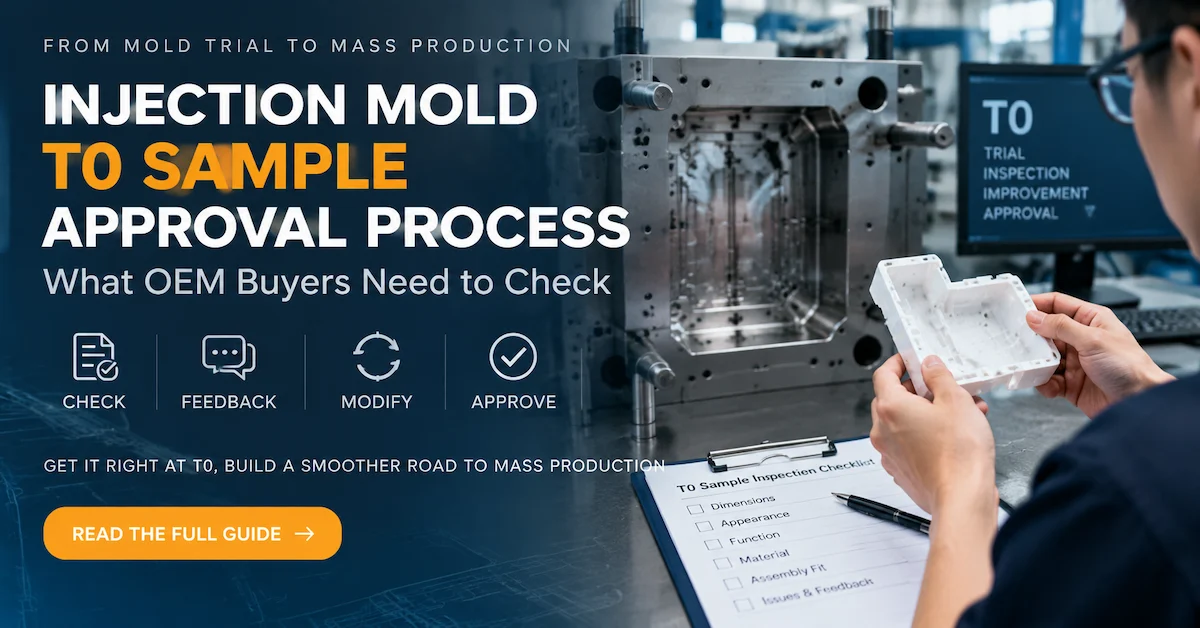
DX Molding’s published workflow includes trial molding, dimensional inspection, sample approval and subsequent optimization, while its support information describes T0/T1 stages and production-control checkpoints.
A structured trial review should identify:
- Mold revision.
- Product drawing revision.
- Resin.
- Active cavity.
- Relevant process conditions.
- Dimensional results.
- Appearance observations.
- Assembly results.
- Open defects.
- Proposed modification.
- Objective of the next trial.
“Sample looks better” is not enough.
A better record says which issue changed and whether the new result meets the approved requirement.
Approve the Product in More Than One Dimension
OEM buyers should avoid reducing sample approval to one statement such as “sample approved.”
Separate the decision where appropriate.
Dimensional Approval
Have agreed critical dimensions passed?
Assembly Approval
Does the molded component fit the actual mating system?
Cosmetic Approval
Are visible surfaces, gate evidence, texture, parting lines and other agreed features acceptable?
Tooling Approval
Are slides, ejection and other mechanisms operating as intended?
Production Readiness
Has the approved result been reproduced under an agreed production-representative condition?
This distinction becomes especially useful if one element is approved while another remains open.
A cosmetic sign-off should not silently approve an unresolved functional dimension.
How Should Quality Documentation Fit Into Mold Development?
Quality records should support actual project decisions.
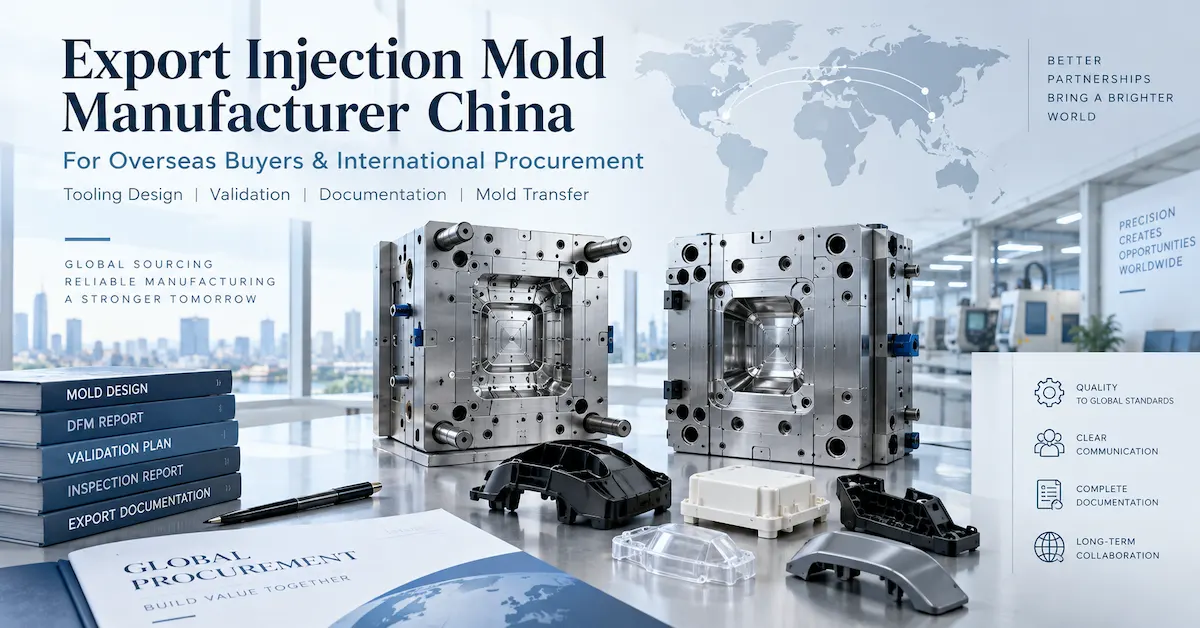
Depending on the part, buyers may need:
- Dimensional reports.
- Mold-trial records.
- Material information.
- Appearance inspection.
- Assembly results.
- Modification records.
- Approved sample identification.
- Process information.
- Final tooling records.
DX Molding’s production and quality support describes support from DFM and mold preparation through sampling, production control, inspection and delivery.
Do not request documents simply because another sourcing project used them. Identify what evidence is necessary to approve your particular component.
Likewise, do not assume that a company certification automatically establishes suitability of every molded product. Product-specific requirements still need to be defined and verified separately.
Plan Mold Development Lead Time by Milestones
Asking “How long does mold development take?” without defining the project stage usually produces a weak answer.
A better project schedule separates:
- Requirements and file review.
- DFM.
- Buyer product revision.
- Development-plan approval.
- Mold design.
- Mold-design approval.
- Machining and component preparation.
- Fitting and assembly.
- Initial trial.
- Measurement and assembly review.
- Mold correction.
- Additional trial where required.
- Final approval.
- Production or tool shipment.
DX Molding’s published workflow similarly separates requirements review, DFM and risk assessment, quotation and production planning, mold manufacture, trial approval and mass production.
This milestone approach makes delays easier to diagnose.
A late CAD revision should not be recorded as machining delay, and a customer sample-review delay should not be confused with toolmaking time.
How Much Does a Custom Mold Development Service Cost?
There is no useful standard price without product information.
Development cost can be influenced by:
- Product-design support.
- Prototype requirements.
- DFM complexity.
- Mold design.
- Cavity count.
- Tool steel.
- Hot-runner components.
- Slides and lifters.
- Precision inserts.
- Surface finish.
- Inspection.
- Number of trial cycles.
- Customer engineering changes.
- Final production arrangement.
This is why two suppliers can provide different quotations for apparently the same CAD file.
They may not be quoting the same development scope.
A useful commercial comparison asks:
What is included before steel cutting?
What is included during trials?
Which corrections are included?
What counts as a customer design change?
Which documents are delivered?
Does the quotation include part production or only tooling?
Comparing scope before comparing totals reduces the chance of a lower initial price becoming a more expensive project later.
How Should OEM and ODM Development Responsibilities Be Divided?
For a mature OEM project, the customer may already control the product design and only need manufacturability review and tooling development.
An ODM or early-stage project can require more manufacturer participation in industrial design, mechanical structure and prototypes.
DX Molding’s current service page explicitly separates ID/MD support, custom plastic molds and OEM/ODM product development, including early concepts and mold-ready engineering.
Before starting, define who approves:
- Product appearance.
- Mechanical structure.
- Material.
- Critical dimensions.
- DFM changes.
- Prototype.
- Tooling design.
- Engineering changes.
- Molded samples.
- Production release.
A phrase such as “one-stop development” should not replace these responsibilities.
What Should You Send for a Custom Mold Development Review?
You can begin with a complete technical package or, for an earlier project, with enough information to identify the next engineering decision.
Useful inputs include:
- 3D CAD.
- 2D drawings.
- Physical reference sample.
- Material requirement.
- Intended product use.
- Mating-component information.
- Critical dimensions.
- Cosmetic requirements.
- Launch quantity.
- Annual forecast.
- Target project milestone.
- Known product problems.
Also identify what remains undecided.
For example:
“The enclosure geometry is released, but the snap design is still open.”
“We have a prototype, but the production resin has not been finalized.”
“The first order is 5,000 units; annual demand could grow significantly.”
These statements help a custom mold development service recommend the right next stage rather than treating an early concept as production-ready.
Send DX Molding your drawings, samples or early product concept for a project-specific manufacturability and tooling review.
Frequently Asked Questions
1. What Is Included in a Custom Mold Development Service?
The scope can include product review, DFM, mechanical optimization, prototype support, mold design, machining, assembly, mold trials, sample inspection, corrections and production preparation. The exact deliverables should be defined before the project begins.
2. Do I Need a Finished CAD Design Before Starting Mold Development?
Not always. Early concepts, drawings or samples can be reviewed before production tooling. However, a production mold should normally not be frozen until important geometry, material and functional requirements are sufficiently controlled.
3. What Is the Difference Between Mold Development and Mold Manufacturing?
Mold manufacturing focuses on producing the physical tool. Mold development is broader: it includes engineering decisions before machining and validation after the tool is built.
4. Why Is DFM Important in Custom Mold Development?
DFM identifies potential manufacturing risks such as draft, wall thickness, undercuts, assembly interference, sink or warpage before expensive tooling work progresses too far.
5. Can DX Molding Support Product Development Before Tooling?
Yes. DX Molding lists industrial design, mechanical structure, product review, prototype validation and OEM/ODM development within its current service scope. The actual project deliverables should be confirmed for the specific product.
6. How Many Mold Trials Are Needed?
There is no universal number. Trial count depends on product complexity, tooling results, sample feedback and engineering changes. Define what each trial needs to demonstrate rather than purchasing an arbitrary number of trials.
7. Can the Mold Be Changed After the First Trial?
Yes, many tools can be modified. The appropriate change depends on the defect, mold construction and whether the underlying cause is tooling, process or product design. Buyer-requested product revisions should be separated from supplier corrections.
8. How Do I Know When the Mold Is Ready for Production?
Use predefined dimensional, appearance, assembly and tooling criteria. Where appropriate, confirm results during a production-representative run rather than approving the mold from one selected sample.
9. Can DX Molding Build the Tool and Produce the Finished Plastic Parts?
Yes. DX Molding provides custom tooling as well as plastic molding services. Define whether the tool stays for ongoing production or will eventually transfer to another molding factory.
10. How Can I Get a More Accurate Mold Development Quote?
Provide the current product files, resin or material requirements, quantity forecast, critical dimensions, assembly information, appearance requirements and intended production arrangement. Clearly identify unresolved decisions so the quotation does not depend on hidden assumptions.
Conclusion
A custom mold development service should provide a controlled route from product idea to production tooling, not simply a quotation followed by machining.
For OEM buyers, the most useful sequence is:
Product requirement → Engineering review → DFM → Prototype if needed → Mold strategy → Mold design → Manufacturing → Trial → Validation → Production release
Each stage should answer a specific question before the project moves forward. That makes changes easier to manage, quotations easier to compare and production requirements easier to preserve after the first samples are approved.
DX Molding supports custom plastic mold development from drawings, physical samples or early product concepts through engineering review, tooling, trial molding and production support. Send DX Molding your CAD files, target quantity, material requirements and open engineering questions to start a project-specific custom mold development review.