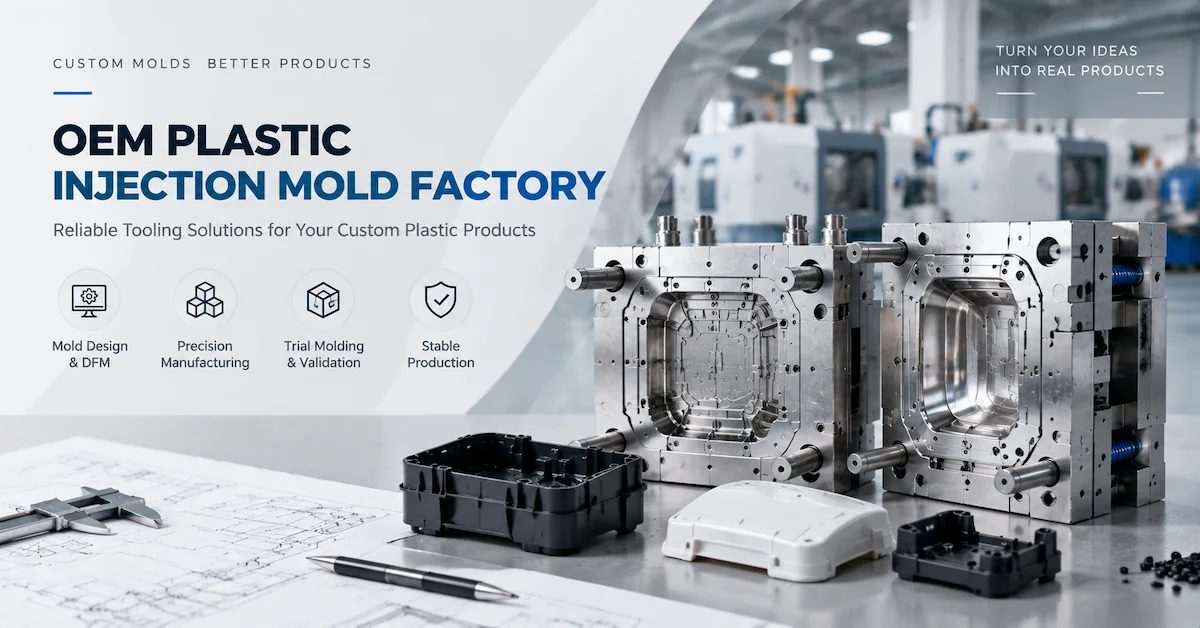
What Is an OEM Plastic Injection Mold Factory?
An OEM plastic injection mold factory is a manufacturing partner that develops and produces custom injection molds based on a buyer’s product requirements, drawings or specifications.
Unlike a standard mold supplier that only focuses on machining a tool, an OEM mold factory typically supports a wider manufacturing process:
- Product manufacturability review.
- DFM analysis.
- Mold design.
- Tool manufacturing.
- Trial molding.
- Sample validation.
- Injection molding production.
- Quality control.
- Engineering change management.
For global OEM buyers, the value of a mold factory is not only the ability to produce steel tooling. The supplier also needs to understand how the mold will perform during actual production.
A successful OEM mold project connects:
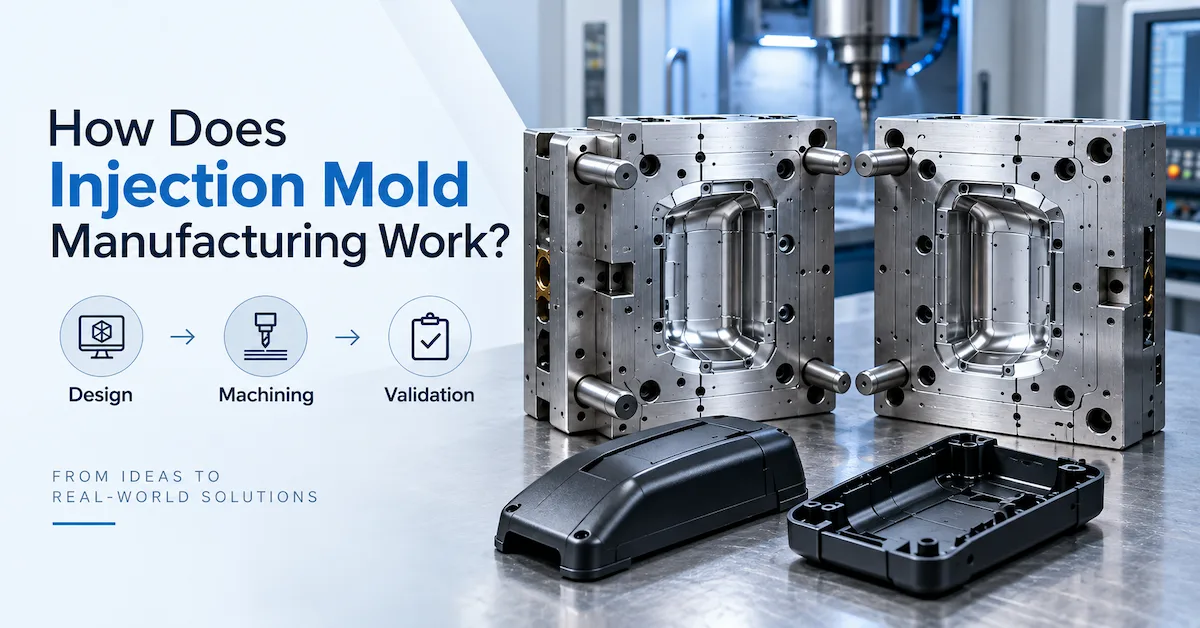
Product Design → Mold Engineering → Tool Manufacturing → Trial Validation → Mass Production
DX Molding provides custom injection mold manufacturing services, supporting OEM projects through engineering review, mold development, tooling production and plastic-part manufacturing.
For buyers, the key question is:
Can this factory support the complete product journey instead of only manufacturing a mold?
Who Should Work With an OEM Plastic Injection Mold Factory?
An OEM mold factory is suitable for companies developing customized plastic components that require their own product design and manufacturing solution.
Consumer Product Brands
Consumer brands often require:
- Custom product shapes.
- Unique housings.
- Appearance-controlled surfaces.
- Multiple plastic components.
- Stable repeat production.
For these projects, the mold factory needs to balance appearance, function and manufacturing cost.
Electronics Companies
Electronic products often include:
- PCB supports.
- Connector openings.
- Internal mounting structures.
- Precision assembly features.
The mold supplier must understand the relationship between plastic parts and electronic components.
Appliance Manufacturers
Appliance components may require:
- Large plastic structures.
- Heat-resistant materials.
- Long production life.
- Consistent appearance.
Industrial Equipment Companies
Industrial OEM projects often focus on:
- Mechanical strength.
- Dimensional stability.
- Functional reliability.
- Long-term supply.
Product Development Companies and Startups
Startups may need additional engineering support because:
- Product design is still evolving.
- Production volume is uncertain.
- Manufacturing experience is limited.
A capable OEM plastic injection mold factory can help identify whether a product is ready for production tooling.
What Should Buyers Confirm Before Choosing an OEM Mold Factory?
Before selecting a supplier, buyers should evaluate several areas.
| Evaluation Area | Buyer Questions |
|---|---|
| Engineering capability | Can the factory review product design and provide DFM suggestions? |
| Mold design | Can they explain tooling structure decisions? |
| Manufacturing process | What equipment and processes are available? |
| Quality system | How are molds and molded parts inspected? |
| Trial process | How are samples evaluated and approved? |
| Production support | Can they support repeat manufacturing? |
| Communication | Are engineering changes documented? |
| Documentation | Are drawings and records provided? |
A reliable factory should be able to explain not only what solution is proposed but also why it is suitable.
Prepare Product Information Before Contacting a Mold Factory
A common mistake in OEM sourcing is contacting factories before the product requirements are clear.
A professional inquiry should include:
| Information | Details |
|---|---|
| Product files | 3D CAD models and drawings |
| Application | Product usage and environment |
| Material | Required plastic resin or performance requirements |
| Quantity | Initial order and annual forecast |
| Assembly | Related components and interfaces |
| Appearance | Surface finish and cosmetic requirements |
| Precision | Critical dimensions and tolerances |
| Production location | Factory or customer production site |
| Timeline | Launch requirements |
A complete project brief helps the OEM plastic injection mold factory evaluate:
- Mold complexity.
- Production requirements.
- Tooling strategy.
- Expected investment.
- Potential risks.
A weak request:
“Please quote an injection mold.”
A useful request:
“We need a plastic enclosure mold for an electronic device. The part requires PCB mounting structures, visible surfaces, ABS material and annual production of 100,000 units.”
The second request creates a much more accurate engineering discussion.
How Does DFM Improve OEM Mold Projects?
DFM (Design for Manufacturing) is one of the most important steps before mold production.
The purpose of DFM is to identify problems before steel machining begins.
DX Molding’s support information includes manufacturability review related to:
- Draft angles.
- Wall thickness.
- Ribs.
- Bosses.
- Undercuts.
- Assembly interference.
- Sink marks.
- Warpage risks.
- Gate considerations.
Review Product Geometry Before Mold Design
Wall Thickness
Wall thickness affects:
- Filling behavior.
- Cooling.
- Shrinkage.
- Surface appearance.
- Dimensional stability.
An OEM plastic injection mold factory should review whether wall changes are needed before tooling.
Ribs and Bosses
Ribs and bosses improve structural strength but may create:
- Sink marks.
- Uneven cooling.
- Cosmetic issues.
The supplier should evaluate their relationship with visible surfaces.
Draft Angle
Draft helps the molded part release from the mold.
Insufficient draft may cause:
- Surface damage.
- Ejection problems.
- Higher production risk.
Undercuts
Undercuts may require:
- Slides.
- Lifters.
- Inserts.
- Special tooling structures.
The supplier should explain whether the feature is necessary or whether product redesign can simplify the mold.
How Does an OEM Plastic Injection Mold Factory Develop a Production Mold?
A professional OEM plastic injection mold factory follows a structured development process to convert a product design into a production-ready tool.
The process normally includes:
- Product requirement review.
- DFM analysis.
- Mold design.
- Tool manufacturing.
- Mold assembly.
- Trial molding.
- Sample inspection.
- Engineering correction.
- Final approval.
- Production support.
Each stage affects the final result.
A problem discovered during DFM may be solved quickly.
A problem discovered after mold manufacturing may require additional cost and time.
Therefore, experienced OEM buyers usually focus on preventing problems before tooling begins.
What Happens During the Mold Design Stage?
After product requirements and DFM approval, the factory develops the mold structure.
Important design decisions include:
Cavity and Core Design
The cavity and core determine the final shape of the molded part.
The design needs to consider:
- Product geometry.
- Plastic shrinkage.
- Draft requirements.
- Surface finish.
- Ejection direction.
- Production quantity.
A good mold design should balance product requirements with manufacturing efficiency.
Parting Line Design
The parting line determines how the mold separates.
The location affects:
- Product appearance.
- Flash control.
- Mold complexity.
- Maintenance.
For visible consumer products, the parting line should be carefully reviewed before tooling approval.
Gate Design
Gate location influences:
- Material flow.
- Weld lines.
- Appearance.
- Filling balance.
- Trimming requirements.
The best gate location depends on:
- Part geometry.
- Material.
- Cosmetic requirements.
- Production strategy.
Cooling System Design
Cooling directly influences:
- Cycle time.
- Dimensional stability.
- Warpage control.
An OEM plastic injection mold factory should consider cooling together with product geometry instead of treating it as a secondary detail.
Ejection System Design
The ejection system removes the molded part after cooling.
The design should prevent:
- Part deformation.
- Stress marks.
- Surface damage.
Ejector locations should be reviewed according to product appearance and function.
DX Molding provides injection mold design support, helping OEM buyers evaluate tooling structure and manufacturing requirements.
How Should Buyers Evaluate Mold Materials and Tool Steel?
Tool material selection affects:
- Mold life.
- Surface quality.
- Maintenance requirements.
- Production stability.
An OEM mold factory should recommend materials according to the actual project instead of applying one material to every product.
Important considerations include:
| Factor | Influence on Tool Material |
|---|---|
| Production volume | Higher volume may require longer-life tooling |
| Plastic resin | Some materials create higher wear |
| Surface finish | Cosmetic parts may need specific finishing capability |
| Corrosion conditions | Certain applications require additional protection |
| Maintenance plan | Replaceable components may be preferred |
DX Molding lists mold steel options including P20, H13 and S136 within its injection mold capabilities. The suitable choice depends on the project requirements, production quantity and application conditions. (dxmolding.com)
The objective is not selecting the most expensive material.
The objective is selecting the appropriate material for the expected production program.
How Does Injection Molding Production Support Add Value?
Some OEM buyers only need tooling.
Others require a supplier that can continue producing plastic parts after mold approval.
A factory that supports both tooling and production can help reduce communication between multiple suppliers.
Production support may include:
- Mold testing.
- Process adjustment.
- Part inspection.
- Repeat production.
- Packaging support.
- Engineering change management.
DX Molding provides plastic injection molding services for OEM customers requiring molded-part production after tooling development.
For buyers, the decision depends on their manufacturing strategy.
Tool Only Model
Suitable when:
- Buyer owns molding equipment.
- Production stays at another factory.
- The buyer needs mold ownership and transfer.
Tool + Production Model
Suitable when:
- Buyer wants one supplier.
- Faster communication is important.
- Supplier-managed production is preferred.
Neither model is universally better.
The correct choice depends on supply-chain requirements.
How Does Quality Control Work in an OEM Mold Factory?
Quality control should cover the complete project, not only final inspection.
A structured quality process may include:
Incoming Material Inspection
Check:
- Steel materials.
- Mold components.
- Plastic materials.
Mold Manufacturing Inspection
Review:
- Machining accuracy.
- Component fitting.
- Surface finish.
- Assembly quality.
Trial Inspection
Evaluate:
- Dimensions.
- Appearance.
- Assembly.
- Mold operation.
Production Quality Control
Monitor:
- Process stability.
- Part consistency.
- Repeat order quality.
DX Molding’s support process includes engineering review, mold inspection, trial support and production assistance. (dxmolding.com)
A reliable OEM plastic injection mold factory should create traceable records from:
Product drawing → Mold revision → Trial sample → Production approval
How Should OEM Buyers Review Mold Trials?
A mold trial is an important project checkpoint.
The purpose is not only producing a sample.
The purpose is verifying whether the tooling solution works.
During trial evaluation, buyers should review:
| Trial Area | Review Point |
|---|---|
| Dimensions | Critical specifications |
| Appearance | Surface defects and cosmetic quality |
| Assembly | Product fit and function |
| Mold operation | Ejection and movement |
| Process stability | Repeatable molding conditions |
Important trial information includes:
- Mold version.
- Product revision.
- Material.
- Machine.
- Test result.
- Required improvements.
A good trial report helps both sides understand what has been approved and what still needs improvement.
How Should Buyers Compare OEM Plastic Injection Mold Factories?
Choosing a supplier only by quotation price can create unnecessary risk.
A complete evaluation should include:
| Evaluation Factor | Questions |
|---|---|
| Engineering | Can they provide DFM recommendations? |
| Tooling capability | Can they handle required mold structures? |
| Manufacturing | Are processes and equipment suitable? |
| Quality | How are samples and production inspected? |
| Communication | Are changes controlled? |
| Delivery | Are milestones clearly managed? |
| Support | Can they assist after delivery? |
A reliable supplier should explain:
- Why a mold structure is selected.
- Why a material is recommended.
- How risks are controlled.
- How production will be supported.
A low quotation without clear scope may create additional cost later.
How Much Does an OEM Plastic Injection Mold Factory Project Cost?
The cost of an OEM mold project depends on the complete manufacturing scope rather than only the size of the mold.
Important cost factors include:
| Cost Factor | How It Influences the Project |
|---|---|
| Product complexity | Complex geometry requires more engineering and tooling work |
| Mold structure | Slides, lifters and inserts increase manufacturing requirements |
| Cavity quantity | More cavities increase tooling investment |
| Material selection | Different plastics affect tooling and processing |
| Surface finish | Texture, polishing and appearance requirements affect cost |
| Precision requirements | Tight tolerances increase machining and inspection needs |
| Trial requirements | Additional validation increases project work |
| Documentation | Export and transfer projects may require additional records |
| Production support | Mold plus molding programs include additional manufacturing scope |
A professional OEM plastic injection mold factory should explain what is included in the quotation.
A complete quotation should clarify:
- Mold design.
- DFM review.
- Mold materials.
- Cavity number.
- Runner system.
- Trial quantity.
- Inspection reports.
- Modification terms.
- Spare components.
- Delivery requirements.
A lower initial quotation does not always represent a lower total project cost.
For example:
Supplier A offers a lower mold price but excludes additional trials and documentation.
Supplier B offers a higher initial price but includes engineering support, inspection records and complete handover information.
The better choice depends on the total project value.
How Can Buyers Control Injection Mold Project Costs?
Cost control should start before tooling begins.
Effective methods include:
Complete DFM Before Manufacturing
Identifying problems before machining can prevent:
- Mold modification.
- Additional machining.
- Delayed trials.
- Unexpected engineering costs.
Match Tooling to Production Volume
A startup with uncertain demand may not need the same mold strategy as an established OEM with stable annual production.
Evaluate:
- Expected quantity.
- Product lifecycle.
- Future growth.
- Manufacturing location.
Separate Required Features From Optional Features
Some features are necessary for product function.
Others may only increase complexity.
For example:
A side opening may require a slide because the product needs that geometry.
A cosmetic feature may be redesigned if it creates unnecessary tooling complexity.
A good supplier helps buyers make these decisions.
How Long Does an OEM Mold Project Take?
Project duration depends on:
- Product complexity.
- Mold structure.
- Engineering approval speed.
- Material availability.
- Trial results.
- Required modifications.
A typical project timeline includes:
| Stage | Main Activity |
|---|---|
| Requirement review | Confirm product requirements |
| DFM | Analyze manufacturing risks |
| Mold design | Create tooling solution |
| Design approval | Confirm final structure |
| Manufacturing | CNC, EDM, assembly and fitting |
| Trial molding | Produce first samples |
| Modification | Improve tooling if needed |
| Final approval | Release production |
DX Molding’s custom manufacturing workflow covers engineering review, tooling development, trials and production support.
A realistic project schedule should define:
- When customer approval is required.
- When tooling begins.
- When samples are available.
- When production can start.
A supplier promising the shortest timeline may not include enough time for validation.
How Does Export Mold Management Work for Global OEM Buyers?
Many OEM buyers work with suppliers in different countries.
In these situations, mold transfer and documentation become important.
Before production or shipment, buyers should confirm:
- Mold ownership.
- Storage responsibility.
- Transfer rights.
- Technical drawings.
- Spare-part information.
- Maintenance records.
- Machine compatibility.
DX Molding’s injection tooling transfer guide explains why mold documentation and production compatibility should be considered before transferring tooling.
A mold that works in one factory may require additional preparation before operating elsewhere.
Important transfer information may include:
| Information | Purpose |
|---|---|
| Mold drawings | Understand tooling structure |
| Product drawings | Maintain product requirements |
| Cooling information | Support installation |
| Component list | Support maintenance |
| Trial records | Understand approved conditions |
| Spare parts | Reduce downtime risk |
How Should OEM Buyers Manage Engineering Changes?
Engineering changes are common during product development.
However, uncontrolled changes can create:
- Confusion.
- Production delays.
- Quality problems.
- Additional costs.
A professional OEM plastic injection mold factory should use controlled change management.
Important records include:
- Product revision.
- Mold revision.
- Change reason.
- Approval person.
- Trial result.
Separate:
Supplier Correction
The tool does not meet the approved requirement.
Customer Engineering Change
The buyer changes the approved product design.
These situations should not be handled the same way commercially.
Clear change management protects both buyer and supplier.
OEM and ODM Cooperation With Mold Factories
Different customers need different levels of manufacturing support.
OEM Cooperation
The buyer usually provides:
- Product concept.
- Design files.
- Technical requirements.
The factory provides:
- DFM.
- Mold design.
- Tool manufacturing.
- Production support.
ODM Cooperation
The factory may provide additional support:
- Product optimization.
- Mechanical suggestions.
- Prototype development.
- Manufacturing improvements.
DX Molding supports OEM/ODM product development, helping customers move from product concepts or drawings toward manufacturing solutions.
Before starting cooperation, define:
- Product ownership.
- Design responsibility.
- Approval process.
- Engineering change control.
- Production responsibility.
How to Select the Right OEM Plastic Injection Mold Factory?
A good supplier evaluation should consider more than equipment photos or quotation prices.
Review:
Engineering Capability
Ask:
- Can they review your design?
- Can they explain DFM suggestions?
- Can they provide alternatives?
Tooling Capability
Confirm:
- Mold structure experience.
- Complex tooling ability.
- Precision control.
- Manufacturing process.
Quality Capability
Review:
- Inspection methods.
- Trial procedures.
- Documentation.
Production Capability
Understand:
- Injection molding support.
- Repeat-order management.
- Production communication.
DX Molding provides custom injection mold solutions for OEM projects requiring custom tooling development.
The best supplier is not necessarily the cheapest.
It is the supplier that can provide a reliable path from design to production.
What Should You Prepare Before Contacting an OEM Plastic Injection Mold Factory?
Prepare the following information:
Product Information
Include:
- CAD files.
- Drawings.
- Application.
- Material requirements.
Production Information
Include:
- Expected quantity.
- Launch schedule.
- Annual forecast.
Technical Information
Include:
- Critical dimensions.
- Assembly requirements.
- Surface requirements.
Commercial Information
Include:
- Mold only or mold plus production.
- Target market.
- Production location.
A detailed project brief helps the supplier provide better engineering recommendations.
Contact DX Molding for OEM mold project evaluation
Frequently Asked Questions
1. What Does an OEM Plastic Injection Mold Factory Provide?
An OEM plastic injection mold factory provides custom tooling solutions based on buyer product requirements. Services may include DFM, mold design, manufacturing, trials and production support.
2. What Is the Difference Between an OEM Mold Factory and a Normal Mold Supplier?
An OEM mold factory usually supports a broader product-development process, including engineering review, tooling development and production coordination, while a basic supplier may focus mainly on mold manufacturing.
3. What Information Should I Send Before Requesting a Mold Quote?
Provide CAD files, drawings, material requirements, production quantity, appearance requirements, assembly information and target production conditions.
4. Can an OEM Mold Factory Help Improve Product Design?
Yes. Many factories provide DFM feedback to identify manufacturing risks before tooling begins.
5. How Long Does an Injection Mold Project Take?
The timeline depends on product complexity, tooling structure, approval speed and trial results. A milestone-based schedule is more useful than a fixed delivery number.
6. Can DX Molding Manufacture Both Molds and Plastic Parts?
Yes. DX Molding provides custom mold manufacturing and plastic molding services. Buyers should define whether they need export tooling or ongoing production support.
7. How Do I Compare Two OEM Mold Factories?
Compare engineering ability, tooling experience, quality systems, communication, documentation and production support instead of only comparing price.
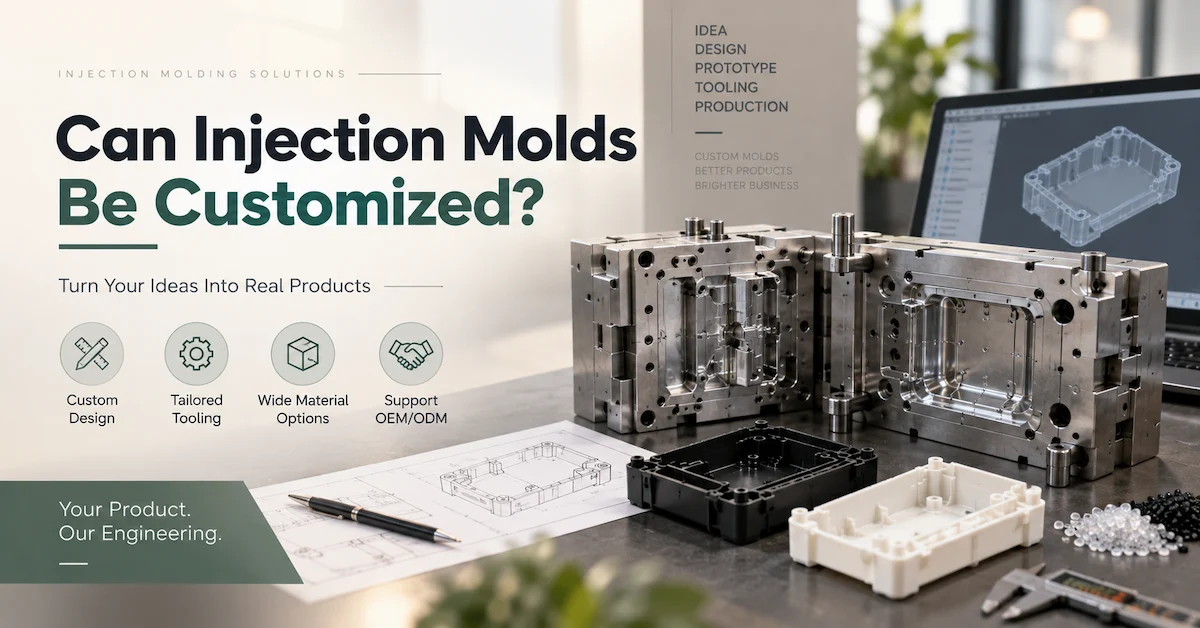
8. Can Injection Molds Be Customized for Different Products?
Yes. Mold structures, cavities, gates, cooling, ejection and other components can be customized according to product requirements.
9. How Do I Protect Mold Ownership?
Define ownership, documentation, transfer rights and maintenance responsibilities before starting the tooling project.
10. What Is the Best Way to Start an OEM Mold Project?
Prepare complete product information and discuss the project with the supplier before tooling begins. Early engineering communication reduces later modifications and delays.
Conclusion
Choosing an OEM plastic injection mold factory is not only about finding a company that can manufacture a mold. For global buyers, the most valuable supplier is one that understands the complete manufacturing process, helps reduce engineering risk and supports stable long-term production.
DX Molding supports OEM customers with custom injection mold development, tooling manufacturing and plastic-part production. Send DX Molding your CAD files, material requirements, production forecast and project goals to begin a project-specific mold evaluation.