What Should an Injection Mold Supplier for Startups Actually Help You Decide?
An injection mold supplier for startups should help a young product team decide whether the design is ready for tooling—not simply offer the lowest mold quotation.
That difference matters because an established OEM often arrives with released drawings, known annual demand, approved materials and an existing quality system. A startup may still be validating product-market fit, mechanical structure, assembly, expected volume and target cost.
Moving into a production mold too early can turn normal product development into expensive steel modifications. Waiting too long can also delay launch.
A better sourcing question is:
Which parts of the product are sufficiently stable to tool, and which decisions should still be validated before steel cutting?
DX Molding supports custom mold development from project-file review and DFM through mold manufacturing, trials and production support. Its current supplier guidance also recommends defining material, quantities, critical dimensions, assembly conditions and tooling scope before placing a tooling order.
For startups, that staged decision process is often more useful than beginning with “How much is the mold?”
Which Startup Projects Are Ready for Injection Molding?
Injection molding becomes more relevant when the product geometry is reasonably stable and the team expects repeat production.
Typical startup projects may include:
- Consumer electronics housings.
- Smart-device enclosures.
- Small appliance components.
- Household products.
- Industrial accessories.
- Control-system housings.
- Plastic clips and mounting components.
- Products combining several molded parts.
However, a production mold may be premature when the team is still changing PCB dimensions, battery location, connector positions, basic ergonomics or core product functions.
Before selecting an injection mold supplier for startups, classify the project stage.
| Product Stage | Main Objective | Tooling Decision |
|---|---|---|
| Early concept | Validate size, function and user interaction | Avoid freezing production tooling |
| Engineering prototype | Check assembly and mechanical layout | Resolve major design risks |
| Pre-production design | Validate material, DFM and critical dimensions | Begin tooling evaluation |
| Pilot-ready design | Confirm samples, assembly and market launch | Production tooling becomes more practical |
| Repeat production | Improve consistency and manufacturing economics | Optimize long-term tooling and production |
This is a project-planning framework, not a fixed rule. A simple product may become tooling-ready quickly, while a technically complex product may require more validation.
DX Molding’s custom development and manufacturing services can be used to discuss the appropriate route before mold manufacturing begins.
Freeze the Right Product Decisions Before Paying for Tooling
Startups do not need every detail to be permanent before requesting a mold review, but some information should be controlled before the mold design is released.
Prioritize:
Overall geometry
Major product shape and assembly architecture should no longer be moving frequently.
Mating components
PCBs, displays, connectors, fasteners or other hardware should have controlled mechanical information.
Plastic material
At minimum, define the required performance or a candidate material for engineering review.
Critical dimensions
Identify dimensions that control assembly, movement, alignment or another product function.
Visible surfaces
Mark the areas customers see so gate, ejector and parting-line locations can be reviewed correctly.
Expected quantity
You do not need a perfect sales forecast, but provide realistic launch, base-case and upside scenarios.
For example, instead of writing “We may sell millions,” a startup might submit:
- Pilot demand: 2,000 parts.
- Launch forecast: 10,000–20,000 parts.
- Base annual forecast: 50,000 parts.
- Upside scenario: 150,000 parts.
Those numbers give the supplier something useful for evaluating tooling economics.
Prepare a Startup Injection Mold RFQ
A startup RFQ should clearly distinguish confirmed requirements from open engineering decisions.
Use the following as a purchasing checklist rather than a universal DX Molding specification.
| RFQ Item | What the Startup Should Provide | Why It Matters |
|---|---|---|
| 3D CAD | Current STEP or equivalent model | Defines product geometry |
| 2D drawing | Critical dimensions and tolerances where available | Supports measurable acceptance |
| Product function | What the molded part must do | Helps prioritize engineering decisions |
| Resin | Approved grade or required performance | Influences shrinkage and tooling |
| Mating parts | PCB, inserts, connectors, screws or second housing | Supports assembly validation |
| Surface requirements | Visible faces, texture and color expectations | Guides gate, parting and ejection decisions |
| Quantity scenarios | Pilot, launch and annual estimate | Helps size tooling investment |
| Tooling destination | Supplier production or another molding factory | Changes mold interfaces and documentation |
| Sample approval | Dimensions, appearance and assembly checks | Defines when tooling is accepted |
| Open questions | Features still under engineering review | Prevents assumptions becoming specifications |
Avoid hiding uncertainty.
“Material under engineering review” is better than specifying a resin simply because an RFQ template demands one.
DX Molding accepts drawings and project requirements for technical review. Send your startup product files for an initial molding discussion when you have enough information to describe the product and unresolved questions.
Use DFM Before You Lock the Startup’s Product Design
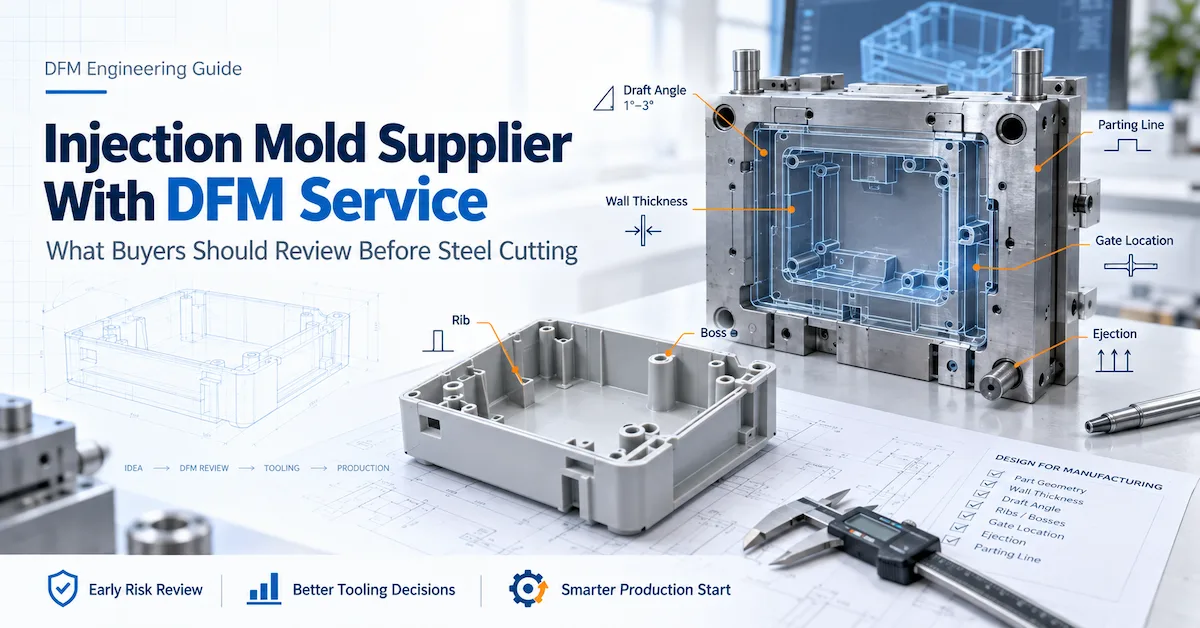
DFM—Design for Manufacturing—is where the product team and tooling engineer identify features that may unnecessarily increase mold complexity or production risk.
A supplier’s DFM review can address areas such as wall thickness, draft, undercuts, parting lines, gates, ejection, sink marks, warpage and assembly requirements. DX Molding’s current supplier-evaluation guide recommends resolving these issues before machining where possible.
Review Wall Thickness and Internal Features
A startup enclosure may contain many ribs and bosses because the design evolved rapidly around internal electronics.
These features should be reviewed against the exterior surfaces behind them.
A strong boss that creates a visible sink mark may require a structural change—not simply a different mold finish.
Question Every Undercut
A side clip, opening or hook can introduce slides, lifters or other moving tooling components.
Ask:
Does the product actually need this geometry?
If the feature can be changed without reducing product function, the startup may avoid unnecessary mold complexity.
Keep Cosmetic Decisions Visible
Mark customer-facing surfaces.
Do not allow the mold designer to guess whether a gate mark or parting line is acceptable in a particular location.
For a startup launching its first physical product, appearance can be a commercial requirement as well as an engineering requirement.
Choose a Tooling Strategy That Matches Uncertain Demand
Startups face a specific problem: future demand may be promising but still unproven.
The most expensive tool is therefore not automatically the best investment, and the cheapest tool is not automatically the smartest way to conserve cash.
| Tooling Strategy | Potential Advantage | Main Risk | Startup Situation to Evaluate |
|---|---|---|---|
| Single-cavity production mold | Lower initial tooling complexity | Lower output per cycle | Demand still developing |
| Multi-cavity mold | Higher potential output | Higher investment and validation workload | Demand already supported by orders or reliable forecasts |
| Cold-runner mold | Straightforward solution where appropriate | Runner waste and handling | Cost-sensitive launch with suitable product |
| Hot-runner mold | May reduce runner material | Higher tooling and maintenance requirements | Repeat volume justifies added system |
| Replaceable inserts | Can support selected changes or maintenance | Additional interfaces and cost | Localized feature likely to evolve |
| Separate pilot and later production tools | Keeps first investment aligned with launch stage | Possible second tooling investment | Product or demand still carries substantial uncertainty |
These options are not rankings. Multiple strategies can be combined depending on the product.
DX Molding offers custom plastic injection mold development and can evaluate cavity and runner approaches against an actual project.
The important startup question is:
What are we paying for now, and what risk does that investment remove?
Avoid Over-Specifying the Mold
Startups sometimes compensate for limited manufacturing experience by requesting the “best” specification everywhere:
- Highest-grade steel.
- Tightest tolerances.
- Hot runner.
- Multiple cavities.
- Maximum mold life.
- Extensive automation.
Each item can be appropriate in the right project. None is automatically necessary.
For example, a startup expecting modest launch quantities may gain little from a complex high-cavity mold if the product is likely to change after market feedback.
Likewise, specifying a tight tolerance on every drawing dimension can increase engineering and inspection effort without improving product function.
Ask your injection mold supplier for startups to explain which mold features protect a real product requirement and which are optional investments.
That makes cost reduction an engineering process rather than a negotiation to remove random items from the quotation.
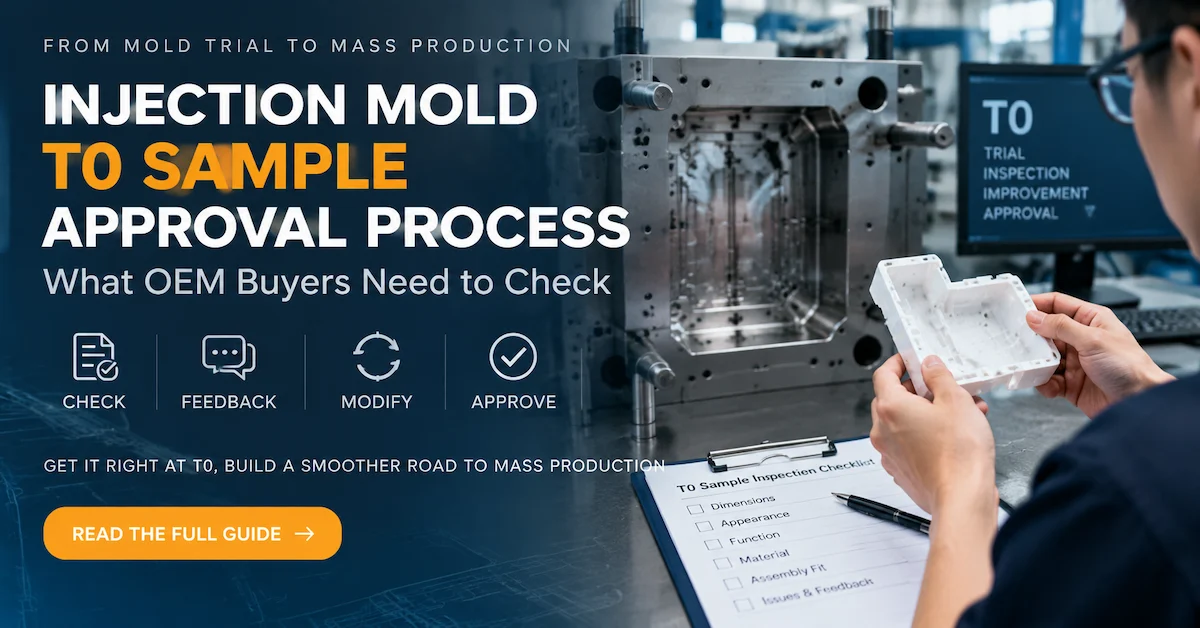
Approve Samples Against Product Function, Not Appearance Alone
The first molded samples can be exciting for a startup team. They are also where disciplined approval becomes essential.
A sample that looks good is not automatically production-ready.
Review at least four areas.
Dimensions
Measure agreed critical characteristics using defined datums and methods.
Assembly
Use real or controlled mating parts. Install the PCB, fasteners, display, connectors or other components that matter to product function.
Appearance
Review texture, gloss, visible weld lines, gate marks, parting lines and other agreed cosmetic conditions.
Mold Performance
Record open mold issues, ejection behavior and any engineering corrections still required.
Link approved samples to the current drawing revision and material.
DX Molding’s supplier-selection guidance emphasizes trial molding, dimensional inspection and documented engineering changes rather than relying on sample appearance alone.
Do Not Confuse a Pilot Run With Full Market Validation
A successful mold trial proves specific manufacturing conditions. It does not prove that the market will buy the product.
That distinction is especially important for startups.
Tooling engineering should validate whether the molded part meets the agreed requirements. The startup’s commercial team still needs to validate sales, customer acceptance and forecast assumptions.
This creates a useful separation:
Manufacturing validation: Can we repeatedly make the part?
Product validation: Does the assembled product work as intended?
Market validation: Will customers buy enough units to support the expected production plan?
Do not force the mold supplier to answer the third question by investing in unnecessarily high-capacity tooling before demand is clearer.
How Should Startups Compare Mold Cost?
Compare the complete project scope, not only the quoted mold price.
DX Molding’s supplier-selection guidance notes that lower tooling quotations can result from different steel, cavity count, runner systems, trial scope, inspection requirements and production assumptions.
A startup comparison should include:
- DFM and engineering.
- Mold design.
- Mold steel.
- Cavity count.
- Runner system.
- Slides and lifters.
- Samples and trials.
- Inspection reports.
- Engineering corrections.
- Spare parts.
- Mold documentation.
- Molded-part price.
- Packaging.
- Mold transfer if needed.
Consider a simple hypothetical example.
Supplier A quotes a $9,000 mold and Supplier B quotes $12,000.
If Supplier A excludes $1,200 of additional trials, $800 of inspection and $1,500 of required tooling changes that Supplier B already included, the effective comparison changes.
These figures are illustrative, not DX Molding pricing.
For startups, cash flow matters—but cheap scope that later becomes mandatory scope is not real savings.
Plan Lead Time Around Decisions, Not Just Launch Date
Startup schedules often begin with a fixed market date:
“We need production in eight weeks.”
That deadline is useful, but mold manufacturing still depends on engineering decisions.
Build the schedule around:
- CAD and requirement review.
- DFM.
- Product revision.
- Mold design.
- Buyer approval.
- Machining.
- Fitting and assembly.
- First trial.
- Dimensional and assembly review.
- Corrections.
- Re-trial.
- Final approval.
- Pilot or production run.
DX Molding’s current project workflow follows a similar sequence from DFM and tooling planning through machining, trial molding and production.
If a startup spends six days deciding whether a connector moves 2 mm, that affects the project schedule.
A supplier cannot recover every engineering delay simply by machining faster later.
Clarify Mold Ownership and Intellectual Property Early
Startups should address ownership before paying a tooling deposit—not when fundraising, changing suppliers or relocating production later.
DX Molding’s supplier-selection guide specifically recommends clarifying mold ownership, mold drawings, CAD data, BOMs, spare-part information and transfer rights before ordering.
Ask:
- Who owns the physical mold after payment?
- Where is it stored?
- Can it be transferred?
- Which mold drawings are provided?
- Is a mold BOM included?
- What spare-part information is available?
- How are engineering revisions controlled?
- What happens if production stops for a period?
If the mold may later move to another factory, plan the transfer requirements from the beginning rather than trying to reconstruct them years later.
DX Molding’s mold-transfer guide further explains why cooling diagrams, spare components, machine compatibility and documentation should be planned before shipment.
Decide Whether the Startup Needs Tooling Only or Parts Production
A startup without an internal molding team may gain more value from a supplier that can continue into part production after mold approval.
That reduces the number of handoffs during the early launch stage.
DX Molding provides custom plastic molding in addition to mold manufacturing, allowing buyers to discuss tooling and molded-part supply as one project where appropriate.
A startup with an established contract manufacturer may instead need a transferable mold.
Neither route is automatically better.
Compare:
Tooling + production with one supplier
Fewer early handoffs, but define mold ownership and future transfer.
Export tooling to another molder
Production stays with the startup’s selected factory, but machine compatibility and handover documentation become more important.
Make this decision before mold design if possible.
Define OEM and ODM Responsibilities
A startup may call its project “OEM” when it actually needs substantial product-development support.
The difference matters.
If the startup provides a mature design, the supplier may focus on manufacturability and tooling.
If the concept is still developing, the project may involve mechanical design, prototyping or ODM-style engineering decisions.
DX Molding’s services cover product-development support as well as mold and production work.
Before kickoff, write down who approves:
- Product geometry.
- Material.
- Critical tolerances.
- Mechanical structure.
- DFM changes.
- Prototype revisions.
- Mold construction.
- Trial samples.
- Production release.
A vague statement such as “supplier will optimize the design” is not enough.
The startup should know what the supplier may change without approval and what remains under founder or engineering-team control.
What Should a Startup Send DX Molding for Review?
You do not need a large corporate RFQ package to begin a meaningful conversation.
Prepare:
- Current CAD files.
- 2D drawing if available.
- Product application.
- Candidate material.
- Mating components.
- Critical dimensions.
- Visible surfaces.
- Launch quantity.
- Expected annual volume.
- Target production date.
- Budget constraints where useful.
- The biggest unresolved engineering question.
Also tell the supplier what has not been finalized.
For example:
“PCB outline is frozen; exterior texture is not.”
“Snap fit works in prototypes; resin grade is still under review.”
“We expect 10,000 launch units but do not yet want tooling sized around the upside forecast.”
Those statements help an injection mold supplier for startups propose a manufacturing route based on the project’s real maturity.
Send DX Molding your startup product drawings and requirements to begin a project-specific mold review.
Frequently Asked Questions
1. When Should a Startup Start Injection Molding?
Start evaluating production tooling when the product geometry, core assembly, material direction and critical requirements are reasonably stable and expected production volume can justify the investment. Major unresolved architecture changes are usually a reason to continue development before freezing the mold.
2. Do Startups Need a Production Mold for Their First Prototype?
Not necessarily. Early prototypes are used to validate design questions, while production tooling is intended for repeat manufacturing. If significant product decisions remain open, prototype methods may be more appropriate before committing to a final mold.
3. What Should I Send an Injection Mold Supplier for Startups?
Send current CAD files, the product function, proposed material, mating components, quantity forecast and critical requirements. Clearly identify unresolved design decisions so the supplier does not treat assumptions as approved specifications.
4. Should a Startup Choose a Single-Cavity or Multi-Cavity Mold?
It depends on demand, part geometry, cycle time and budget. A single cavity may reduce initial complexity, while multiple cavities can increase output. Do not choose cavity count from an optimistic sales forecast alone.
5. How Much Does a Startup Injection Mold Cost?
Cost depends on geometry, mold structure, steel, cavities, runner system, undercuts, finish, trials and inspection. A meaningful quotation requires actual product files and requirements. Compare included scope rather than expecting one standard startup mold price.
6. Can DX Molding Make the Mold and Then Produce Our Parts?
DX Molding supports custom injection mold manufacturing and plastic molding. A startup can discuss either ongoing molded-part supply or an export mold, depending on its manufacturing strategy and project requirements.
7. What Happens if We Change the Product After the Mold Is Made?
Some changes can be made by modifying inserts or other tooling features, while others may require substantial rework or new tooling. Issue a controlled drawing revision and request a feasibility, cost and schedule assessment before authorizing changes.
8. Who Should Own a Startup’s Injection Mold?
Ownership should be explicitly defined in the purchase agreement. Also clarify rights to mold drawings, engineering data, spare-part information, modification records and future mold transfer. Do not wait until production needs to move.
9. How Can Startups Protect Confidential Product Information?
Discuss confidentiality and information access before sharing sensitive engineering data, and define the commercial terms appropriate to the project. Intellectual-property arrangements should be documented rather than assumed from a standard tooling quotation.
10. What Is the Biggest Tooling Mistake Startups Make?
One of the most expensive mistakes is freezing a production mold while important product decisions are still changing. Another is over-investing in mold capacity based on an unvalidated sales forecast. Engineering readiness and realistic demand should guide tooling investment together.
Conclusion
Choosing an injection mold supplier for startups is not simply a search for a company willing to build the first mold. The better question is whether the supplier can help connect an evolving product to an appropriate tooling investment without treating every early assumption as a permanent production specification.
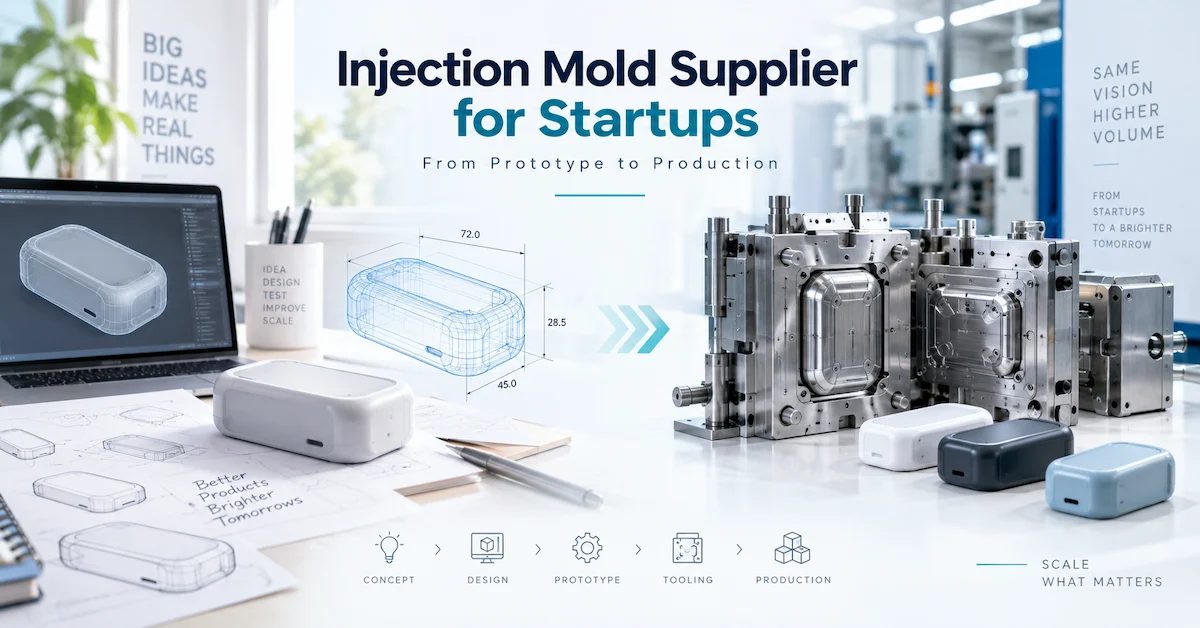
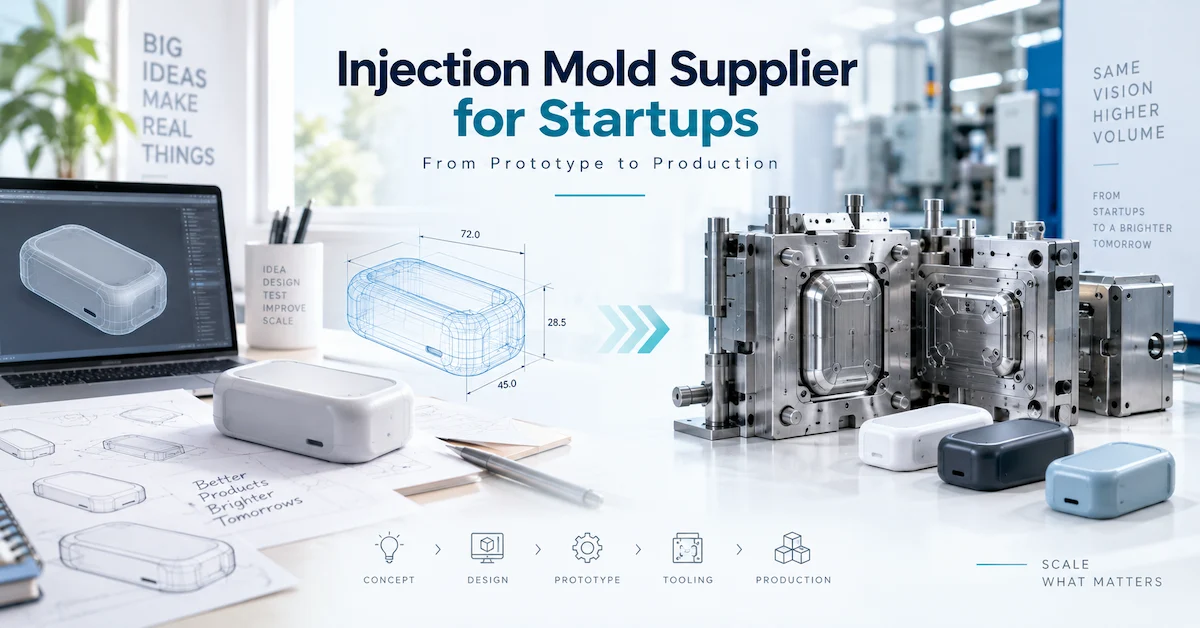
Startup teams should focus on a controlled sequence:
product validation → DFM → tooling decision → mold design → trial samples → assembly approval → pilot production → repeat manufacturing.
That sequence helps founders avoid two opposite mistakes: spending too much on tooling before the product and demand are stable, or selecting such a limited mold that production becomes unnecessarily expensive once the launch succeeds.
For a startup preparing its first custom plastic product, send DX Molding your CAD files, material direction, launch quantity and open engineering questions. A drawing-based review gives both sides a clearer basis for deciding what should be tooled now, what still needs validation and what manufacturing path fits the next stage of the product.