What Is a High Precision Mold Manufacturer?
A high precision mold manufacturer develops injection molds for plastic parts where dimensional consistency, repeatability, fit, surface quality, or functional geometry requires tighter manufacturing control than a general-purpose mold project.
High precision does not come from one CNC machine or one final inspection.
It is the result of controlling the entire chain:
Part Design → DFM → Mold Design → Precision Machining → Assembly → Trial Molding → Measurement → Process Optimization
For OEM buyers, this distinction matters because a mold can appear dimensionally correct on the bench but still produce unstable parts if cooling, gating, shrinkage, venting, ejection, or molding conditions are not properly considered.
DongXin supports custom plastic injection mold development from engineering review through mold manufacturing, trials, and production support.
Standard Mold Manufacturing vs High Precision Mold Manufacturing
Not every molded product requires the same level of tooling control.
A simple cover or non-critical consumer component may tolerate broader dimensional variation than a connector housing, precision assembly component, optical housing, or tightly fitted mechanical part.
| Factor | General Mold Project | High Precision Mold Project |
|---|---|---|
| Dimensional requirements | Standard functional dimensions | Critical dimensions closely controlled |
| Mold design | Conventional tooling strategy | Greater focus on thermal and dimensional behavior |
| Machining | Standard CNC/EDM processes | More demanding machining and fitting control |
| Cooling | General cooling layout | Thermal balance becomes critical |
| Material behavior | Basic processing consideration | Shrinkage and stability require deeper analysis |
| Inspection | Basic dimensional checks | Critical features require structured measurement |
| Trial molding | Confirms part formation | Confirms dimensional capability and repeatability |
| Process window | Wider acceptance range | Stable process window is especially important |
The important point is that “high precision” should be defined by the part drawing and functional requirements, not used as a marketing label.
High Precision Begins With DFM
One of the most expensive mistakes in precision molding is attempting to solve a product-design problem after the mold has already been manufactured.
A professional DFM review should identify dimensions and features that can influence moldability or dimensional stability.
Critical Dimensions
Not every dimension should receive the tightest tolerance.
Engineering teams should distinguish between:
- Assembly dimensions
- Sealing dimensions
- Alignment features
- Connector positions
- Hole spacing
- Flatness-sensitive surfaces
- Cosmetic dimensions
- Non-critical geometry
Applying unnecessarily tight tolerances everywhere can increase tooling, measurement, and production complexity without improving product performance.
ISO 20457 provides an international framework for dimensional and geometrical tolerances for plastic molded parts and can be useful when engineering teams define realistic molded-part requirements.
ISO 20457 – Plastics moulded parts
Wall Thickness
Uneven wall thickness can create different cooling and shrinkage rates across the same component.
This may contribute to:
- Sink marks
- Warpage
- Dimensional variation
- Internal stress
For precision parts, geometry should therefore be reviewed together with expected material behavior.
Draft, Ribs, and Bosses
Features such as:
- Deep ribs
- Screw bosses
- Thin walls
- Tall cores
- Snap features
can influence both tooling difficulty and part stability.
DongXin's engineering and project support can be used during the pre-tooling stage to evaluate these risks before mold manufacturing begins.
Mold Design Determines Precision Before Machining Starts
Precision machining cannot compensate for a fundamentally poor mold design.
A high precision mold manufacturer must consider how mold architecture affects the finished part.
Gate Design and Placement
The gate determines how molten plastic enters the cavity.
Its position can influence:
- Flow balance
- Weld lines
- Packing
- Gate vestige
- Local shrinkage
- Warpage
For dimensionally sensitive components, gate location should be selected based on both filling behavior and the functional requirements of the part.
A gate positioned near a critical feature may affect local pressure and shrinkage.
Parting Line Design
Parting-line location affects:
- Flash control
- Mold alignment
- Appearance
- Shut-off geometry
- Dimensional relationships
Critical mating surfaces should be considered carefully when the parting strategy is established.
Core and Cavity Construction
Precision molds may require:
- Replaceable inserts
- Independent core components
- Precision shut-offs
- Slides
- Lifters
- Interlocking structures
Breaking complex tooling into controlled inserts can sometimes make machining, maintenance, and future correction more manageable.
Cooling System Design
Cooling is one of the most important—and often underestimated—factors in precision injection molding.
If one region of a mold remains significantly hotter than another, the molded part may cool and shrink unevenly.
Potential consequences include:
- Warpage
- Flatness variation
- Dimensional drift
- Longer cycle times
- Inconsistent production
Cooling channels should therefore be considered during mold design rather than added as an afterthought.
For complex projects, simulation tools such as Autodesk Moldflow can help engineering teams evaluate filling, packing, cooling, and warpage risks before finalizing tooling decisions.
Precision CNC Machining for Mold Cores and Cavities
After design approval, precision manufacturing begins.
CNC machining is commonly used for:
- Mold cavities
- Cores
- Inserts
- Mold plates
- Slider components
- Precision locating features
For high precision molds, machining accuracy alone is not enough.
Manufacturers must also consider:
- Tool wear
- Machining sequence
- Datum consistency
- Heat generated during machining
- Surface requirements
- Inspection between operations
A small error in one component may affect several relationships after the complete mold is assembled.
Why EDM Is Important in Precision Mold Manufacturing
EDM is often used where conventional milling cannot efficiently produce the required geometry.
Typical applications include:
- Deep narrow features
- Sharp internal details
- Complex ribs
- Fine shut-offs
- Difficult cavity geometry
For some precision tooling projects, CNC machining and EDM work together rather than competing with each other.
The correct process depends on geometry, material, surface requirements, and accessibility.
Mold Assembly and Fitting Cannot Be Ignored
Even accurately machined components must operate together as one complete system.
During mold assembly, toolmakers need to verify:
- Core and cavity alignment
- Insert positioning
- Slider movement
- Lifter operation
- Ejection
- Shut-off contact
- Mold opening and closing
A dimensional problem may originate not from one machined component but from the relationship between multiple mold components.
This makes assembly and fitting an important part of high precision mold manufacturing.
How Material Selection Affects Mold Precision
The mold does not determine finished-part dimensions by itself.
Plastic materials shrink as they cool, and different polymers behave differently.
Factors affecting dimensional behavior include:
- Resin family
- Material grade
- Fillers
- Fiber orientation
- Mold temperature
- Melt temperature
- Packing conditions
- Part geometry
Common engineering materials can include:
- ABS
- PC
- PC/ABS
- PA
- POM
- PP
- Engineering thermoplastics
However, the exact material grade should ideally be confirmed before final mold compensation decisions are made.
Filled Materials Require Additional Consideration
Glass-fiber or mineral-filled materials can behave differently from unfilled polymers.
Fiber orientation may influence:
- Directional shrinkage
- Warpage
- Surface quality
- Mechanical properties
For tight-tolerance components, simply applying a generic shrinkage percentage across the entire model may not provide sufficient engineering insight.
Shrinkage Is a System, Not a Single Number
Shrinkage is one of the most important topics in precision plastic part manufacturing.
Actual molded shrinkage can be influenced by:
Material + Geometry + Gate Position + Packing + Cooling + Mold Temperature + Process Conditions
This means two areas of the same molded part may not behave identically.
Common Shrinkage-Related Problems
OEM teams may encounter:
- Hole spacing variation
- Bowing of flat surfaces
- Housing mismatch
- Connector misalignment
- Roundness variation
- Overall length or width deviation
The solution may require modifying:
- Mold dimensions
- Gate strategy
- Packing conditions
- Cooling
- Part geometry
rather than adjusting a single machine parameter.
Injection Speed and Filling Control
A high precision mold still needs a stable molding process.
Injection speed influences how material moves through the runner and cavity.
An uncontrolled filling profile may contribute to:
- Air traps
- Flow marks
- Weld-line problems
- Flash
- Filling imbalance
The goal is not simply to inject faster.
The objective is to establish a repeatable filling strategy appropriate for the resin, geometry, gate, and mold design.
Pressure and Packing Control
After cavity filling, packing helps compensate for material shrinkage while the gate remains active.
Too little packing may contribute to:
- Sink
- Voids
- Under-sized features
Excessive packing can contribute to:
- Internal stress
- Flash
- Difficult ejection
- Dimensional distortion
Precision part development therefore requires a stable processing window instead of continuously increasing pressure to correct defects.
Temperature Management
Temperature influences material viscosity, filling, crystallization behavior, cooling, and final part dimensions.
Important variables may include:
- Barrel temperature
- Nozzle temperature
- Mold temperature
- Cooling-water temperature
If these conditions vary significantly between production runs, part dimensions may also change.
This is why repeatability matters as much as achieving one acceptable first sample.
Why Mold Cooling Affects Tight-Tolerance Parts
Cooling strategy deserves separate attention because many dimensional problems develop after the cavity has already filled successfully.
Uneven cooling can contribute to:
- Differential shrinkage
- Warpage
- Flatness problems
- Residual stress
A high precision mold manufacturer should therefore consider the relationship between:
Cooling channel position → Part geometry → Material → Cycle → Final dimensions
instead of evaluating cooling only as a way to shorten cycle time.
Mold Validation Should Test More Than One Sample
A single good molded part does not prove that a mold is production-ready.
High precision projects should evaluate whether the tooling and molding process can repeatedly produce acceptable parts.
Trial Molding
Initial trials can identify:
- Filling problems
- Flash
- Sink
- Warpage
- Ejection problems
- Surface defects
Dimensional Inspection
Critical dimensions should then be compared against:
- Product drawings
- CAD data
- Assembly requirements
- Functional criteria
Depending on the project, suitable inspection methods may include conventional gauges, dimensional measurement equipment, or more advanced metrology.
Assembly Testing
For parts used in assemblies, dimensional inspection alone may not reveal every issue.
Samples should also be evaluated for:
- Fit
- Alignment
- Snap engagement
- Screw assembly
- Connector placement
- Functional performance
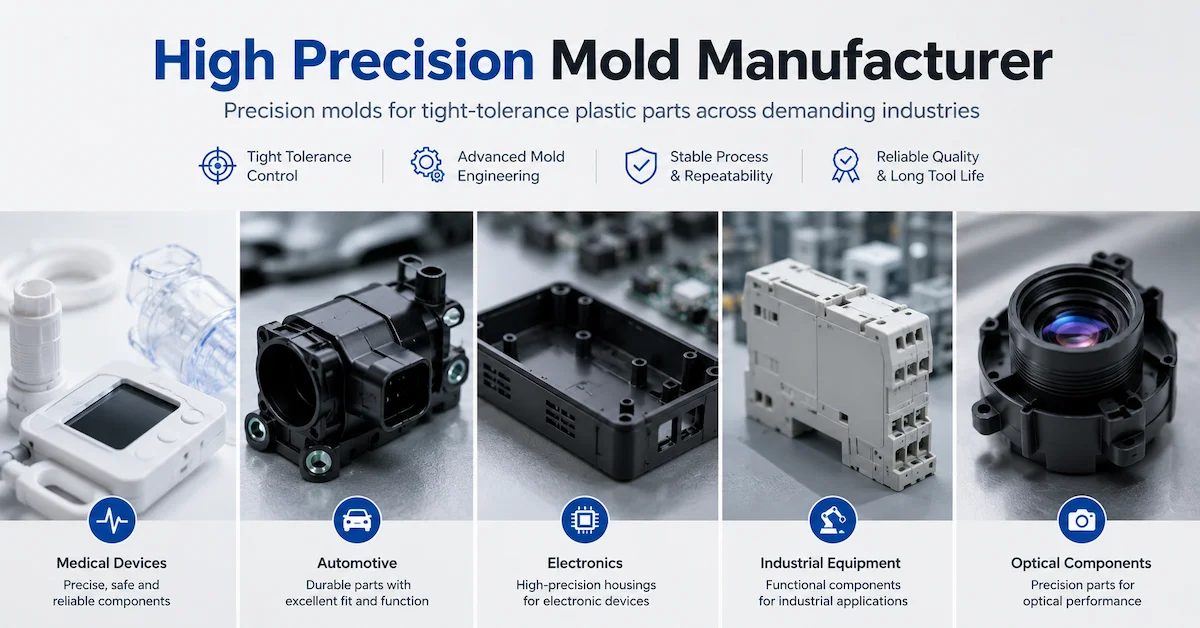
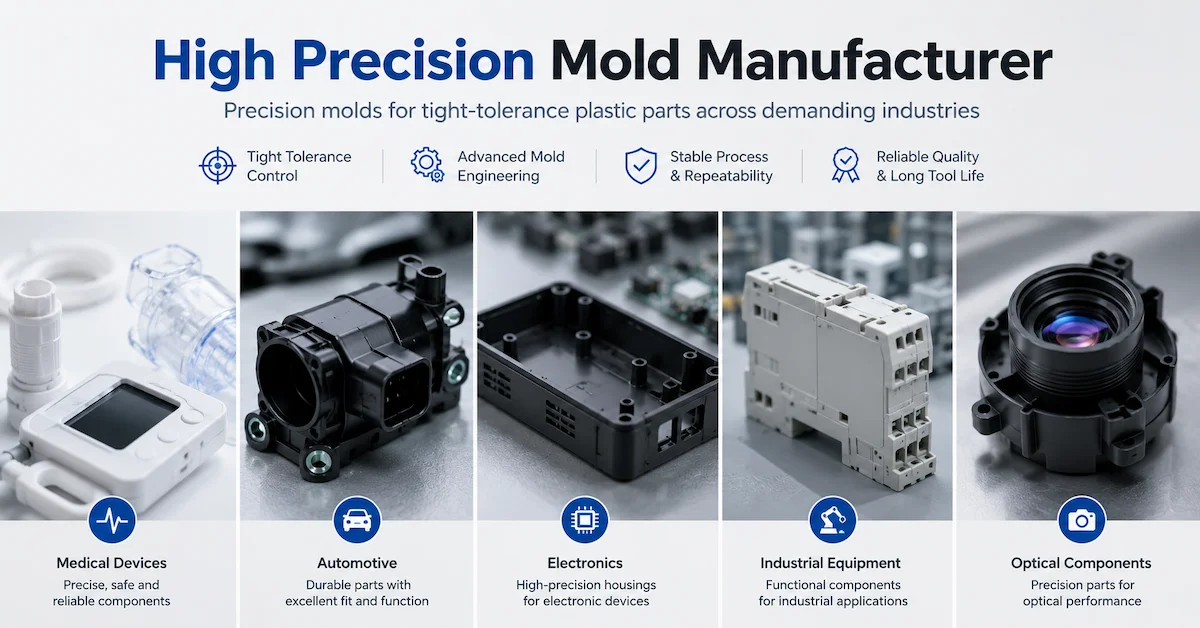
Common Applications for High Precision Plastic Molds
High precision tooling can be useful wherever dimensional relationships affect product function.
Automotive Components
Examples can include:
- Interior functional parts
- Sensor housings
- Electrical housings
- Precision mounting components
Electronics
Applications may include:
- Connector housings
- Device enclosures
- Switch components
- Internal structural parts
Medical and Laboratory Products
Some medical or laboratory projects require carefully controlled geometry and documented product specifications.
Manufacturing requirements should always be determined by the actual application and applicable quality or regulatory requirements rather than assumed from the product category.
Industrial Components
Examples include:
- Control-system housings
- Precision covers
- Mechanical interfaces
- Functional plastic components
Benefits of Working With a High Precision Mold Manufacturer
For the right application, precision tooling can provide several practical advantages.
Better Dimensional Consistency
Well-controlled mold design and manufacturing can help reduce variation between parts.
Improved Assembly Performance
Accurate mating geometry can support more consistent:
- Fit
- Alignment
- Mechanical assembly
- Functional interfaces
Reduced Correction During Production
Identifying dimensional risks during DFM and tooling development may reduce the need for repeated modifications later.
Support for Complex Product Designs
Precision machining, inserts, sliders, EDM, and controlled tooling architecture can make more demanding geometries manufacturable.
The purpose is not to make every product unnecessarily complex.
It is to manufacture the required geometry reliably.
Challenges OEM Buyers Should Understand
High precision projects also introduce additional requirements.
Higher Tooling Complexity
More demanding dimensional relationships may require additional:
- Engineering
- Machining
- Inspection
- Tool fitting
- Validation
Material Behavior Becomes More Important
A dimensionally accurate steel cavity does not guarantee an equally accurate plastic part.
Resin shrinkage and process conditions must also be controlled.
Engineering Changes Can Be More Expensive
Once critical mold dimensions are finalized, major design changes may require:
- Insert replacement
- Steel modification
- Additional machining
- New trials
This makes early DFM especially valuable.
How to Evaluate a High Precision Mold Manufacturer
OEM buyers should avoid selecting a supplier based only on statements such as:
“We can hold very tight tolerances.”
Instead, ask how the supplier achieves dimensional control.
1.Ask About DFM
Can the manufacturer identify:
- Critical dimensions?
- Shrinkage risk?
- Warpage risk?
- Gate effects?
- Cooling challenges?
2. Review Mold Design Capability
Does the supplier explain:
- Parting line
- Gate
- Cooling
- Ejection
- Inserts
- Slider or lifter requirements?
3.Evaluate Manufacturing Processes
Check whether mold development includes appropriate:
- CNC machining
- EDM
- Fitting
- Assembly
- Inspection
4. Ask How Critical Dimensions Are Verified
A credible supplier should be able to explain:
- What is measured
- When it is measured
- How samples are evaluated
- How deviations are corrected
5. Review Trial and Correction Procedures
Ask what happens after T0.
A professional process should allow engineering teams to review defects and dimensional findings before final approval.
6.Evaluate Mold-to-Production Support
A supplier capable of both tooling and plastic molding can continue optimizing the relationship between mold design and molding parameters after the tool is completed.
This can be valuable for tight-tolerance projects where tooling and process conditions must work together.
Questions to Include in a Precision Mold RFQ
Before contacting a manufacturer,prepare:
| Information | Why It Matters |
|---|---|
| 3D CAD | Defines complete geometry |
| 2D drawing | Identifies tolerances and critical dimensions |
| Material grade | Influences shrinkage and processing |
| Production volume | Influences mold construction |
| Surface requirement | Affects machining and finishing |
| Critical dimensions | Directs engineering attention |
| Assembly information | Identifies functional relationships |
| Expected tool location | Export mold or local production affects planning |
| Quality requirements | Defines inspection expectations |
The more clearly these requirements are defined, the more meaningful a mold quotation becomes.
DongXin's contact team can review CAD files, drawings, material requirements, and expected production needs before tooling development.
FAQ About High Precision Mold Manufacturers
What is a high precision mold manufacturer?
A high precision mold manufacturer designs and manufactures molds for components requiring controlled dimensional accuracy, repeatability, complex geometry, or critical assembly relationships. The process typically requires coordinated DFM, mold design, machining, fitting, trial molding, and measurement.
What makes a mold high precision?
High precision depends on the complete tooling system rather than one tolerance value. Mold design, machining accuracy, insert alignment, cooling, material shrinkage, molding conditions, and dimensional validation all affect the final result.
Does a precision mold automatically produce precision plastic parts?
No. The mold is only one part of the system. Resin behavior, gate design, packing, mold temperature, cooling, machine conditions, and process stability also influence finished-part dimensions.
Why is cooling important in a precision injection mold?
Uneven cooling can cause different regions of the part to shrink at different rates. This may contribute to warpage, flatness problems, and dimensional variation.
What files should I send for a high precision mold quotation?
Ideally provide a 3D CAD model, 2D drawing with critical tolerances, resin or material grade, production-volume estimate, surface requirements, and assembly information.
How should OEM buyers define tight tolerances?
Tolerances should be based on functional requirements, material behavior, part geometry, and the selected molding process. Critical dimensions should be distinguished from non-critical features rather than applying the tightest tolerance across the entire drawing.
Can one manufacturer produce both the precision mold and finished plastic parts?
Yes. DongXin supports custom injection mold manufacturing as well as plastic molding, allowing tooling development and production optimization to remain within one project workflow.
How do I know whether my product actually needs a high precision mold?
If product performance depends on critical dimensions, close-fitting assemblies, alignment, flatness, repeatable geometry, or other sensitive interfaces, a precision tooling strategy may be appropriate.A DFM review should determine which features genuinely require additional control.
Conclusion
Choosing a high precision mold manufacturer is not simply about finding a factory that advertises the smallest tolerance.
Precision must be engineered across the entire project:
DFM → Mold Design → Gate and Cooling Strategy → CNC/EDM → Assembly → Trial Molding → Measurement → Process Optimization
For OEM buyers, the most important questions are:
- Which dimensions are truly critical?
- How will resin shrinkage affect them?
- How is the mold designed around those risks?
- How will critical mold features be manufactured?
- How will molded samples be measured?
- Can the process remain stable during production?
DongXin provides custom mold and molding services for OEM projects requiring coordinated engineering, tooling development, trial validation, and production support.
If your product has critical dimensions, complex geometry, or demanding assembly requirements, you can contact DongXin with your CAD files, drawings, material requirements, and expected production volume for project evaluation.