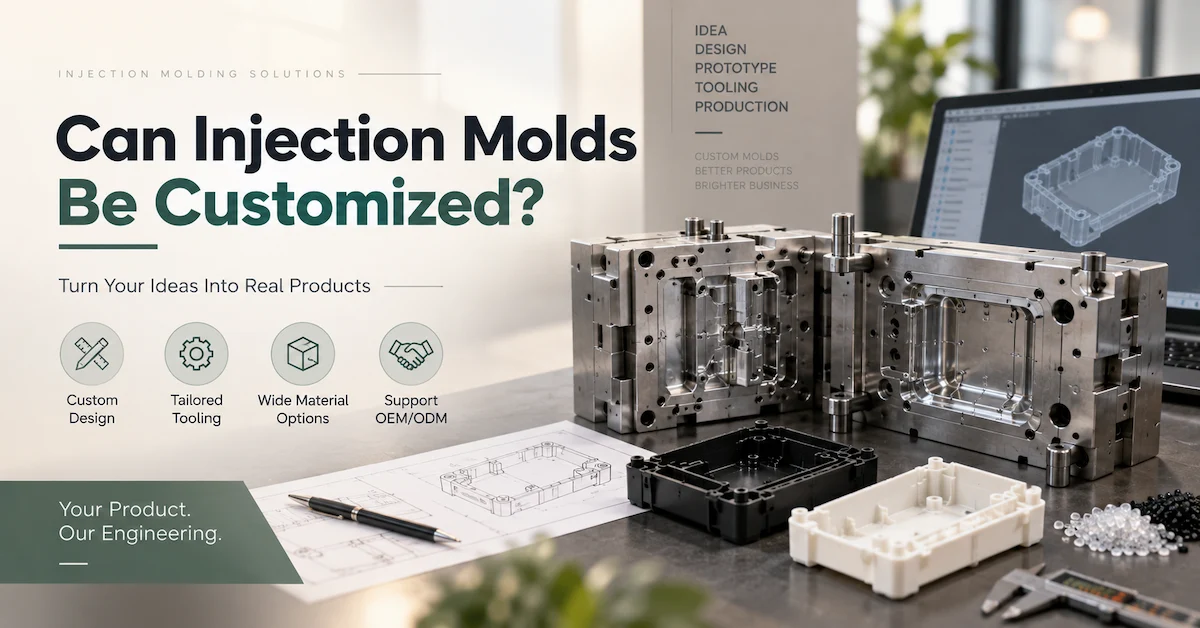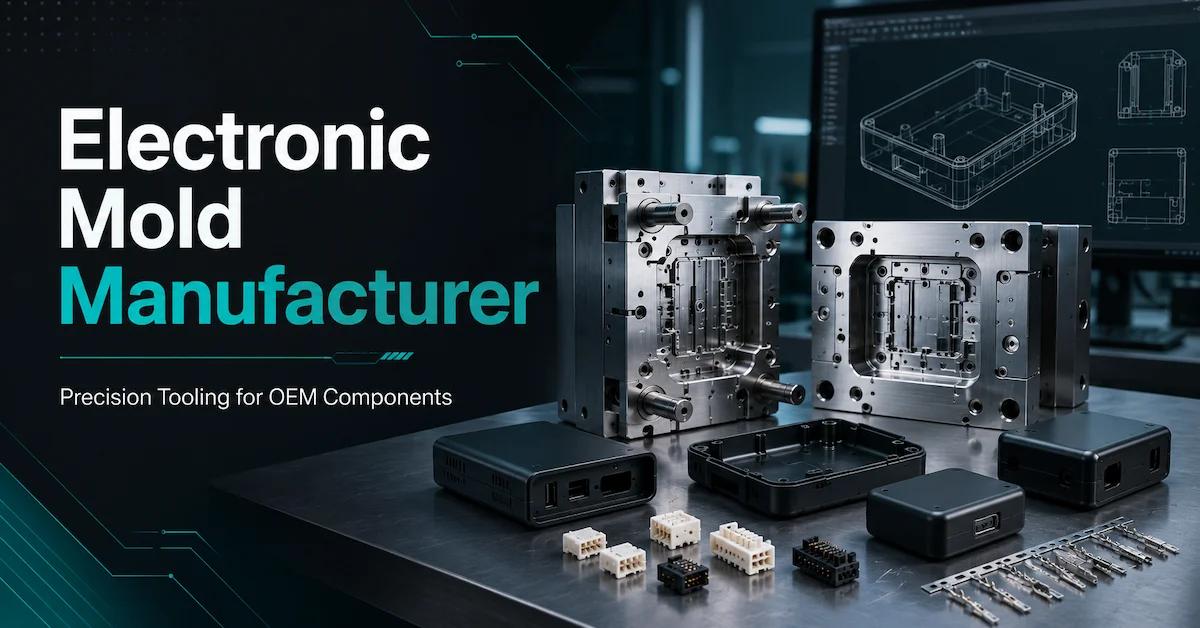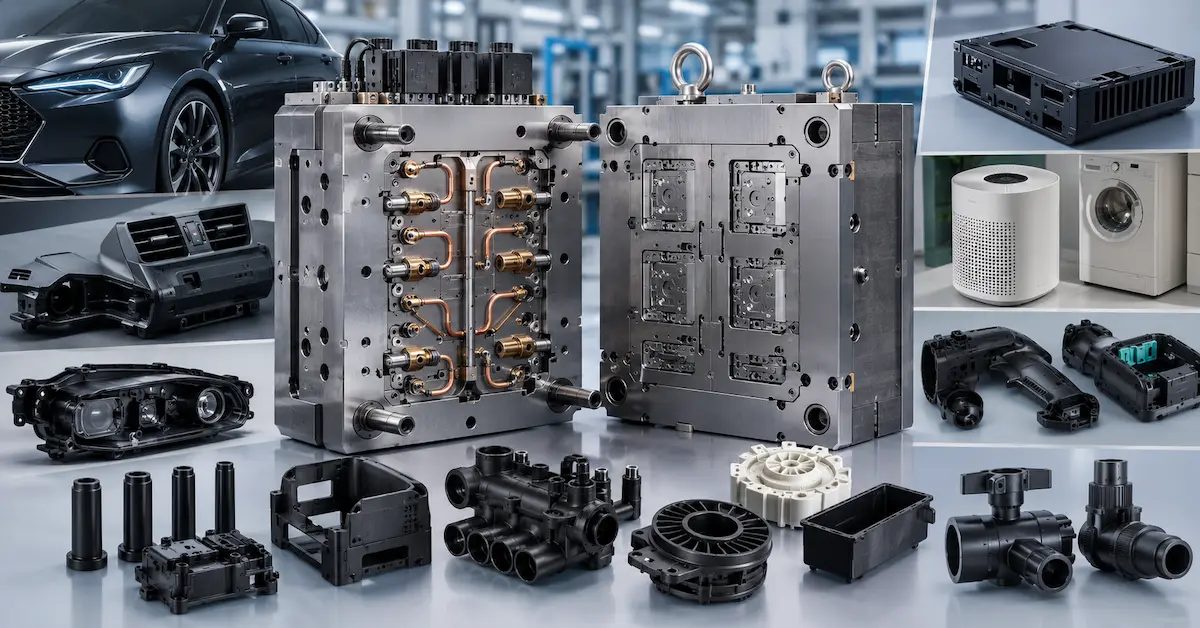
What Is a Hot Runner Mold Manufacturer?
A hot runner mold manufacturer designs and builds injection molds in which heated runner components keep plastic molten as it travels from the injection molding machine toward the mold cavities.
Unlike a conventional cold runner, the runner material is generally not ejected as a solid runner together with every molding cycle.
That difference can help suitable OEM projects reduce runner waste, improve production efficiency, support multi-cavity layouts, and gain greater control over how resin reaches each cavity.
However, a hot runner system also introduces additional engineering requirements involving:
- Manifold layout
- Nozzle selection
- Gate design
- Temperature control
- Thermal expansion
- Cavity balance
- Cooling
- Electrical components
- Maintenance access
This means the right question for an OEM buyer is not simply:
“Can you build a hot runner mold?”
A better question is:
“Can you design a hot runner mold that matches my resin, part geometry, cavity count, production volume, cosmetic requirements,and long-term maintenance plan?”
Mold-Masters defines a hot runner as a heated plastic-conveying system inside an injection mold that carries molten resin from the machine barrel toward the cavities. Autodesk likewise describes hot runners as heated runner systems in which the material remains molten rather than being ejected as runner scrap.
When Does a Hot Runner Mold Make Business Sense?
Hot runner tooling is not automatically better than cold runner tooling.
It becomes attractive when the production economics and part requirements justify the additional mold complexity.
OEM buyers should consider a hot runner mold when one or more of the following conditions apply:
| Project Condition | Why Hot Runner Tooling May Help |
|---|---|
| High annual production volume | Runner savings can accumulate over large quantities |
| Expensive engineering resin | Reducing runner waste may have greater financial value |
| Multi-cavity mold | Heated distribution can support efficient cavity feeding |
| Large molded part | Eliminating a large cold runner may reduce material waste |
| Cosmetic part | Gate strategy can help manage visible vestige locations |
| Automated production | No solid runner may simplify downstream handling |
| Shorter production cycle target | Removing runner cooling can sometimes support cycle optimization |
| Limited regrind allowance | Less runner scrap reduces dependence on recycled runner material |
The decision should be made from total production economics, not only the initial mold quotation.
When a Cold Runner May Be the Better Choice
A trustworthy hot runner mold manufacturer should also be willing to tell a customer when a hot runner is unnecessary.
Cold runner tooling may make more sense when:
- Production volume is relatively low
- The part is simple
- Resin cost is not a major cost driver
- The mold must remain easy to repair locally
- Project investment needs to stay low
- The resin has challenging thermal sensitivity
- Color changes happen frequently
- The customer does not have suitable maintenance capability
- The expected material savings do not justify the additional tooling investment
This is an important supplier-selection signal.
If every RFQ is automatically pushed toward the most complex mold architecture, the supplier may be optimizing the tooling quotation rather than the buyer's production economics.
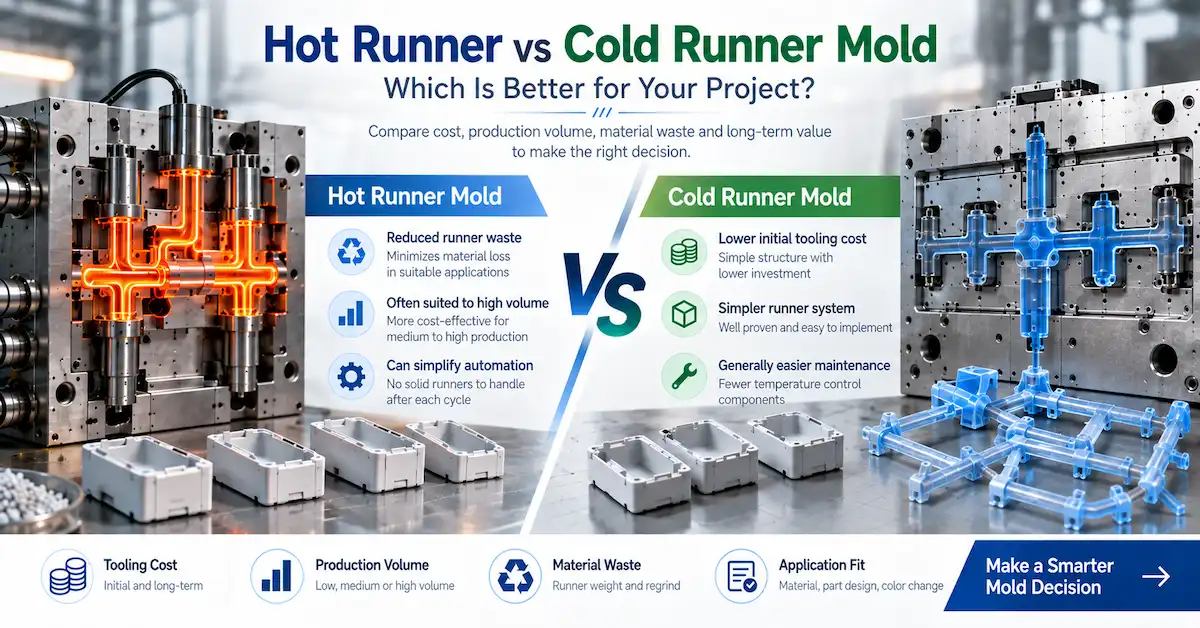
Hot Runner Mold vs Cold Runner Mold
For procurement teams, the choice is easier to understand when tooling cost and operating cost are evaluated separately.
| Factor | Cold Runner Mold | Hot Runner Mold |
|---|---|---|
| Initial tooling investment | Usually lower | Usually higher |
| Runner scrap | Solid runner produced | Significantly reduced or eliminated depending on system |
| Mold complexity | Lower | Higher |
| Temperature control | Simpler | Dedicated control required |
| Maintenance | Generally easier | More specialized |
| Material utilization | Lower when runners are discarded | Potentially higher |
| Multi-cavity scalability | Good | Often attractive for high-volume applications |
| Gate options | Conventional | Thermal gate or valve gate options |
| Automation | Runner separation may be required | Can simplify runner handling |
| Best fit | Lower-volume/simple projects | Higher-volume or material-sensitive economics |
The correct decision depends on cost per acceptable part over the expected production life, not simply which mold costs less to manufacture.
How a Hot Runner System Works
A typical hot runner mold contains several functional elements.
Manifold
The manifold distributes molten plastic from the machine nozzle toward individual hot runner nozzles.
Its design influences:
- Flow balance
- Pressure drop
- Material residence time
- Thermal balance
- Cavity-to-cavity consistency
For multi-cavity projects, balanced material delivery becomes especially important.
Hot Runner Nozzles
Nozzles transfer the molten material from the manifold toward each gate.
Selection depends on factors such as:
- Resin
- Shot size
- Part geometry
- Gate diameter
- Cavity spacing
- Required appearance
Heaters
Heating elements maintain the required temperature within the hot runner system.
If the thermal system is poorly controlled, resin behavior can become inconsistent.
Temperature Sensors and Controllers
Temperature control helps maintain a repeatable melt condition through the hot runner.
A temperature that is too low can affect flow.
A temperature that is too high can increase the risk of material degradation for some polymers.
Gate
The gate is the final transition between the hot runner system and the molded part.
Gate design can affect:
- Cosmetic appearance
- Filling
- Packing
- Gate vestige
- Cycle performance
- Part removal
Thermal Gate vs Valve Gate Hot Runner Molds
Two common concepts OEM buyers will encounter are thermal gating and valve gating.
Thermal Gate
A thermal gate controls material primarily through thermal conditions and the molding cycle.
Potential advantages include:
- Simpler structure
- Lower system complexity
- Lower initial cost than some valve-gate solutions
It can work well when gate appearance and sequential control are not major concerns.
Valve Gate
A valve gate uses a mechanical valve pin to open and close the gate.
Depending on the project, valve gates may offer greater control over:
- Gate opening timing
- Gate closing
- Gate vestige
- Sequential filling
- Large-part flow management
Valve-gate systems can be particularly relevant to:
- Automotive components
- Large plastic housings
- Cosmetic surfaces
- Multi-point injection
- Sequential filling strategies
They also introduce additional components and maintenance requirements.
The manufacturer should therefore explain why a valve gate is needed, not simply specify it because it appears more advanced.
Why Hot Runner Mold Design Starts With the Plastic Part
The hot runner system should not be designed independently from the molded component.
Before choosing a manifold, nozzle, or valve gate, the mold engineering team should review the part itself.
A proper DFM analysis should consider:
- Part dimensions
- Wall thickness
- Flow length
- Resin
- Cosmetic surfaces
- Weld-line sensitivity
- Critical dimensions
- Undercuts
- Draft
- Expected annual quantity
- Required cavity count
DongXin's engineering support can be integrated at the early tooling stage so product and mold requirements are reviewed before mold manufacturing begins.
Material Selection Can Determine Hot Runner Success
Not every thermoplastic behaves the same inside a heated runner system.
Material characteristics that should be evaluated include:
- Processing temperature
- Thermal stability
- Viscosity
- Shear sensitivity
- Additives
- Fillers
- Residence-time sensitivity
- Color-change requirements
Common injection-molding materials may include:
- PP
- ABS
- PC
- PC/ABS
- PA
- POM
- TPE
- Engineering thermoplastics
But resin-family names alone are not enough.
The exact production grade is important.
For example, two PA materials may behave very differently because of:
- Glass-fiber content
- Viscosity
- Moisture sensitivity
- Additives
- Processing temperature
For a serious hot runner quotation, the buyer should ideally provide the exact resin grade or at least the intended material family and supplier specification.
Why Cavity Count Matters
Hot runner technology is often considered together with multi-cavity mold design.
A 2-cavity, 8-cavity, 16-cavity, or higher-cavity-count mold creates increasingly demanding questions around:
- Flow balance
- Cavity spacing
- Manifold layout
- Pressure balance
- Heating uniformity
- Cooling
- Mold size
- Machine shot capacity
The economic advantage also changes.
For example, if every cold-runner cycle produces a relatively large amount of runner scrap, increasing production volume can make material utilization progressively more important.
This is why buyers evaluating a multi cavity mold manufacturer should review hot runner and cold runner architecture together rather than treating them as unrelated decisions.
Runner Balance Is Critical in Multi-Cavity Molds
For a multi-cavity tool, each cavity should ideally receive comparable filling conditions.
If one cavity fills significantly earlier than another, possible consequences include:
- Overpacking
- Short shots
- Weight differences
- Dimensional variation
- Different shrinkage
- Different cosmetic appearance
Autodesk notes that runner layout is important for achieving even cavity filling and that multi-cavity runner systems should be designed so parts finish filling consistently.
A hot runner mold manufacturer should therefore evaluate the complete feed system rather than simply placing identical nozzles above each cavity.
Gate Location Can Decide Whether the Mold Performs Well
Gate position can strongly influence the molded part.
A poor gate decision may contribute to:
- Weld lines
- Flow marks
- Air traps
- Uneven packing
- Warpage
- Visible gate marks
For appearance-sensitive products, customers should clearly identify:
A-surfaces / cosmetic surfaces
during RFQ or DFM review.
This allows the tooling team to evaluate whether gate locations will remain visible after molding and assembly.
Large Parts May Require Sequential Valve Gating
Large automotive or industrial plastic components may require several injection points because one gate cannot efficiently fill the entire geometry.
In some projects, sequential valve gating can be considered.
Instead of opening every gate at the same time, valve gates can be controlled according to a defined filling sequence.
The objective may be to manage:
- Flow fronts
- Weld-line location
- Filling pressure
- Part appearance
- Packing behavior
However, sequential gating should be justified through engineering analysis and trial validation.
It is not a universal requirement for every large part.
Cooling Still Matters in a Hot Runner Mold
Hot runner systems control the temperature of the feed system.
They do not eliminate the need for good cavity cooling.
The molded component still needs controlled heat removal.
Cooling design can affect:
- Cycle time
- Shrinkage
- Warpage
- Dimensional stability
- Surface appearance
This creates two different thermal requirements inside the same tool:
Runner system: keep resin molten
Core and cavity: remove heat from the molded part
Managing those two thermal zones is a fundamental part of hot runner mold engineering.
Thermal Expansion Must Be Considered
Hot runner components operate at elevated temperatures.
As the system heats up, components expand.
The mold design therefore needs to consider thermal behavior during:
- Manifold installation
- Nozzle positioning
- Seal interfaces
- Electrical routing
- Mold assembly
Poor thermal compensation can contribute to problems such as:
- Leakage
- Misalignment
- Component damage
This is one reason hot runner molds require more specialized design and assembly than basic cold-runner molds.
Hot Runner Mold Manufacturing Process
A well-managed project should move through a controlled development sequence.
Step 1: RFQ and Product Review
The buyer provides:
- 3D CAD
- 2D drawings
- Resin
- Expected volume
- Surface finish
- Critical tolerances
- Assembly requirements
Step 2: DFM Analysis
Engineering reviews:
- Wall thickness
- Draft
- Gate options
- Flow length
- Undercuts
- Parting line
- Cavity strategy
- Ejection
Step 3: Hot Runner Feasibility
The tooling team evaluates:
- Hot runner vs cold runner
- Cavity count
- Gate type
- Nozzle locations
- Manifold requirements
- Resin compatibility
- Mold size
Step 4: Mold Design
The complete tool is designed around:
- Core and cavity
- Hot runner
- Cooling
- Ejection
- Slides/lifters
- Mold plates
- Electrical routing
Step 5: Precision Machining
CNC and EDM operations manufacture:
- Core
- Cavity
- Inserts
- Mold plates
- Precision shut-offs
Step 6: Hot Runner Installation and Mold Assembly
The mold and hot runner system are assembled and checked.
Step 7: Trial Molding
Trial production evaluates:
- Filling
- Gate condition
- Flash
- Sink
- Warpage
- Cosmetic defects
- Dimensional results
Step 8: Optimization
Possible adjustments may involve:
- Gate
- Processing parameters
- Cooling
- Mold fitting
- Venting
Step 9: Production Approval
After samples satisfy the agreed requirements, the tool can be released for production or shipment.
DongXin's plastic injection mold manufacturing and plastic molding capabilities allow tooling and finished-part production requirements to be discussed within the same project workflow.
What Actually Determines Hot Runner Mold Cost?
Buyers often ask:
“How much does a hot runner mold cost?”
There is no meaningful universal price because the tooling architecture depends on the actual project.
Major cost drivers include:
| Cost Factor | Why It Changes the Quote |
|---|---|
| Part size | Affects mold and manifold dimensions |
| Cavity count | More cavities may require more nozzles and larger tooling |
| Gate quantity | More injection points increase system complexity |
| Valve gate requirement | Adds mechanical/control components |
| Resin | Influences nozzle and thermal design |
| Mold steel | Influences machining and tooling investment |
| Slides/lifters | Add tooling complexity |
| Surface finish | May require additional processing |
| Tolerances | Increase machining and validation requirements |
| Hot runner configuration | Major system cost variable |
| Expected production life | Influences mold construction strategy |
A useful RFQ should therefore compare complete tooling solutions, not only headline prices.
Tooling Cost vs Cost Per Part
This is where hot runner tooling becomes commercially interesting.
Imagine two tooling options:
Option A: Lower-cost cold runner mold
and
Option B: Higher-cost hot runner mold
The initial tooling quotation does not tell the whole story.
The buyer should compare:
Tooling investment + resin consumption + cycle cost + labor + scrap + maintenance
over the expected production quantity.
If resin waste per cycle is meaningful and annual quantity is high, a more expensive mold may produce a lower total manufacturing cost.
Conversely, if production quantity is small, the hot runner investment may never be recovered.
A Simple Hot Runner ROI Question
OEM procurement teams can ask:
How many acceptable parts must be produced before the material and production savings recover the additional tooling investment?
To estimate this, collect:
- Additional hot runner tooling cost
- Runner weight per cold-runner cycle
- Resin cost per kilogram
- Annual production volume
- Number of cavities
- Estimated cycle difference
- Scrap/regrind policy
The resulting calculation is much more useful than asking whether hot runners are generally “better.”
Maintenance Is Part of the Purchase Decision
Hot runner systems contain heated and electrical components that may require specialized maintenance.
OEM buyers should discuss maintenance before placing the tooling order.
Important questions include:
- How are heaters replaced?
- How are thermocouples accessed?
- How are valve pins serviced?
- Which parts are considered consumables?
- What spare parts should be purchased with the mold?
- Are wiring diagrams supplied?
- Is a hot runner manual included?
- Can components be sourced in the destination country?
Manufacturers such as Mold-Masters maintain dedicated operating and maintenance documentation for hot runner systems, illustrating why hot runner ownership should include a maintenance plan rather than only the original mold specification.
Export Molds Need Extra Hot Runner Planning
For an overseas buyer, the mold may eventually operate thousands of kilometers away from the mold manufacturer.
That makes maintainability especially important.
Before an export mold ships, confirm:
- Electrical specification
- Connector arrangement
- Controller compatibility
- Spare heaters
- Spare thermocouples
- Valve-gate spare parts where applicable
- Wiring diagram
- Water-line diagram
- Mold assembly drawing
- Hot runner documentation
- Maintenance instructions
The cheapest initial configuration may become expensive if replacement parts are difficult to obtain after the mold reaches the buyer's factory.
Common Hot Runner Mold Problems Buyers Should Understand
Material Leakage
Possible causes may include:
- Installation problems
- Thermal expansion issues
- Seal problems
- Component wear
Heater Failure
A failed heater can disrupt the required thermal profile.
Good maintenance access can reduce repair difficulty.
Thermocouple Failure
Incorrect temperature feedback can cause unstable temperature control.
Gate Stringing or Drooling
Gate behavior may be influenced by:
- Material
- Temperature
- Gate design
- Process settings
Color Change Difficulty
Material inside the manifold and nozzles can make color transitions more involved than in simpler runner systems.
Material Degradation
Excessive residence time or unsuitable temperature conditions may affect heat-sensitive materials.
A capable manufacturer should explain these risks during system selection instead of discussing only benefits.
Applications of Hot Runner Injection Molds
Hot runner tooling can be used across many industries.
Automotive Plastic Parts
Potential applications include:
- Interior components
- Exterior components
- Housings
- Functional plastic parts
Large or multi-point-filled automotive components may particularly benefit from careful gate and flow planning.
Electronics
Examples include:
- Device housings
- Connector components
- Structural plastic parts
- Electrical enclosures
Consumer Products
Examples include:
- Appliance components
- Household plastic products
- Repeated high-volume components
Industrial Components
Examples include:
- Equipment housings
- Covers
- Functional molded components
Medical and Laboratory Components
Some high-volume medical or laboratory plastic components may use hot runner tooling.
However, application-specific quality, regulatory, material, and production requirements must be confirmed individually. A hot runner mold alone does not establish medical compliance.
What Should a Hot Runner Mold Manufacturer Ask You?
This is one of the fastest ways to judge supplier engineering depth.
A competent manufacturer should ask more than:
“Please send 3D drawing.”
Expect questions about:
- Which resin will be used?
- What is the exact material grade?
- What is annual volume?
- What is the expected mold life?
- Which surfaces are cosmetic?
- What dimensions are critical?
- How many cavities are required?
- Is the mold staying in China or being exported?
- What injection machine will run the mold?
- What controller is available?
- Are frequent color changes expected?
- Is regrind permitted?
- Is automation planned?
If a supplier quotes a complex hot runner mold without understanding these inputs, the quotation may not reflect the final tooling requirement.
How to Evaluate a Hot Runner Mold Manufacturer
For a high-value tooling project, procurement teams should evaluate engineering evidence rather than marketing statements.
1. DFM Capability
The manufacturer should be able to explain:
- Gate strategy
- Cavity layout
- Parting line
- Cooling
- Ejection
- Mold risks
2.Hot Runner Selection Logic
Ask why the proposed solution uses:
- Hot runner instead of cold runner
- Thermal gate instead of valve gate
- Specific gate locations
- Specific cavity count
The explanation should relate to your product.
3. Mold Design Capability
Review whether the manufacturer considers:
- Manifold space
- Thermal expansion
- Cooling
- Wiring
- Maintenance access
- Mechanical strength
4.Precision Manufacturing
Evaluate whether the mold-building workflow appropriately includes:
- CNC
- EDM
- Mold fitting
- Assembly
- Inspection
5. Trial Validation
Ask what will be checked during T0/T1 trials.
The trial should not only prove that plastic comes out of the mold.
It should evaluate:
- Filling
- Appearance
- Dimensions
- Gate quality
- Ejection
- Assembly performance
6.Production Capability
If the mold manufacturer also provides injection molding, the team can continue optimizing the relationship between:
tooling + hot runner + resin + process
rather than transferring an unproven mold immediately to another supplier.
7. After-Sales Support
For export tooling, clarify:
- Spare parts
- Drawings
- Documentation
- Remote troubleshooting
- Mold modification support
before placing the order.
Red Flags When Comparing Hot Runner Mold Suppliers
OEM buyers should be cautious when a supplier:
- Recommends a hot runner without asking annual volume
- Cannot explain why a valve gate is required
- Quotes without confirming resin
- Ignores the customer's molding machine
- Does not discuss spare parts
- Cannot explain maintenance access
- Avoids discussing expected gate appearance
- Focuses only on mold price
- Provides no trial-validation plan
- Uses extremely tight tolerance claims without linking them to the actual drawing
The strongest supplier is rarely the one with the longest capability list.
It is the supplier that makes the tooling decision understandable.
Hot Runner Mold RFQ Checklist for OEM Buyers
Before requesting a quotation,prepare the following information:
| RFQ Information | Why the Manufacturer Needs It |
|---|---|
| 3D STEP file | Complete part geometry |
| 2D drawing | Tolerances and critical dimensions |
| Resin grade | Thermal and flow behavior |
| Color | Hot runner and changeover considerations |
| Annual quantity | Determines production economics |
| Target cavity count | Influences tool and manifold design |
| Surface finish | Affects gate and parting strategy |
| Critical surfaces | Helps avoid visible gate marks |
| Injection machine | Confirms mold-machine compatibility |
| Mold destination | Determines export requirements |
| Tool ownership requirements | Defines documentation and standards |
| Expected project life | Supports tooling strategy |
A well-prepared RFQ allows manufacturers to quote the same requirement, which makes supplier comparison much more meaningful.
What Should Be Included in the Quotation?
For a serious hot runner mold project,the quotation should clearly state or clarify:
- Cavity number
- Mold structure
- Proposed gate strategy
- Hot runner configuration
- Mold steel proposal
- Mold base
- Resin
- Trial expectations
- Sample quantity
- Manufacturing lead-time assumptions
- Tooling ownership
- Documentation
- Spare parts
- Mold destination
- Whether production molding is included
If several suppliers quote substantially different prices, compare these assumptions before concluding that one supplier is simply more expensive.
Why OEM Buyers Should Consider Mold + Molding Together
A hot runner mold is designed to operate as part of an injection molding process.
Its real performance depends on interaction among:
- Mold
- Hot runner
- Injection molding machine
- Resin
- Temperature
- Pressure
- Cooling
- Cycle settings
This is why a tooling supplier that also understands the production stage can offer practical value.
DongXin provides custom injection mold and plastic molding support, allowing OEM teams to discuss mold development, sample validation, and production requirements as one connected project.
FAQ About Hot Runner Mold Manufacturers
What is a hot runner mold?
A hot runner mold uses heated internal channels to keep thermoplastic molten while it travels from the injection molding machine toward the mold cavities. Unlike a cold runner, the runner material generally remains inside the heated system rather than being ejected as a solid runner.
Is a hot runner mold more expensive than a cold runner mold?
Usually, the initial tooling investment is higher because the mold includes additional components, heating, temperature control, and engineering. Whether it is more economical overall depends on production quantity, resin cost, runner weight, cycle requirements, and maintenance.
When should I use a hot runner mold?
Hot runner tooling is often worth evaluating for high-volume production, expensive materials, multi-cavity molds, large runner systems, automated production, and projects where runner waste significantly affects unit cost.
Are hot runner molds suitable for multi-cavity molding?
Yes. Hot runner systems are commonly considered for multi-cavity molds, but cavity filling, manifold balance, gate location, temperature control, and cooling must be engineered carefully.
What is the difference between thermal gate and valve gate hot runners?
Thermal gates rely primarily on thermal and process conditions, while valve gates use mechanical pins to control the gate. Valve gates can provide greater gate-control flexibility but add tooling complexity and maintenance requirements.
Can every plastic material use a hot runner?
Not every resin behaves equally well in every hot runner configuration. The exact material grade, processing temperature, thermal sensitivity, additives, fillers, viscosity, and residence-time requirements should be reviewed before selecting the system.
Does a hot runner always reduce cycle time?
Not necessarily. Eliminating the need to cool and eject a cold runner can create opportunities for cycle optimization, but actual cycle time depends on part geometry, material, wall thickness, cooling, mold design, and processing conditions.
What maintenance does a hot runner mold require?
Maintenance may include inspection or replacement of heaters, thermocouples, nozzle components, valve pins, seals, wiring, and related components depending on the system. Buyers should establish spare-parts and maintenance requirements before mold shipment.
How do I choose a hot runner mold manufacturer?
Evaluate DFM capability, gate and runner design, thermal engineering, precision mold manufacturing, trial validation, production support, maintenance planning, and how clearly the supplier explains the proposed tooling architecture.
What information should I send for a hot runner mold quotation?
Provide 3D CAD, 2D drawings, resin grade, annual volume, cavity expectations, surface requirements, critical dimensions, injection-machine information, mold destination, and any tooling standards required by your company.
Conclusion
Choosing a hot runner mold manufacturer should be a production-economics decision, not simply a tooling-technology decision.
The right solution connects:
Product Design → Resin → Production Volume → Cavity Count → Gate Strategy → Hot Runner Design → Mold Manufacturing → Trial Validation → Mass Production
A good manufacturer should be able to explain:
- Why a hot runner is recommended
- Why a particular gate strategy fits the product
- How the cavities will be balanced
- How thermal conditions will be managed
- How the mold will be maintained
- How samples will be validated
- How the investment affects long-term part cost
For some projects, a cold runner remains the better solution.
For others, especially high-volume, multi-cavity, material-intensive, or automation-oriented programs, the right hot runner architecture can become an important part of the total manufacturing strategy.
DongXin supports OEM customers with mold design, custom injection mold manufacturing and plastic molding services. If you are evaluating a hot runner mold for a new project, contact DongXin with your 3D CAD, 2D drawing, resin grade, annual volume, cavity requirement, and injection-machine information so the tooling concept can be evaluated before quotation.