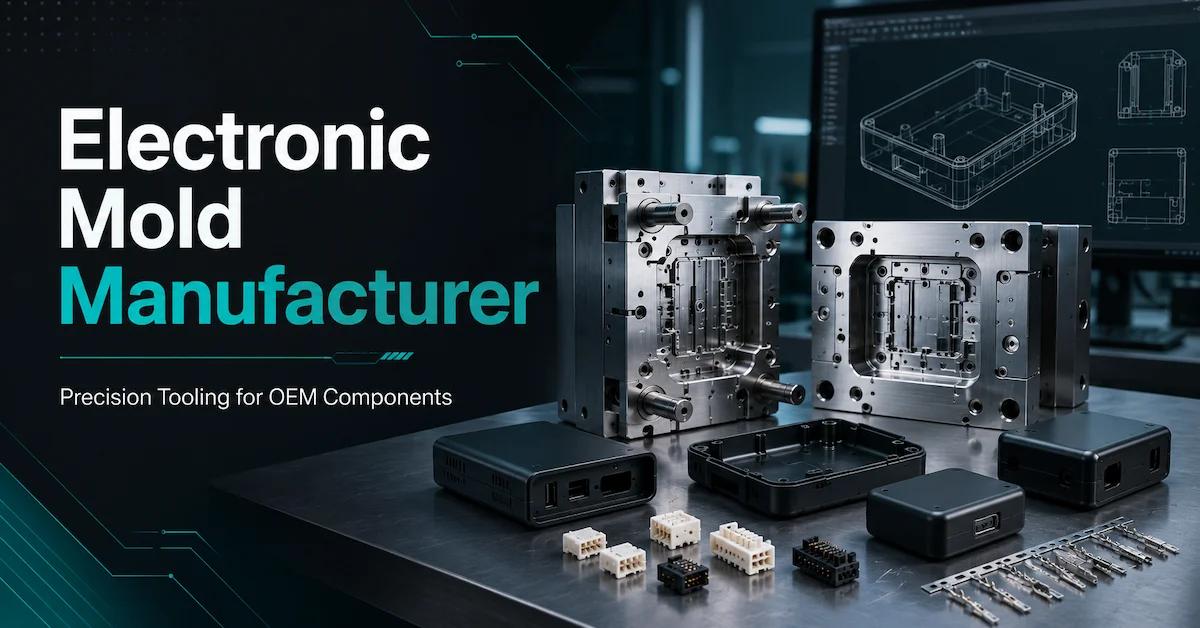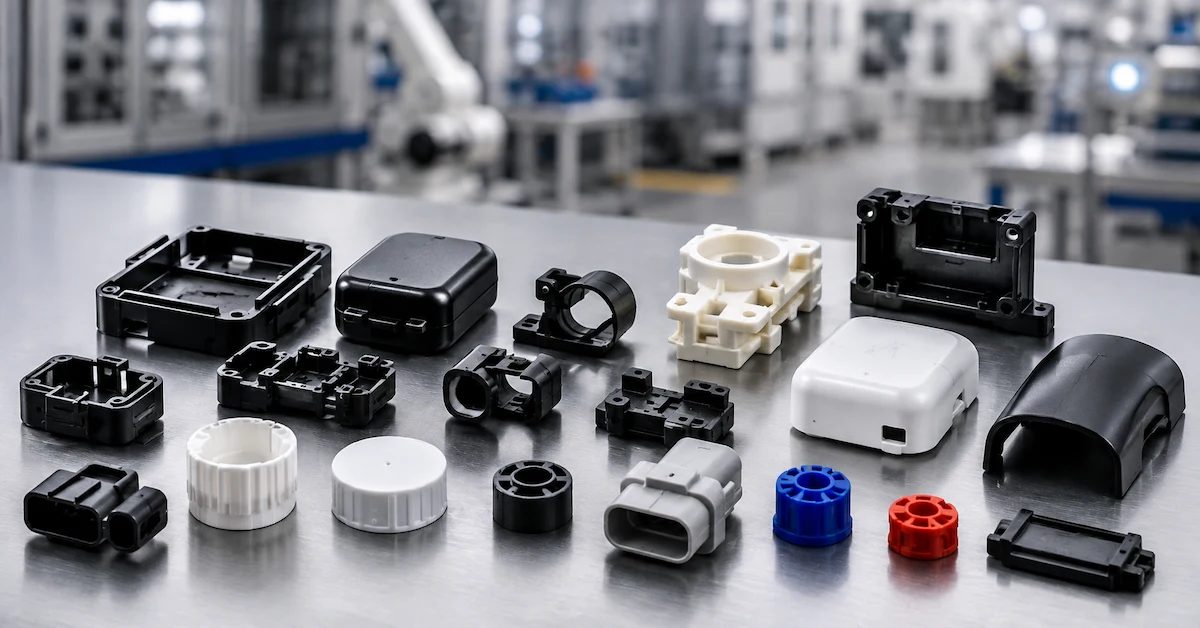
What Is a Three Plate Mold?
A three plate mold is an injection mold architecture that uses an additional runner stripper plate so the molded part and cold-runner system can separate through different opening planes.
Compared with a conventional two plate cold-runner mold, this additional movement gives mold designers greater flexibility over where the gate enters the part.
JICA's injection molding training material describes a three plate mold as consisting of a cavity plate, core plate, and runner stripper plate. It also notes that the molded product and runner are removed through different separation surfaces.
This makes three plate tooling particularly relevant when an OEM project requires:
- Pinpoint gates
- Gates away from the outer edge
- Automatic runner separation
- Multiple gate locations
- Improved control of visible gate marks
- Balanced feeding of multiple cavities
However, the additional mold movement also means more:
- Components
- Mold length
- Opening stroke
- Manufacturing work
- Maintenance considerations
For OEM buyers,the right question is not:
“Is a three plate mold more advanced?”
It is:
“Does my part actually need the gate flexibility and runner separation that justify a three plate mold?”
DongXin supports custom plastic injection mold development from DFM and mold engineering through tooling trials and production preparation.
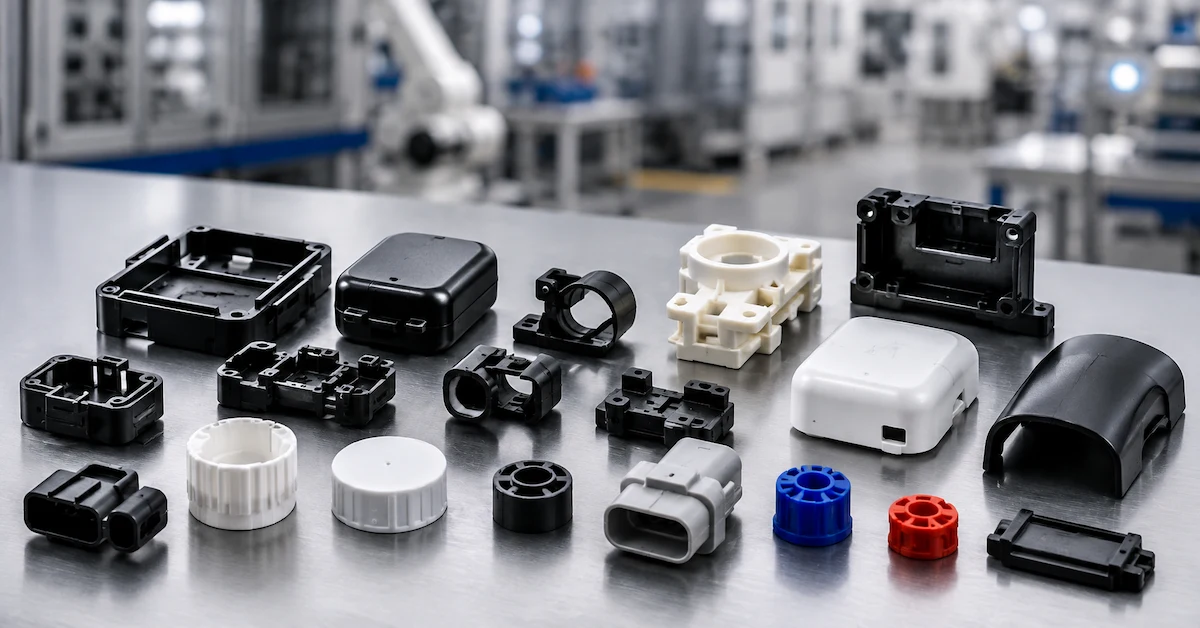
Why OEM Buyers Use Three Plate Injection Molds
The main reason to use three plate architecture is gating flexibility.
Autodesk's injection molding design guidance identifies two plate and three plate construction as common cold-runner architectures and notes that the additional plate in a three plate mold enables additional gate locations.
That capability can solve several practical product-design problems.
Gate Location Away From the Part Edge
Some components cannot accept an edge gate because of:
- Assembly interfaces
- Visible exterior surfaces
- Functional edges
- Sealing areas
- Product geometry
A three plate mold can allow a pinpoint gate to feed the part from a more suitable location.
Automatic Runner Separation
The runner and molded component can separate during the mold-opening sequence.
This may reduce manual runner removal and support more automated production.
Multiple Gate Locations
Larger or difficult-to-fill parts may benefit from multiple gates.
Three plate architecture can provide additional cold-runner gate-placement options without immediately moving to a hot runner system.
Multi-Cavity Production
Three plate molds can also serve multi-cavity tooling where balanced runner distribution and pinpoint gating are useful.
But additional cavities increase the importance of runner balance.
How Does a Three Plate Mold Work?
The key difference is that the mold opens through multiple separation stages.
A simplified cycle is:
- Mold closes.
- Molten resin enters the sprue and runner.
- Resin passes through gates into the cavities.
- Parts cool and solidify.
- The mold begins opening.
- Runner separation occurs through the dedicated runner opening.
- Gates separate from the molded components.
- The product side opens.
- Parts are ejected.
- Runner material is removed.
- The mold closes for the next cycle.
JICA training material specifically illustrates different parting/opening planes in three plate tooling and distinguishes the runner stripper plate from the cavity and core plates.
For buyers, this means the mold requires sufficient machine opening stroke and correctly controlled opening sequence.
Main Components of a Three Plate Mold
The phrase “three plate” refers to the functional opening architecture rather than implying that the entire mold contains only three pieces of steel.
A production tool can contain many additional plates, inserts, pins, guides, cooling circuits, and mechanical components.
Cavity Plate
The cavity plate commonly carries or supports the cavity-side geometry.
It may include:
- Cavity inserts
- Cooling channels
- Venting
- Parting surfaces
Core Plate
The core plate commonly forms internal product geometry and may retain the molded component before ejection.
It may include:
- Core inserts
- Slides
- Lifters
- Cooling channels
- Shut-offs
Runner Stripper Plate
This additional plate helps separate and release the cold runner.
Its introduction is what differentiates the classic three plate architecture from a conventional two plate cold-runner mold.
Runner System
The feed system may include:
- Sprue
- Main runner
- Branch runners
- Pinpoint gates
Ejection System
Depending on the product, ejection may use:
- Ejector pins
- Sleeves
- Stripper mechanisms
- Specialized ejectors
The complete mold architecture therefore has to be designed around both runner separation and finished-part ejection.
Why Pinpoint Gates Are Closely Associated With Three Plate Molds
Pinpoint gating is one of the strongest reasons OEM buyers encounter three plate tooling.
A pinpoint gate is a relatively small gate commonly positioned on a face of the molded component rather than being limited to a conventional edge-gate location.
A properly engineered pinpoint gate can provide:
- Small gate vestige
- Flexible gate positioning
- Automatic gate separation
- Multiple feeding points
This can be useful for:
- Cosmetic housings
- Electronics components
- Consumer parts
- Multi-cavity products
- Components where edge gating interferes with assembly
JICA's technical material specifically associates pinpoint gate molding with three plate structure.
But smaller gates can also increase demands on:
- Injection pressure
- Resin flow
- Gate design
- Gate freeze behavior
- Runner design
So pinpoint gating should not be selected only because it leaves a smaller mark.
Three Plate Mold vs Two Plate Mold
This is the first comparison most OEM buyers should make.
| Factor | Two Plate Mold | Three Plate Mold |
|---|---|---|
| Basic opening architecture | Simpler | Additional runner-opening stage |
| Cold-runner gate flexibility | Lower | Greater |
| Pinpoint gate | Less typical | Common |
| Runner separation | Usually same primary opening | Separate opening plane |
| Mold structure | Simpler | More complex |
| Opening stroke requirement | Generally lower | Generally higher |
| Maintenance | Easier in many cases | More components to inspect |
| Initial tooling investment | Often lower | Often higher |
| Best fit | Straightforward gating | Projects needing flexible cold-runner gating |
JICA notes that three plate construction typically carries greater mold and molding cost than two plate architecture because of the added structure and operating sequence.
That does not mean three plate molds are inefficient.
It means the added functionality should solve a real product or production requirement.
When a Two Plate Mold Is the Better Choice
A competent three plate mold supplier should sometimes recommend a two plate mold instead.
Two plate architecture may be preferable when:
- An edge gate is acceptable
- A tunnel gate can solve automatic degating
- Gate location is not restrictive
- The product is relatively straightforward
- Lower tooling complexity is desirable
- Easier export-mold maintenance is important
- Production volume does not justify a more elaborate feed system
Adding a third plate when it provides no meaningful benefit can create unnecessary:
- Cost
- Mold size
- Maintenance
- Cycle complexity
The goal is not to purchase the most complicated mold.
The goal is to purchase the simplest mold architecture that reliably produces the required part.
Three Plate Mold vs Hot Runner Mold
These two options can sometimes compete for the same project because both may solve gate-location challenges.
However, they do so differently.
Three Plate Cold Runner
The material in the runner cools and is removed each cycle.
Potential advantages include:
- No heated manifold system
- More flexible cold-runner gate placement
- Easier temperature-system maintenance
- Lower initial investment than some hot-runner configurations
Potential disadvantages include:
- Runner material consumption
- Additional mold-opening movement
- Larger opening stroke
- Runner handling
Hot Runner Mold
A heated feed system keeps material molten inside the runner.
Potential advantages can include:
- Reduced cold-runner waste
- Flexible gate positioning
- Efficient high-volume production
- Valve-gate options for demanding applications
Potential disadvantages include:
- Higher initial investment
- Heating and control components
- More specialized maintenance
- Resin compatibility considerations
For high-volume projects, buyers should compare:
three plate tooling investment + runner material cost
against:
hot runner investment + maintenance + production savings
rather than deciding from mold price alone.
Three Plate Mold vs Hot Runner: Quick Buyer Decision Table
| Project Requirement | Three Plate Cold Runner | Hot Runner |
|---|---|---|
| Moderate production quantity | Strong option | Depends on ROI |
| Small pinpoint gates | Strong option | Strong option |
| Low runner waste priority | Weak | Strong |
| Simple maintenance priority | Better | More complex |
| Expensive resin | Runner cost can matter | Often worth evaluating |
| Frequent mold export | Easier support may help | Spare-parts planning important |
| Very high volume | Possible | Often worth evaluating |
| Valve-gate control | No | Yes |
A good supplier should explain the economic logic behind its recommendation.
DFM Should Decide the Mold Architecture Before Steel Is Cut
Three plate mold sourcing should begin with product geometry—not with a predefined mold label.
During DFM, the engineering team should review:
- Part size
- Wall thickness
- Draft
- Undercuts
- Cosmetic surfaces
- Critical dimensions
- Flow length
- Weld-line sensitivity
- Material
- Cavity count
- Annual production quantity
DongXin's engineering support can be used during the pre-tooling stage to evaluate moldability before final mold architecture is released.
Identify Cosmetic Surfaces
If the customer does not identify A-surfaces early, a technically functional gate may still create an unacceptable appearance.
Identify Assembly Interfaces
Gate marks should not interfere with:
- Clips
- Seals
- Mating surfaces
- Connectors
- Fastener areas
Identify Critical Dimensions
Gate and packing conditions can influence shrinkage and dimensional behavior.
Dimensions affecting assembly should therefore be clearly identified on the drawing.
Runner Design Is Critical in Three Plate Tooling
The additional runner freedom provided by three plate construction is useful only if the feed system is properly designed.
Key variables include:
- Runner diameter
- Runner length
- Branch layout
- Gate size
- Gate position
- Material viscosity
- Cavity number
For a multi-cavity mold, poor runner balance can cause cavities to fill at different times.
Autodesk explains that runner balance analysis is used to optimize runner sections so cavities fill more evenly while maintaining acceptable pressure, helping reduce overpacking and unnecessary runner volume.
What Happens When the Runner Is Not Balanced?
Possible consequences include:
- One cavity filling early
- Another cavity short-shotting
- Different packing conditions
- Part-weight variation
- Dimensional differences
- Flash in earlier-filling cavities
- Inconsistent appearance
For OEM projects requiring several identical parts from every shot, cavity-to-cavity consistency matters as much as the quality of one individual sample.
Multi-Cavity Three Plate Molds
Three plate construction can be useful for multi-cavity molds where pinpoint gates need to feed multiple parts from strategically selected locations.
Potential applications include:
- Small housings
- Caps
- Clips
- Electronic components
- Consumer products
- Industrial plastic components
The mold manufacturer must coordinate:
Cavity Layout → Runner Layout → Gate Position → Cooling → Ejection
Increasing cavity count should therefore not be treated as simply copying one cavity 8 or 16 times.
Machine capacity also needs to be considered.
Important inputs include:
- Total shot weight
- Clamp requirement
- Mold dimensions
- Opening stroke
- Ejection requirements
The Production Resin Should Be Known Before Final Mold Design
The same mold concept can behave differently with different thermoplastics.
Material factors include:
- Viscosity
- Shrinkage
- Processing temperature
- Shear sensitivity
- Fillers
- Abrasiveness
- Thermal stability
Typical materials may include:
- ABS
- PP
- PC
- PC/ABS
- PA
- POM
- TPE
- Engineering thermoplastics
But the exact grade is much more useful than simply saying:
“Plastic material.”
A three plate mold supplier should ideally request the production-grade material specification before finalizing:
- Runner size
- Gate size
- Mold compensation
- Processing assumptions
Cooling Still Determines Part Stability
Three plate architecture solves runner and gating requirements.
It does not solve poor thermal design.
Cooling can influence:
- Cycle time
- Warpage
- Shrinkage
- Flatness
- Dimensional consistency
Important cooling regions may include:
- Deep cores
- Thick bosses
- Large flat walls
- Areas around inserts
- Dense cavity layouts
For multi-cavity molds, cooling consistency between cavities also becomes important.
Two cavities receiving similar melt flow can still produce different parts if their thermal conditions differ significantly.
Venting Should Not Be Overlooked
As plastic fills a cavity, trapped air must escape.
Poor venting may contribute to:
- Burn marks
- Short shots
- Surface defects
- Excessive injection pressure
Three plate gate flexibility can improve how a cavity is fed, but the manufacturer still needs to analyze end-of-fill locations.
DFM and mold trials should review:
- Deep ribs
- Far ends of flow paths
- Weld-line zones
- Thin features
Ejection Design Matters After the Gate Problem Is Solved
It is possible to design an excellent gate and still have an unreliable mold because the product cannot eject properly.
Ejection design needs to consider:
- Part retention
- Draft
- Surface appearance
- Part stiffness
- Ejector mark locations
- Product deformation
Common solutions include:
- Ejector pins
- Sleeves
- Stripper plates
- Lifters
Cosmetic products require particular care because ejector marks may be unacceptable on visible surfaces.
Manufacturing a Three Plate Mold
After design approval, tooling typically moves through several controlled manufacturing stages.
CNC Machining
CNC machining may be used for:
- Core
- Cavity
- Inserts
- Mold plates
- Runner-related components
EDM
EDM may be required for:
- Deep details
- Narrow ribs
- Difficult corners
- Precision shut-offs
Grinding and Fitting
Parting surfaces and moving components need controlled fitting.
Mold Assembly
Toolmakers verify:
- Plate movement
- Opening sequence
- Guide systems
- Runner release
- Ejection
- Slides and lifters
- Mold closing
Three plate molds deserve particular attention during assembly because their additional opening movement must work reliably.
Why Opening Sequence Matters
A three plate mold depends on controlled movement between the mold sections.
If the sequence does not function correctly, problems can include:
- Runner not separating
- Gate damage
- Parts sticking
- Mold component interference
- Unreliable automatic operation
JICA's training documentation specifically treats the opening sequence of three plate molds as an important part of understanding the architecture.
For buyers, this means mold trial should verify the complete automatic cycle—not only sample appearance.
What Should Be Checked During T0?
A useful first trial should evaluate:
Runner Release
Does the runner separate consistently?
Gate Break
Do pinpoint gates break where intended?
Filling
Are all cavities completely filled?
Part Appearance
Check:
- Gate vestige
- Weld lines
- Flow marks
- Burn marks
- Sink
Dimensional Results
Critical features should be inspected against the approved drawing.
Ejection
Does the part eject without:
- Drag
- Stress marks
- Distortion
- Sticking
Automatic Mold Sequence
The mold should complete the required opening, runner release, part ejection, and closing operations consistently.
What Determines Three Plate Mold Cost?
Three plate mold pricing depends on much more than the number of plates.
| Cost Driver | Why It Matters |
|---|---|
| Part size | Changes mold dimensions and machining |
| Cavity count | More cavities increase runner and tooling complexity |
| Gate number | Affects runner network |
| Mold steel | Influences material and machining cost |
| Resin | Changes gate,runner and wear considerations |
| Slides/lifters | Add mechanisms |
| Surface finish | May require polishing or texture |
| Tight tolerances | Increase machining and validation |
| Runner layout | More complex feed systems require engineering |
| Expected production life | Influences tooling construction |
| Trial requirements | Affects validation workload |
A serious mold quotation should explain the proposed structure sufficiently for the buyer to understand what is being purchased.
Three Plate Mold Cost Should Be Compared With Production Cost
A lower tooling price does not always produce the lowest long-term cost.
For a three plate cold-runner mold, buyers should estimate:
Runner Weight × Resin Cost × Number of Cycles
If the tool produces large runners over millions of cycles, material economics may justify evaluating a hot runner.
Conversely, if the program volume is modest, a hot runner system may add investment that never delivers sufficient payback.
The correct comparison is:
Tool Cost + Material + Cycle + Labor + Scrap + Maintenance
not:
Tool Quote A vs Tool Quote B
When Three Plate Tooling May Not Be the Best Solution
Consider alternatives when:
- Edge or tunnel gating works well in a two plate mold
- Production quantity is too low to justify additional complexity
- Runner weight becomes economically significant
- High-volume production favors a hot runner
- Valve-gate control is required
- Machine opening stroke is limited
- Local maintenance simplicity is a major priority
A professional supplier should be able to explain when not to buy a three plate mold.
That is often a stronger indication of engineering competence than simply offering every possible mold technology.
Export Three Plate Molds Require Extra Planning
If the mold will be shipped to the customer's factory, maintenance and machine compatibility should be considered during sourcing.
Confirm:
- Injection machine platen size
- Tie-bar spacing
- Mold thickness
- Opening stroke
- Ejection interface
- Locating ring
- Sprue-bushing requirements
- Water connections
- Electrical components where applicable
Also request documentation such as:
- Mold assembly drawing
- Cooling diagram
- Parts list
- Recommended spare parts
- Material specifications
An export mold needs to remain serviceable after it leaves the supplier's toolroom.
What Should a Three Plate Mold Supplier Ask Before Quoting?
A strong supplier should ask for more than a STEP file.
Expect questions such as:
- What resin grade will be molded?
- What annual quantity is expected?
- Which surfaces are cosmetic?
- Which dimensions are critical?
- What cavity count is required?
- Is automatic degating required?
- Why is pinpoint gating preferred?
- Where will the mold run?
- Which injection molding machine will be used?
- Will the supplier also produce the molded parts?
These questions indicate that the manufacturer is designing around the production program rather than quoting only the steel.
How to Evaluate a Three Plate Mold Supplier
1. Ask Why Three Plate Architecture Is Recommended
The supplier should explain why it is better for the part than:
- Two plate
- Tunnel gate
- Hot runner
2. Review the Gate Proposal
Ask for:
- Gate type
- Gate location
- Expected vestige
- Runner layout
3. Review Runner Balance
For multi-cavity tools, ask how the supplier intends to achieve similar filling conditions across cavities.
4. Check Opening-Sequence Design
Ask how the runner stripper and mold-opening stages are controlled.
5. Evaluate Manufacturing Capability
The tooling workflow should appropriately cover:
- CNC
- EDM
- Mold fitting
- Assembly
- Inspection
6. Understand Trial Approval
Ask:
- How many trial stages are expected?
- What will be measured?
- How will corrections be handled?
- Who approves the final sample?
7. Evaluate Production Support
A supplier capable of both tooling and plastic injection molding production can continue optimizing the mold under actual processing conditions.
Red Flags When Comparing Three Plate Mold Suppliers
Be cautious if a supplier:
- Recommends three plate tooling without explaining why
- Does not ask about resin
- Does not identify cosmetic surfaces
- Cannot explain runner separation
- Ignores machine opening stroke
- Provides no runner-balance discussion for multi-cavity tooling
- Cannot explain the gate vestige
- Gives no DFM before mold release
- Provides no mold-trial plan
- Focuses only on tooling price
A good supplier makes the mold concept understandable before asking the customer to approve it.
Three Plate Mold RFQ Checklist
Prepare the following before requesting quotations:
| Information | Why It Matters |
|---|---|
| 3D CAD / STEP | Defines complete geometry |
| 2D drawing | Identifies tolerances |
| Resin grade | Determines flow and shrinkage assumptions |
| Annual volume | Supports architecture decisions |
| Cavity requirement | Affects mold and runner design |
| Cosmetic surfaces | Guides gate and ejection planning |
| Gate restrictions | Helps determine three plate necessity |
| Critical dimensions | Directs validation |
| Surface finish | Affects tooling requirements |
| Injection machine | Confirms mold compatibility |
| Mold destination | Supports export design |
| Finished-part requirement | Defines tooling-only vs mold + molding project |
Providing this information produces a more meaningful RFQ than simply asking:
“Price for three plate mold?”
What Should a Three Plate Mold Quotation Clarify?
Before comparing prices, confirm whether each quote includes the same assumptions.
Useful items include:
- Mold cavity count
- Proposed mold architecture
- Gate type
- Runner layout
- Mold steel
- Mold base
- Slides/lifters
- Surface requirements
- Tooling trial
- Sample quantity
- Expected lead-time assumptions
- Documentation
- Spare parts
- Mold destination
- Production molding if required
Two quotations can appear to describe the same “three plate mold” while actually representing very different tooling solutions.
Applications of Three Plate Injection Molds
Three plate tooling can be used across several industries when the part and gating requirements justify it.
Electronics
Potential parts include:
- Device housings
- Covers
- Electrical components
- Internal structures
Automotive
Possible applications include:
- Small functional components
- Interior plastic parts
- Brackets
- Housings
Consumer Products
Examples include:
- Appliance components
- Household plastic parts
- Small molded accessories
Industrial Products
Examples include:
- Equipment housings
- Control components
- Mounting parts
Other Precision Plastic Parts
Three plate architecture can also support smaller multi-cavity components requiring centrally positioned or automatically separated pinpoint gates.
The choice should always be based on the individual product rather than industry name alone.
FAQ About Three Plate Mold Suppliers
What is a three plate injection mold?
A three plate mold uses an additional runner stripper plate and multiple separation planes so the cold runner and finished molded parts can be released separately.
Why use a three plate mold instead of a two plate mold?
A three plate mold is commonly selected when a project needs greater cold-runner gate-location flexibility, particularly pinpoint gates and separate runner removal.
What type of gate is commonly used in a three plate mold?
Pinpoint gates are strongly associated with three plate cold-runner tooling, although final gate selection still depends on resin, part geometry, appearance, and processing requirements.
Is a three plate mold more expensive than a two plate mold?
It is generally more complex and can require greater tooling investment, but actual cost depends on part size, cavity count, steel, mechanisms, tolerances, surface finish, and other project requirements.
Can a three plate mold be multi-cavity?
Yes. Three plate molds can support multiple cavities, but runner layout and cavity balance require careful design to maintain consistent filling.
What is the difference between a three plate mold and a hot runner mold?
A conventional three plate mold uses a cold runner that solidifies and is removed during each cycle. A hot runner maintains molten material inside a heated feed system and can reduce runner waste.
Does a three plate mold automatically remove the runner?
The architecture can support automatic runner and gate separation, but reliable operation depends on correct runner, gate, opening-sequence, and mold design.
When should I choose a hot runner instead?
A hot runner may be worth evaluating for high-volume programs, expensive materials, large runner weights, automation requirements, or applications where eliminating cold-runner waste creates a meaningful economic benefit.
What should I send a three plate mold supplier for quotation?
Send 3D CAD, 2D drawings, exact or intended resin, annual production quantity, cavity requirements, cosmetic surfaces, critical dimensions, injection-machine information, and mold destination.
Can DongXin manufacture the mold and the finished plastic parts?
DongXin supports plastic injection mold manufacturing as well as plastic molding, allowing tooling trials and later production requirements to be managed within one project workflow.
Conclusion
Choosing a three plate mold supplier should start with the product's gating and production requirements—not with a preference for a particular mold architecture.
A three plate mold can provide valuable advantages when an OEM project requires:
- Pinpoint gating
- Greater cold-runner gate flexibility
- Separate runner removal
- Multi-cavity feeding
- Automated degating
But those advantages come with additional:
- Mold movement
- Manufacturing complexity
- Opening-stroke requirements
- Maintenance
- Tooling investment
The right sourcing decision therefore connects:
Part Geometry → Resin → Gate Requirement → Runner Design → Cavity Count → Mold Architecture → Trial Validation → Production Economics
DongXin provides custom mold and molding services for OEM projects requiring DFM, injection mold development, tooling trials, and production support.
For a more useful three plate mold evaluation, contact DongXin with your 3D CAD, 2D drawing, resin grade, annual volume, cavity requirement, gate restrictions, critical dimensions, and mold destination.