What Is a Two Plate Mold?
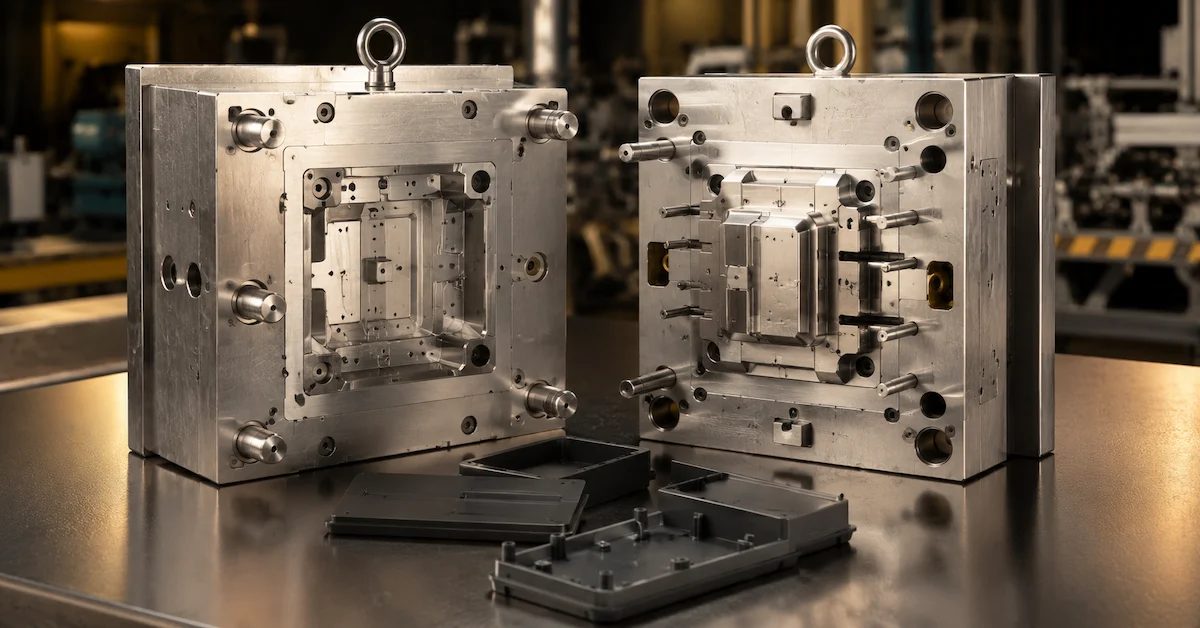
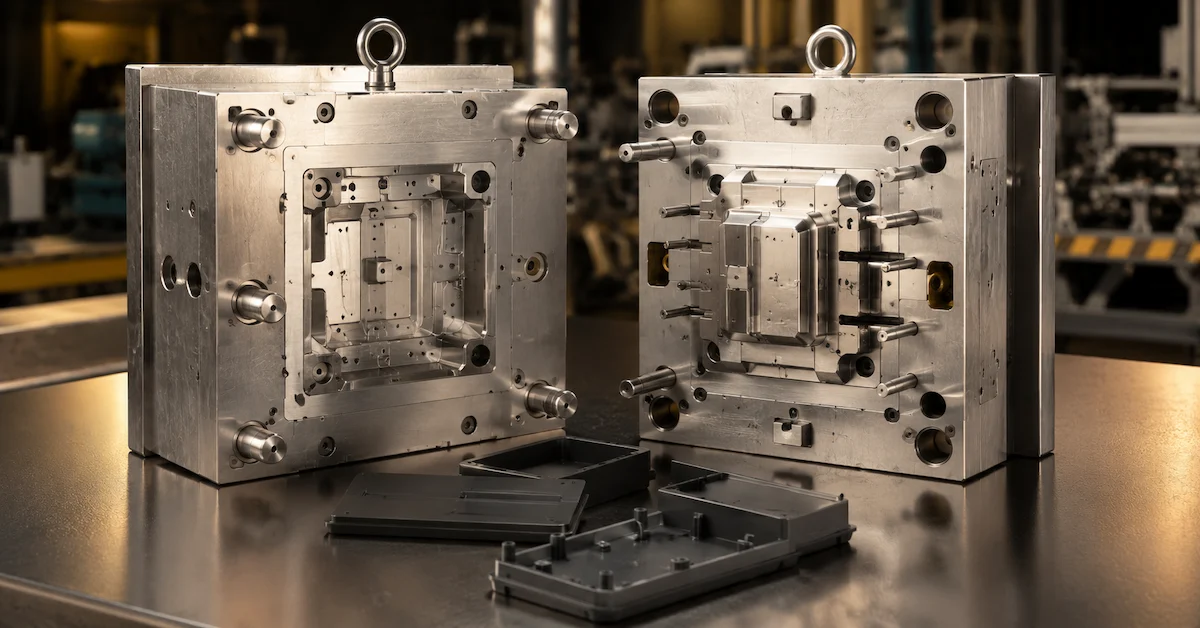
A two plate mold is an injection mold whose main mold halves separate at one primary parting line between the cavity side and core side.
In a conventional cold-runner two plate mold, the molded part and runner system are generally released from the same parting plane. Autodesk identifies two-plate and three-plate construction as common cold-runner mold architectures, while JICA training material describes the cavity plate and core plate as the two principal mold sections.
For many plastic parts, this relatively direct structure can make a two plate mold attractive because it can offer:
- Fewer mold movements
- Straightforward opening and closing
- Easier maintenance
- Lower structural complexity
- Reliable mass-production potential
- Flexible single- or multi-cavity layouts
But simple architecture does not mean simple engineering.
A professional two plate mold manufacturer still needs to control:
Part Design → DFM → Gate → Runner → Cooling → Ejection → CNC/EDM → Mold Trial → Production Validation
For OEM buyers, the important question is therefore not:
“Is a two plate mold cheaper?”
It is:
“Is a two plate mold the simplest architecture that can reliably produce my part at the required quality and volume?”
DongXin supports custom plastic tooling from engineering review through mold development and trial molding. Plastic injection mold solutions from DongXin
When Is a Two Plate Mold a Good Choice?
Two plate molds are widely applicable, but they are especially worth evaluating when the product does not require unnecessary mold-opening stages or complex runner separation.
Typical project conditions include:
| Project Condition | Why a Two Plate Mold May Fit |
|---|---|
| Relatively straightforward part geometry | Simpler mold action may be sufficient |
| Edge or tunnel gate is acceptable | Two-plate gating can often meet the requirement |
| Single-cavity production | Straightforward tooling structure |
| Multi-cavity production | Balanced cold or hot runner can be designed |
| Cost-sensitive tooling program | Avoiding unnecessary plates can reduce complexity |
| Export tooling | Simpler architecture may be easier to maintain |
| Stable long-term production | Fewer mold actions may simplify maintenance |
| OEM part with no special gate requirement | Two-plate design may provide the required functionality |
The word “may” matters.
A tooling architecture should be selected after reviewing the real CAD model, not from the keyword or product category alone.
How Does a Two Plate Injection Mold Work?
During a typical injection molding cycle:
- The mold closes.
- Molten resin enters the mold.
- Resin travels through the sprue, runner, and gate where applicable.
- The cavity fills and packing occurs.
- The plastic cools.
- The mold opens along its primary parting line.
- The molded component is retained on the intended side.
- The ejection system pushes the part from the mold.
- The mold closes for the next cycle.
In a conventional cold-runner configuration, the runner normally comes out through the same primary mold opening.
This differs from a conventional three plate cold-runner mold, which adds another opening movement to separate the runner system.
For the OEM buyer, that difference affects:
- Mold complexity
- Gate options
- Degating
- Cycle sequence
- Maintenance
- Tooling cost
Main Components of a Two Plate Mold
A typical mold may include far more than “two plates.”
The term describes the basic mold-opening architecture rather than the total number of steel plates or components inside the tool.
Cavity Side
The cavity side commonly forms visible or exterior geometry.
Depending on the part, it may contain:
- Cavity inserts
- Runner
- Gate
- Cooling channels
- Venting
- Locating features
Core Side
The core side commonly forms internal geometry and may retain the molded component when the mold opens.
It can include:
- Core inserts
- Ejector pins
- Sleeves
- Lifters
- Slides
- Cooling channels
Mold Base
The mold base supports and locates the tooling components.
Ejection System
Possible ejection methods include:
- Ejector pins
- Sleeves
- Stripper mechanisms
- Specialized ejectors
The correct method depends on product geometry and where ejection marks are acceptable.
Why Gate Strategy Is Important in Two Plate Mold Design
Gate location is one of the most important decisions in two plate tooling.
Autodesk notes that sprues, runners, and gates form the feed system carrying melt into the cavity, and that runner layout can affect pressure, material use, filling balance, and final part quality.
Common Gate Options
Depending on geometry,a two plate mold may use options such as:
- Direct sprue gate
- Edge gate
- Fan gate
- Tab gate
- Tunnel/submarine gate
- Hot runner gate
The correct gate should be selected according to:
- Part geometry
- Wall thickness
- Resin
- Flow length
- Cosmetic surface
- Packing requirements
- Gate removal
- Automation
Edge Gate
An edge gate is relatively straightforward and widely applicable.
However, the gate vestige remains at the part edge and usually needs to be considered in appearance and assembly.
Tunnel Gate
A properly designed tunnel or submarine gate can allow automatic separation in some two plate molds.
This can be useful when buyers want:
- Reduced manual degating
- Automated production
- Cleaner part handling
But tunnel gates are not appropriate for every resin or geometry.
Direct Sprue Gate
A direct sprue gate may provide a short flow path and can be suitable for certain large or thick components.
The tradeoff is a larger gate mark and possible secondary gate removal.
Why Pinpoint Gating May Lead to a Three Plate Mold
This is one of the most important procurement distinctions.
A conventional cold-runner two plate mold has limitations on where the runner and gate can be separated because the runner and molded component share the primary mold opening.
Three plate tooling introduces an additional runner-separation plane, which can provide more freedom in gate placement. Autodesk's injection molding design material specifically notes that three plate cold-runner molds allow additional gate locations compared with conventional two plate cold-runner molds.
Therefore, a three plate mold may be considered when:
- Pinpoint gating is required
- Gate location cannot conveniently be placed at the edge
- Automatic runner separation is important
- Cosmetic requirements make conventional edge gating undesirable
But additional functionality also adds tooling complexity.
Two Plate Mold vs Three Plate Mold
OEM buyers should choose architecture based on the part rather than assuming one design is always superior.
| Factor | Two Plate Mold | Three Plate Mold |
|---|---|---|
| Main opening structure | Simpler | Additional opening stage |
| Tool complexity | Generally lower | Generally higher |
| Cold-runner gate flexibility | More limited | Greater flexibility |
| Pinpoint gating | Less suitable conventionally | Common application |
| Runner separation | Same main opening in typical cold runner | Separate runner opening |
| Maintenance | Generally simpler | More components to maintain |
| Initial tooling cost | Often lower | Often higher |
| Best fit | Straightforward gating and production | Projects needing additional gate flexibility |
A good two plate mold manufacturer should not automatically sell a two plate solution.
The manufacturer should explain why it fits the product better than the alternatives.
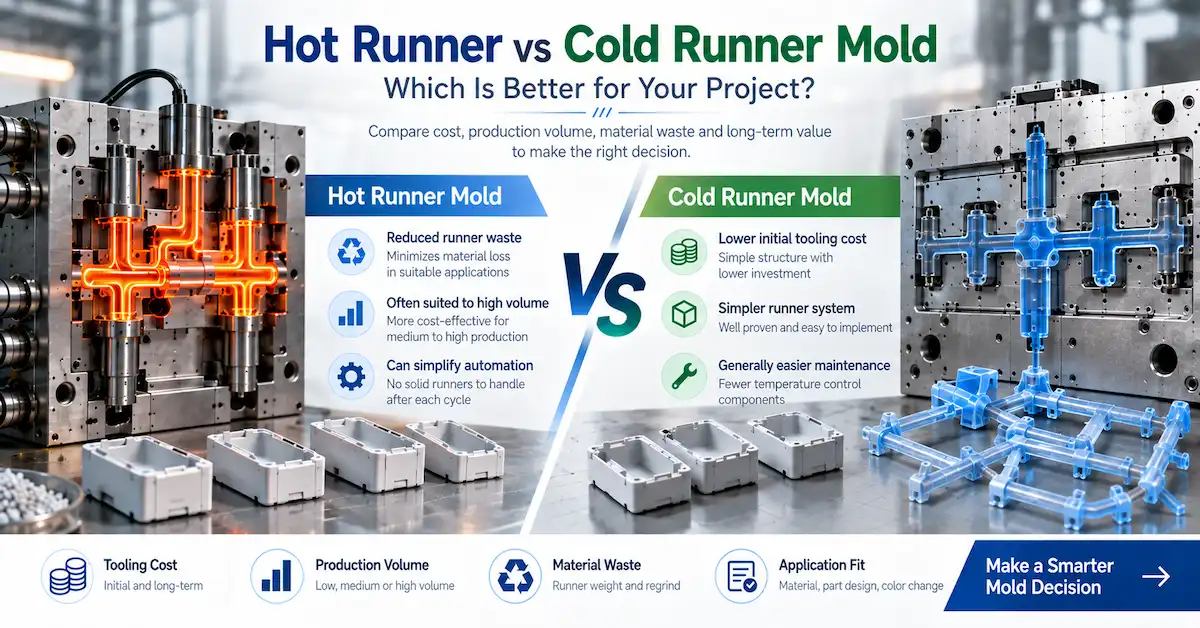
Two Plate Mold vs Hot Runner Mold
These terms are not always direct opposites.
A two plate mold describes mold-opening architecture.
A hot runner describes the resin-delivery system.
A two plate mold can therefore be designed with:
- Cold runner
- Hot runner
depending on production requirements.
For buyers,the more useful comparison is often:
Two Plate Cold Runner
Potential advantages:
- Simpler system
- Lower initial tooling investment
- Easier maintenance
- Flexible for lower or moderate production volumes
Potential tradeoffs:
- Runner material
- Degating
- Material waste if runners cannot be reused
- Runner cooling time
Two Plate Hot Runner
Potential advantages for suitable projects:
- Less cold-runner material
- Potentially cleaner automation
- Efficient multi-cavity feeding
- Additional gate possibilities depending on system
Potential tradeoffs:
- Higher initial cost
- Temperature-control requirements
- More maintenance
- Additional system components
If production volume is high, OEM buyers can compare this article with the hot-runner sourcing criteria discussed in DongXin's hot runner mold guide.
Single-Cavity vs Multi-Cavity Two Plate Molds
Two plate architecture can be used for both.
Single-Cavity Mold
Suitable when:
- Part size is large
- Volume is limited
- Tooling simplicity is important
- Project validation is still evolving
Multi-Cavity Mold
Suitable when:
- Large quantities of identical components are required
- Machine capacity supports multiple cavities
- Production economics justify the tooling investment
The biggest technical challenge becomes runner and cavity balance.
Autodesk recommends considering cavity number, material, processing conditions, runner layout, and flow balance when designing multi-cavity two plate runner systems.
A poorly balanced mold may create:
- Different filling times
- Part-weight variation
- Overpacking
- Short shots
- Dimensional variation
Therefore, increasing cavity count is not simply a matter of copying the cavity multiple times.
Part Design Still Determines Mold Complexity
A two plate mold can become mechanically complex if the molded component contains difficult geometry.
Features that affect mold architecture include:
- Undercuts
- Side holes
- Deep ribs
- Internal hooks
- Snap fits
- Threads
- Complex shut-offs
Slides
Slides can release external undercuts or side features.
They may increase:
- Mold width
- Machining
- Assembly complexity
- Maintenance requirements
Lifters
Lifters may be used for certain internal undercuts.
Again, the mold may still technically be a two plate mold even though several mechanical actions occur during opening and ejection.
This is why buyers should never compare quotations only by the label “2-plate mold.”
Two suppliers can quote two-plate tooling with significantly different internal structures.
DFM Should Be Completed Before Tooling Release
DFM helps determine whether the proposed two plate mold architecture is actually manufacturable.
Key questions include:
Is the Draft Sufficient?
Insufficient draft can cause:
- Drag marks
- Difficult ejection
- Surface damage
Is Wall Thickness Reasonably Uniform?
Large thickness changes can contribute to:
- Sink
- Shrinkage differences
- Warpage
Are Undercuts Necessary?
Removing unnecessary undercuts can sometimes eliminate:
- Slides
- Lifters
- Added maintenance
Where Should the Parting Line Be?
Parting-line decisions influence:
- Appearance
- Flash
- Mold construction
- Ejection
- Dimensional relationships
Which Surfaces Are Cosmetic?
Identifying visible surfaces early can prevent:
- Unwanted gate marks
- Ejector marks
- Visible parting lines
DongXin can review part geometry during the pre-tooling stage before mold construction begins. DongXin engineering and project support
Resin Selection Influences Two Plate Mold Design
A mold should be designed around the production resin, not just the CAD geometry.
Relevant material behavior includes:
- Shrinkage
- Flow
- Processing temperature
- Abrasiveness
- Thermal sensitivity
- Filler content
- Surface requirements
Common molded-material families may include:
- ABS
- PC
- PC/ABS
- PP
- PA
- POM
- TPE
- Other engineering thermoplastics
The exact grade matters.
For example, a glass-filled material may influence:
- Mold wear
- Flow behavior
- Dimensional shrinkage
- Surface finish
OEM buyers should therefore provide the intended resin grade before final mold-design approval whenever possible.
Cooling Design Can Determine Production Stability
Two plate tooling may be mechanically straightforward, but cooling still requires engineering.
Cooling affects:
- Cycle time
- Shrinkage
- Warpage
- Part dimensions
- Mold temperature consistency
Potential problem areas include:
- Deep cores
- Thick bosses
- Large flat surfaces
- Areas near slides
- Closely spaced multi-cavity layouts
A mold that fills correctly but cools unevenly may still produce unstable components.
This is particularly important in:
- Precision housings
- Automotive components
- Electronics assemblies
- Large flat plastic parts
Venting Is a Small Detail With a Large Effect
Air inside the mold cavity must escape as molten plastic fills the space.
Poor venting may contribute to:
- Burn marks
- Short shots
- Incomplete filling
- Surface defects
- Excessive filling pressure
Venting strategy should therefore be considered around:
- End-of-fill areas
- Ribs
- Deep pockets
- Weld-line regions
It is one of the details OEM buyers may not see in a quotation, but it can strongly affect trial results.
Precision Machining and Mold Fitting
Once the design is approved, the mold enters manufacturing.
Common operations may include:
- CNC machining
- EDM
- Grinding
- Drilling
- Polishing
- Fitting
- Assembly
DongXin's tooling workflow supports custom mold development through precision machining and trial preparation.
For dimensionally demanding projects, readers may also refer to the high-precision mold manufacturing decision criteria discussed in the site's precision-tooling content.
Mold Trial Is Where the Design Is Verified
The first mold trial should answer more than:
“Did a part come out?”
A useful trial evaluates:
- Filling
- Gate condition
- Flash
- Sink
- Weld lines
- Warpage
- Surface appearance
- Ejection
- Critical dimensions
- Assembly
Possible improvements after trial may involve:
- Processing parameters
- Venting
- Gate
- Cooling
- Mold fitting
- Local steel correction
OEM buyers should clarify the sample-approval process before tooling starts.
What Determines Two Plate Mold Cost?
A two plate structure does not have one standard price.
Major cost drivers include:
| Cost Factor | Effect on Tooling |
|---|---|
| Part size | Influences mold size and machining |
| Cavity count | More cavities increase manufacturing complexity |
| Resin | Influences tooling and processing requirements |
| Mold steel | Changes material and machining cost |
| Slides/lifters | Add mechanisms and machining |
| Gate type | Influences runner and tooling design |
| Hot vs cold runner | Major system-cost difference |
| Surface finish | May add polishing or texture requirements |
| Tolerances | May increase machining and inspection |
| Expected production volume | Influences mold construction strategy |
| Trial requirements | Affects validation workload |
The cheapest quotation is not automatically the lowest-cost production solution.
Simple Structure Does Not Mean Cheapest Total Cost
Buyers should compare:
Tooling Cost + Production Cost + Material Waste + Labor + Maintenance + Quality Risk
For example:
A simple two plate cold-runner mold might have lower initial cost.
But if the runner is heavy and resin is expensive, long-term material consumption may become important.
Alternatively, an expensive hot-runner system may not make economic sense for a low-volume program.
The right tool is the one that fits the full production plan.
When a Two Plate Mold May Not Be the Best Choice
A capable two plate mold manufacturer should be willing to recommend another architecture when the project requires it.
Consider alternatives when:
- Pinpoint gate location is essential
- Runner separation requires another opening stage
- Very high-volume material economics favor hot runner
- Multiple gate locations need advanced control
- Large-part filling requires sequential valve gating
- Product geometry makes another architecture more practical
This is one of the strongest signs of engineering credibility:
A manufacturer should optimize the project—not force every project into the same mold structure.
What Should OEM Buyers Evaluate in a Two Plate Mold Manufacturer?
A sourcing decision should evaluate engineering evidence rather than website slogans.
1.DFM Capability
Can the manufacturer explain:
- Draft
- Wall thickness
- Undercuts
- Parting line
- Gate location
- Ejection
2. Mold Architecture Selection
Ask:
Why two plate?
The manufacturer should explain why it is preferable to:
- Three plate
- Hot runner
- Other tooling alternatives
for the specific product.
3.Runner and Gate Design
For cold-runner tooling, ask:
- What gate is proposed?
- Where will the runner be?
- How is the gate removed?
- Will the gate mark affect assembly?
- How is runner balance controlled?
4. Cooling Strategy
Ask how critical regions will be cooled.
5. Machining and Mold Assembly
The manufacturer should have a clear process for:
- CNC/EDM
- Mold fitting
- Assembly
- Functional verification
6.Trial and Quality Validation
Clarify:
- What is checked at T0?
- What dimensions are measured?
- How are defects recorded?
- What happens if correction is required?
7. Production Support
A supplier that can support both mold and molding can continue optimizing tooling and processing after the initial mold trial.
DongXin supports both custom molds and finished plastic-part production. DongXin plastic molding services
Red Flags When Comparing Two Plate Mold Suppliers
Be cautious when a supplier:
- Quotes without reviewing resin
- Does not ask about annual volume
- Cannot explain gate location
- Calls every tool “standard”
- Does not identify undercuts
- Cannot explain why two plate was selected
- Provides no DFM
- Avoids discussing trial approval
- Offers unusually low pricing without defining mold structure
- Makes tolerance or mold-life claims without reference to your drawing and production requirement
A strong quotation makes the proposed tooling architecture understandable.
Two Plate Mold RFQ Checklist
To receive more comparable quotations,OEM buyers should provide:
| RFQ Item | Why It Matters |
|---|---|
| 3D CAD / STEP | Defines complete geometry |
| 2D drawing | Defines critical dimensions |
| Resin grade | Influences shrinkage and molding |
| Annual volume | Helps select mold architecture |
| Target cavity count | Influences runner and mold size |
| Surface finish | Affects tool construction |
| Cosmetic surfaces | Helps plan gate and ejection |
| Critical tolerances | Directs tooling control |
| Assembly requirements | Identifies functional dimensions |
| Machine information | Helps confirm mold compatibility |
| Mold destination | Important for export tooling |
| Production requirement | Determines whether mold or mold + molding is needed |
Do not send only an image and ask:
“How much?”
A high-quality RFQ improves both quotation accuracy and supplier comparison.
Questions to Ask Before Placing a Tooling Order
Before approving a two plate mold, ask the manufacturer:
- Why is a two plate structure recommended?
- What gate type will be used?
- Where will the gate mark appear?
- Is the runner automatically separated?
- Is the runner balanced?
- What cavity count is recommended?
- Are slides or lifters required?
- How is cooling arranged?
- Which dimensions will be checked after trial?
- What documentation and support are included?
A supplier that answers these clearly is easier to evaluate than one that only promises “high quality.”
Common Applications of Two Plate Injection Molds
Two plate tooling is used across a broad range of molded products.
Automotive Plastic Parts
Potential applications include:
- Interior components
- Housings
- Brackets
- Functional molded parts
Electronics
Examples include:
- Device housings
- Electrical components
- Covers
- Internal supports
Consumer Products
Examples include:
- Household components
- Appliance parts
- Plastic accessories
Industrial Components
Examples include:
- Equipment housings
- Covers
- Mounting components
- Functional plastic parts
Medical or Laboratory Components
Some medical and laboratory plastic components may use two plate tooling, but application-specific material, quality, regulatory, and production requirements must be evaluated separately.
The mold architecture itself does not establish medical compliance.
FAQ About Two Plate Mold Manufacturers
What is a two plate injection mold?
A two plate injection mold uses one primary mold-opening parting line between the core and cavity sides. In a conventional cold-runner configuration, the molded part and runner normally release through the same mold opening.
Why is it called a two plate mold if the mold contains many plates?
The term refers to the primary mold-opening architecture, not the total number of steel plates, inserts, ejector plates, or other components inside the tool.
What is the difference between two plate and three plate molds?
A two plate cold-runner mold usually releases the product and runner through the same main opening. A three plate mold introduces another separation movement, providing additional runner and gate-placement flexibility.
Can a two plate mold use a hot runner?
Yes. Two plate mold architecture can be combined with a hot runner system when production volume, material economics, gating, or automation requirements justify it.
Can a two plate mold be multi-cavity?
Yes. Two plate molds can contain multiple cavities. For multi-cavity applications, runner balance, cavity layout, cooling, and machine capacity become important design considerations.
What gate types can be used in a two plate mold?
Possible options include direct sprue, edge, fan, tab, tunnel/submarine, and hot-runner gates depending on product geometry, resin, appearance, and production requirements.
Is a two plate mold always cheaper than a three plate mold?
Not necessarily. Two plate architecture is generally simpler, but final tooling cost also depends on cavity count, part size, sliders, lifters, steel, hot runner systems, tolerances, and surface requirements.
When should I avoid a two plate cold-runner mold?
Another architecture may be more suitable when the project needs additional cold-runner gate-location flexibility, automatic runner separation through another opening stage, advanced hot-runner control, or other specialized functions.
What information does a two plate mold manufacturer need for a quotation?
Provide 3D CAD, 2D drawings, resin grade, annual volume, cavity requirement, surface finish, critical dimensions, assembly requirements, injection-machine information where available, and mold destination.
Can DongXin provide both the mold and molded plastic parts?
DongXin supports custom plastic injection mold development and plastic molding, allowing OEM buyers to discuss tooling, sample validation, and production requirements within one manufacturing workflow.
Conclusion
Choosing a two plate mold manufacturer should begin with one principle:
Use the simplest mold architecture that can reliably meet the part's functional, quality, volume, and production requirements.
For many plastic components, a two plate mold can provide a practical balance of:
- Straightforward structure
- Reliable operation
- Flexible cavity options
- Manageable maintenance
- Competitive tooling investment
But the architecture must still be engineered around:
Part Geometry → Resin → Gate → Runner → Cooling → Ejection → Cavity Count → Production Volume
A strong manufacturer should be able to explain not only how it will build the mold, but also why a two plate structure is the right choice.
DongXin supports OEM projects with DFM review, custom injection mold development, tooling trials, and plastic molding production. DongXin mold and molding services
For a more useful tooling evaluation, send your 3D CAD, 2D drawing, resin grade, expected annual quantity, cavity requirement, critical dimensions, and mold destination when requesting a quotation. Contact DongXin for a tooling review