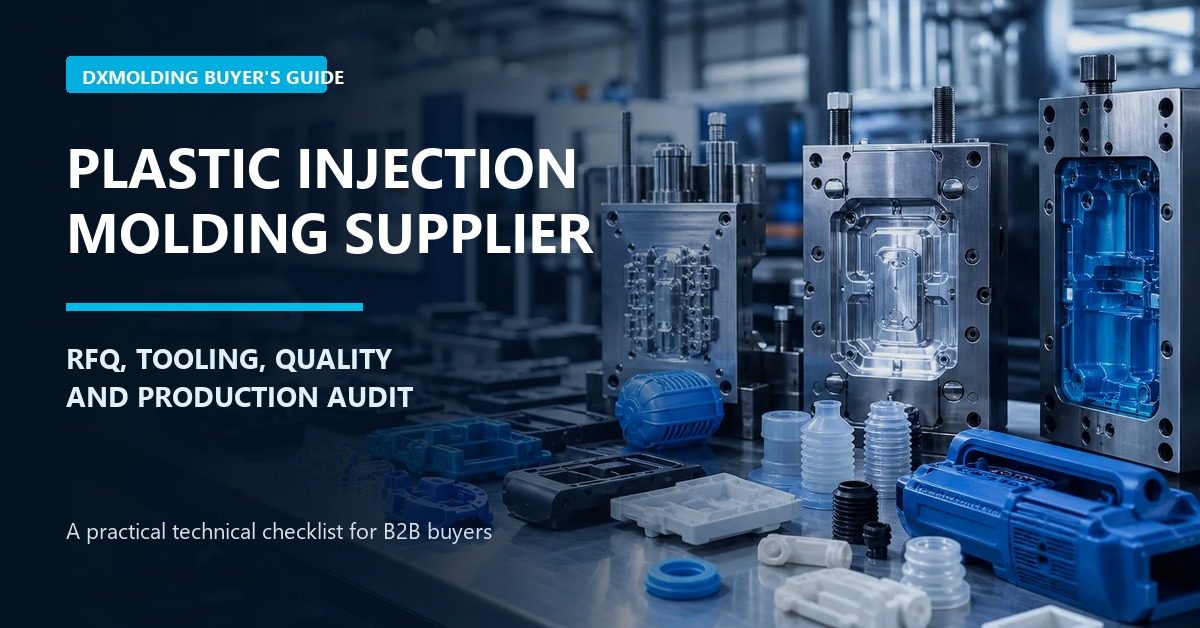
A dependable plastic injection molding supplier should do more than run a molding machine. The supplier must be able to review the part before tooling, define what the mold will deliver, control resin and process conditions, measure the dimensions that matter, manage changes, and repeat the approved result in production. A polished quotation or a wall of machines does not prove those abilities. Evidence does.
This guide is written for product engineers, sourcing managers, quality teams, and founders who need custom molded parts rather than a generic list of factories. It explains what to send in an RFQ, what to ask during a technical audit, how to compare quotations on the same basis, and how to recognize problems before a purchase order locks them into the project.
Short answer: choose the supplier whose assumptions, engineering decisions, validation plan, and responsibilities are easiest to verify. The lowest tooling price can become the most expensive option if the quote excludes necessary actions, the tool cannot maintain the required part, or every production issue turns into an argument about responsibility.
What Is a Plastic Injection Molding Supplier?
A plastic injection molding supplier converts a defined plastic part into repeatable production output. Depending on the supplier's scope, that work may include design-for-manufacturability review, mold design and manufacturing, material sourcing, mold trials, injection molding, secondary operations, inspection, assembly, packaging, and delivery.
That definition matters because companies use similar labels for very different business models. One company may build molds but outsource all production molding. Another may mold parts using customer-owned tools but have limited tooling support. A trading company may coordinate several factories. A vertically integrated supplier may manage tooling and production through one project team. None of these models is automatically wrong, but the buyer needs to know who performs each operation, where the work happens, and who owns the result.
Before requesting a price, ask the supplier to map the proposed supply chain:
- Who performs DFM and approves mold design decisions?
- Who machines, assembles, and trials the mold?
- Where will production molding take place?
- Who purchases and verifies the resin?
- Who measures samples and production parts?
- Which secondary operations or assembly steps are subcontracted?
- Who is responsible when tooling, molding, or assembly causes a defect?
A clear answer exposes the real operating model. It also prevents a common sourcing failure: selecting a supplier for tooling capability when the real business risk sits in material control, molding, inspection, or change management.
Start With a Controlled RFQ Package
Supplier comparison begins with the information the buyer sends. If three companies receive three different assumptions, their prices and lead times are not comparable. A vague request such as “quote this plastic housing” invites every supplier to make its own decisions about resin, steel, cavity count, finish, tolerance, inspection, packaging, and mold life.
A useful RFQ package normally contains the following:
- Editable 3D model. STEP is widely used for solid geometry. The model should represent the current revision.
- Controlled 2D drawing. Identify datums, critical dimensions, tolerances, threads, inserts, appearance zones, notes, and revision status.
- Material requirement. Provide a resin grade when it is fixed. If it is not fixed, describe temperature, chemicals, load, impact, appearance, flame, regulatory, and environmental needs.
- Volume profile. State prototype quantity, launch quantity, annual demand, likely peak demand, and expected program life. These figures affect cavity count, automation, tool construction, and production planning.
- Cosmetic standard. Define color, texture, gloss, visible surfaces, gate restrictions, weld-line concerns, and unacceptable defect boundaries.
- Functional and assembly context. Explain mating parts, sealing surfaces, fasteners, loads, electronics, fluids, moving interfaces, and the real use environment.
- Validation deliverables. Specify samples, dimensional reports, material records, capability studies, appearance approval, test fixtures, assembly trials, packaging tests, or other required evidence.
- Commercial scope. State the destination, delivery term, packaging expectation, ownership requirement, spare-part requirement, and whether the mold must be exportable.
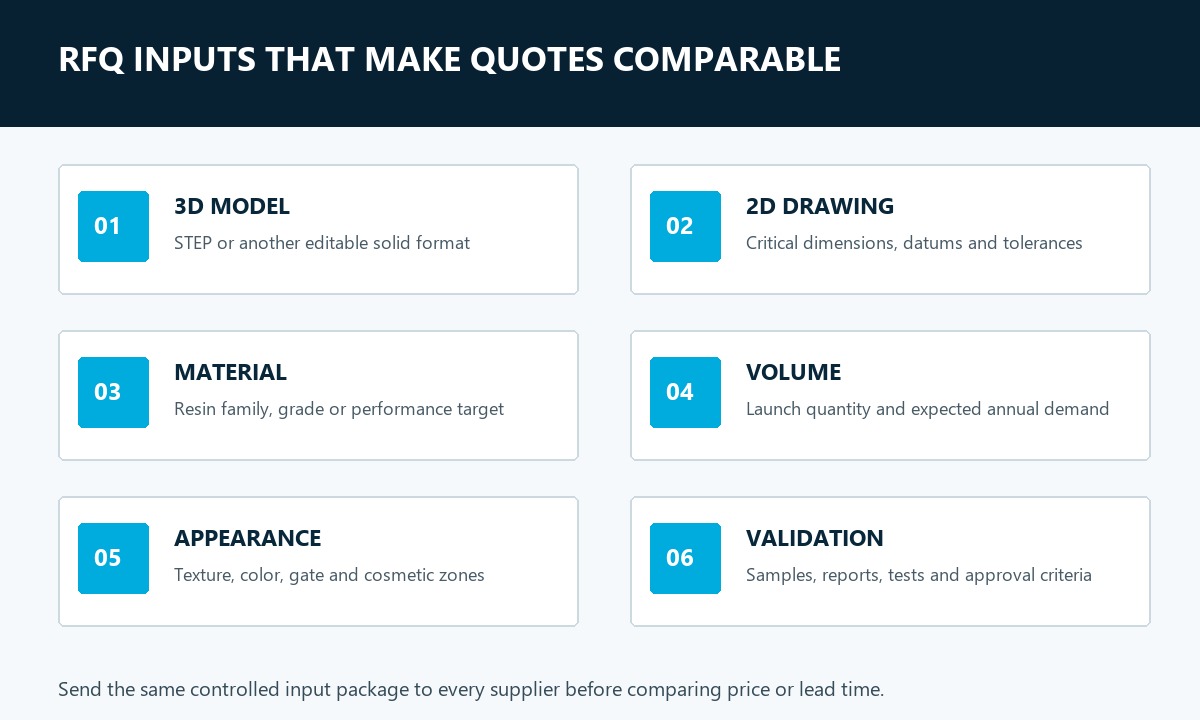
Send the same controlled package to every candidate. Record questions and answers in writing. When an assumption changes, update the comparison sheet rather than relying on a message buried in an email thread. This simple discipline makes later price discussions far more useful.
Audit the Supplier's DFM Thinking, Not Just Its DFM File
Many factories can return a colorful DFM presentation. The important question is whether the review connects part design, mold design, process behavior, measurement, and the intended use of the part.
A meaningful DFM review should identify the decision, the reason, the risk if nothing changes, and the proposed option. For example, “increase draft” is incomplete. A stronger review identifies the affected face, current draft, texture or polish requirement, expected release direction, risk of drag or distortion, and the design change that would reduce that risk.
Ask the plastic injection molding supplier to discuss these areas with the relevant geometry visible:
- Wall-thickness transitions and thick regions that may drive sink, voids, cooling imbalance, or warpage.
- Draft on cosmetic, textured, deep, or ribbed surfaces.
- Ribs, bosses, gussets, and screw features in relation to the nominal wall.
- Undercuts and whether they require slides, lifters, collapsible features, inserts, or part redesign.
- Likely gate locations and their effects on appearance, pressure, weld lines, fiber orientation, and trimming.
- Ejection area, part retention, witness marks, and deformation risk.
- Venting at fill ends, deep ribs, shutoffs, and locations likely to trap air.
- Critical dimensions, datum strategy, shrinkage assumptions, and realistic measurement access.
- Assembly stack-up, sealing, snap fits, threaded inserts, and interfaces with non-molded components.
Do not reward a supplier for finding the largest number of “problems.” Reward the supplier for separating real production risks from preferences, explaining trade-offs, and helping the team close decisions. Good DFM is a conversation with ownership, not a report sent to satisfy a checklist.
Separate Part Approval From Mold Approval
A sample can look acceptable while the tool remains poorly defined. Conversely, a well-built tool does not guarantee that the current molding process can repeatedly produce the approved part. Buyers should approve both the output and the manufacturing asset.
The tooling specification should cover more than a mold price. Depending on the project, it may define cavity count, mold base, steel and hardness, interchangeable inserts, runner system, hot-runner brand, cooling interfaces, ejection method, wear components, texture, engraving, shot counter, machine interface, electrical and hydraulic standards, lifting points, spare components, documentation, maintenance, and export requirements.
Tool-life language also needs conditions. A shot target without the resin, glass or mineral content, maintenance plan, process window, acceptable part-quality boundary, and treatment of replaceable wear parts is not a complete specification.
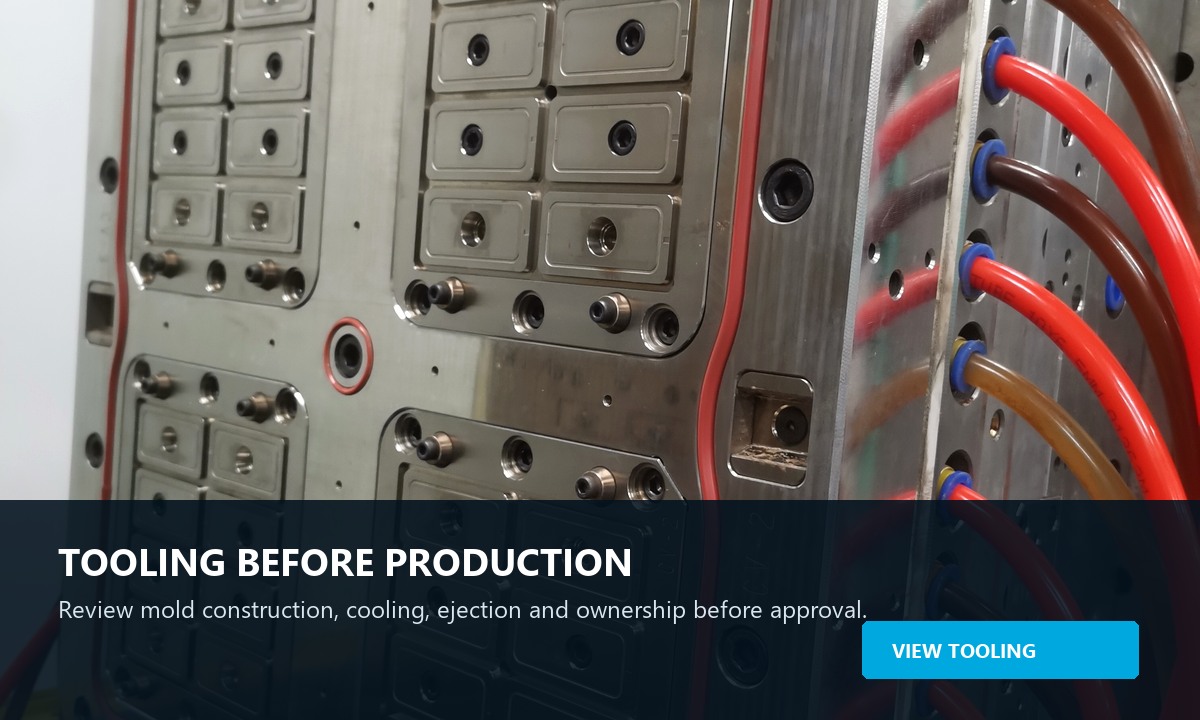
Ownership must be explicit too. The contract should state who owns the mold, when ownership transfers, how the asset is identified, where it will be stored, who pays for routine maintenance or repairs, whether production can be subcontracted, and what the supplier must provide if the tool moves. If export may be required, agree on drawings, bill of materials, spare parts, connection standards, lifting, preservation, packing, and trial support before production begins.
Check Whether the Molding Process Fits the Part
Machine count alone tells a buyer very little. A capable custom injection molding company needs a suitable machine, a controlled process, trained operators, maintenance support, and enough scheduling discipline to keep the approved process available.
Ask which machine family is proposed and why. The answer should consider clamp force, shot size, screw diameter, injection pressure, tie-bar spacing, platen size, daylight, mold thickness, core-pull needs, material residence time, dryer capacity, robot or manual handling, and secondary equipment. A machine that can physically accept the mold may still be a poor process fit.
Then ask how the process will be established and controlled. Useful evidence includes a defined setup sheet, actual versus set values, material-drying records when relevant, a trial history, a process window, first-piece approval, in-process checks, alarm response, changeover control, and documented action when output moves outside the approved condition.
Cycle time deserves the same discipline. A fast trial cycle is not automatically a stable production cycle. Shortening cooling may move cost in the right direction while moving warpage, dimensions, or assembly performance in the wrong direction. A trustworthy supplier can explain what limits the cycle and which change would be needed to reduce it without quietly shifting risk to the buyer.
Material Control Is Part of Process Control
Specifying “ABS,” “PC,” “nylon,” or “PP” is often too broad. Resin grades differ in flow, reinforcement, UV package, flame rating, colorability, release additives, impact performance, shrinkage, moisture sensitivity, and compliance documentation. The intended grade, acceptable alternative policy, color system, and regrind rule should be controlled before validation.
During an audit, trace one bag or container of material through receiving, storage, drying, machine loading, molding, identification, and finished-goods records. Ask how the supplier prevents a similar-looking resin from entering the wrong job. Check whether lot information can be connected to a production batch and whether approved color concentrate, additives, and regrind limits are documented.
For moisture-sensitive materials, the name of the dryer is not enough. The team should understand drying temperature, time, dew point or other relevant control, exposure after drying, and the response to an interruption. For appearance-critical parts, ask how purging, contamination, color change, and startup scrap are handled.
If a project has regulatory or customer-specific material requirements, define the exact evidence. “Compliant material” is not a complete answer. The buyer may need a supplier declaration, current material data, a certificate tied to the purchased grade or lot, restricted-substance information, migration or biocompatibility testing, or evidence for the finished part. The requirement depends on the product, market, contact type, and regulation.
Quality Certification Is a Starting Point, Not the Audit Result
A certificate can show that a management system was audited within a stated scope, but it does not prove that a particular mold, resin, operator, measurement method, or production lot will meet your specification. Verify the legal entity, site, standard, scope, certification body, and validity. Then audit the project controls that matter.
The official ISO 9001 page describes a general quality-management-system standard. For molded-part dimensional tolerances, ISO 20457 is a relevant technical reference. Neither should be used as a decorative logo or as a substitute for a mutually agreed drawing, measurement method, sampling plan, and acceptance rule.
A practical project quality plan should answer:
- Which characteristics are critical to function, safety, assembly, appearance, or regulation?
- How is each characteristic measured, with which fixture or instrument, at what condition, and by whom?
- What happens when the drawing is ambiguous or the measurement method disagrees between buyer and supplier?
- What is checked at first article, during production, at final inspection, and after a change?
- How are cavities identified and analyzed separately?
- How are nonconforming parts contained, reviewed, dispositioned, and prevented from re-entering production?
- Which records travel with the shipment, and which remain available on request?
Ask to see a completed record with sensitive customer details removed. A blank template shows intention. A completed, internally consistent record shows how the system is actually used.
Make Measurement Methods Part of the Specification
Plastic parts change with temperature, conditioning, moisture, time after molding, fixturing, and measurement force. A dimension can appear acceptable in one method and fail in another. This is especially important for flexible walls, large housings, free-state geometry, snap features, sealing surfaces, and glass-filled materials.
For each critical dimension, define the datum scheme, conditioning, fixture, instrument, location, force when relevant, and reporting precision. If a coordinate measuring machine is needed, confirm that the part can be located repeatably and that the probing strategy matches the drawing intent. If a go/no-go gauge better represents assembly function, agree on the gauge design and correlation method.
Capability indices also need context. A Cpk number without the characteristic, tolerance, measurement-system suitability, sample plan, stability evidence, cavity identity, and process condition can create false confidence. Use statistical evidence to understand a controlled process, not to decorate a report.
Define What T0, T1, and Later Trials Must Prove
Trial names vary by supplier, so do not assume that “T1” means the same deliverable everywhere. Define the objective and output of each stage.
Initial Tool Trial
The first trial typically asks whether the mold operates, fills, cools, ejects, and produces parts that can be evaluated. It may reveal interference, flash, short shots, air traps, sticking, ejection marks, cooling imbalance, or unexpected part deformation. The output should include more than photographs. Request the trial conditions, resin identification, sample quantity, cavity identity, observed issues, and proposed actions.
Correction and Dimensional Trial
After agreed corrections, the next trial should determine whether the major tooling and part issues are closing. Dimensions should be measured at an agreed conditioning time. Appearance and assembly should be reviewed using defined standards. Open issues should have owners and next actions.
Production-Representative Validation
Before final release, require the material, machine, cycle, auxiliary equipment, handling, and inspection plan intended for production, unless a documented difference is accepted. A handful of hand-selected parts does not demonstrate production readiness. The validation quantity and duration should match the risk, cavity count, expected variation, and customer requirement.
The most useful question is not “How many trials are included?” It is “What must be true before the tool and process move to the next gate?”
Evaluate Production Parts, Not Only Tooling Samples
Tooling samples receive unusual attention. Engineers may adjust the machine carefully, sort the best parts, and protect each sample for shipment. Routine production happens under schedule pressure, with material lots, changeovers, preventive maintenance, operator shifts, and competing jobs. Supplier selection should test whether the approved result survives that environment.
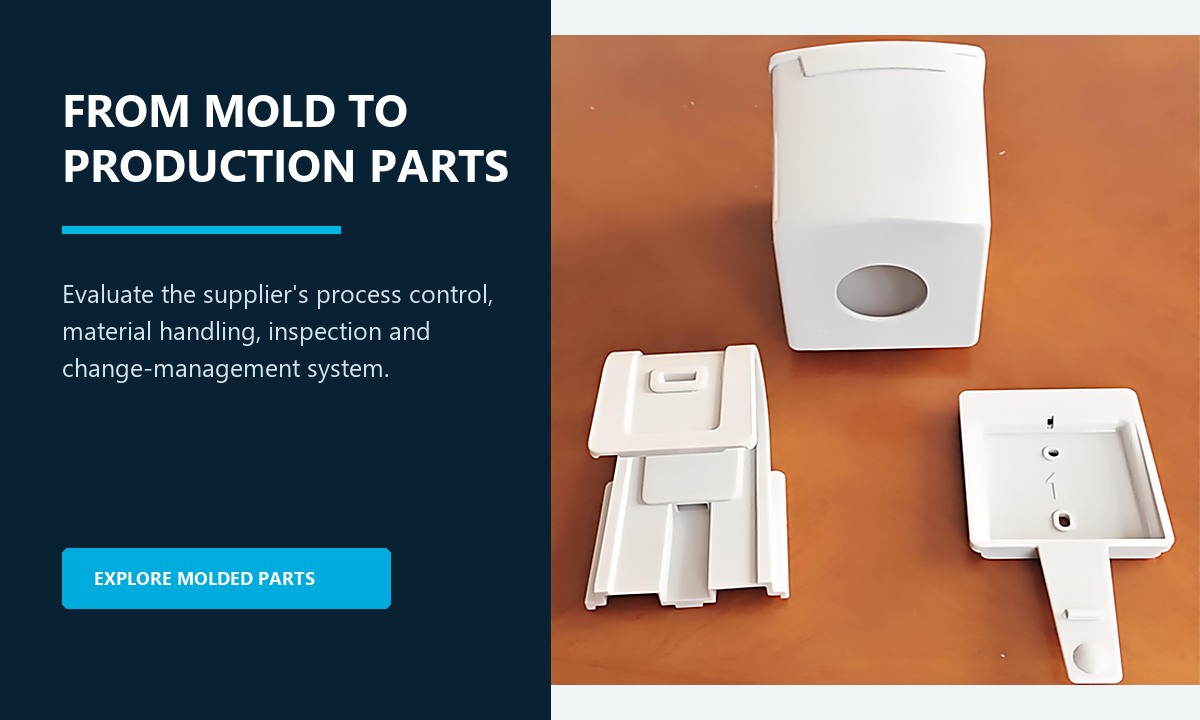
Ask how the supplier transfers the trial process into production. Review setup approval, master samples, boundary samples, cavity identification, control plans, work instructions, packaging, maintenance intervals, and the reaction plan for drift. Confirm whether future production will use the same site and whether moving the mold to another machine requires review or revalidation.
A strong plastic parts manufacturer should also be able to explain recurring-defect prevention. When flash, short shots, burn marks, sink, warpage, weld-line weakness, contamination, splay, or ejection damage occurs, does the team only adjust settings, or does it separate material, machine, mold, method, measurement, and part-design causes? Temporary adjustment and permanent corrective action are different jobs.
Compare Capacity With Your Demand Pattern
“High capacity” is not a production plan. Give candidates a realistic demand profile and ask them to show the proposed machine, cycle assumption, operating calendar, yield assumption, maintenance allowance, secondary-operation constraint, and backup plan.
Capacity risk often hides outside the molding press. The bottleneck may be resin drying, insert loading, printing, ultrasonic welding, leak testing, inspection, assembly, packaging, or a single skilled technician. Ask the supplier to identify the slowest step and the longest-replacement item.
Also separate two clocks:
- Tool delivery clock: design approval, steel and components, machining, assembly, initial trial, and corrections.
- Approved-product launch clock: material, samples, measurements, functional tests, appearance approval, packaging, customer feedback, changes, revalidation, and production scheduling.
A promised tool date can be met while the approved-part launch is late. Compare suppliers using the complete gate plan, not one headline number.
Control Engineering Changes Before They Reach the Mold
Custom projects change. The issue is not whether changes happen, but whether the team can identify the revision, assess the impact, obtain approval, implement the right version, and preserve traceability.
Ask for the supplier's engineering-change workflow. A useful impact review considers part geometry, mold inserts, cooling, ejection, resin, process settings, inspection programs, gauges, assembly, packaging, approved samples, work instructions, spare parts, open purchase orders, inventory, and revalidation.
Every change should answer five questions:
- What exactly is changing?
- Why is it changing?
- What existing tooling, parts, documents, and approvals are affected?
- What must be tested or measured again?
- Who approves release and how is the old revision prevented from use?
This discipline is particularly important when a verbal “small adjustment” involves a critical dimension, shutoff, texture, gate, sealing area, or assembly interface.
Compare Total Project Cost, Not Only Piece Price
The correct commercial comparison uses the same scope and assumptions. Separate one-time and recurring cost, then examine the risks behind both.
One-time costs may include DFM, mold design, tooling, hot runner, texture, gauges, fixtures, samples, material for trials, dimensional reports, functional testing, packaging development, and shipping. Recurring costs may include resin, color, molding, inserts, secondary operations, inspection, assembly, packaging, freight, duties, inventory, and scrap.
Ask candidates to state inclusions, exclusions, validity, tax treatment, delivery term, currency, payment milestones, change assumptions, and sample quantities. A low tool quote may exclude texture, hot-runner controls, spare components, measurement, or necessary correction rounds. A low part price may rely on a resin substitution, optimistic cycle, undefined scrap, different packaging, or production at a site not included in the audit.
Total landed cost should also consider the buyer's internal cost of managing ambiguity. Repeated clarification, unplanned sorting, line stoppage, emergency freight, customer returns, tool transfer, and revalidation can exceed the original unit-price difference.
Use a Weighted Supplier Audit Scorecard
A scorecard helps a cross-functional team compare evidence, but it should not hide a critical failure inside an average. Treat legal, safety, regulatory, material-identity, tooling-ownership, and essential technical requirements as gates.
| Audit area | Suggested weight | Evidence to review |
|---|---|---|
| DFM and engineering communication | 15% | Annotated review, trade-off explanation, decision log, revision control |
| Tooling definition and maintenance | 15% | Tool specification, design review, component list, maintenance and transfer plan |
| Molding process control | 15% | Machine fit, setup record, process window, startup approval, reaction plan |
| Material control and traceability | 10% | Approved grade, lot trace, storage, drying, substitutions and regrind policy |
| Measurement and quality planning | 15% | Control plan, measurement method, completed reports, calibration and nonconformance control |
| Trial and validation discipline | 10% | Gate criteria, sample plan, issue list, correction record and production-representative run |
| Capacity and delivery resilience | 10% | Demand model, bottleneck review, maintenance allowance and contingency plan |
| Commercial clarity and ownership | 10% | Comparable quotation, exclusions, ownership, change terms, packaging and delivery scope |
Score each area only after writing down the evidence. “Good communication” is an impression. “Returned an annotated DFM within the agreed review period, identified three assembly risks, and maintained a revision-controlled issue log” is auditable evidence.
Red Flags When Choosing a Plastic Injection Molding Supplier
One weak answer does not always disqualify a supplier, but several of the following signals should trigger deeper review:
- A quotation arrives without technical questions even though the RFQ is incomplete.
- The supplier promises a universal tolerance without discussing size, resin, geometry, shrinkage, conditioning, and measurement.
- The tool-life promise is not connected to steel, wear components, material, maintenance, and an acceptance boundary.
- The team refuses to identify where tooling, molding, inspection, or secondary operations occur.
- DFM comments are generic and cannot be linked to the part model.
- The quoted resin is a family name with no grade, maker, substitution rule, or compliance evidence.
- Only perfect presentation samples are available; no completed production records can be shown.
- The measurement method is decided after a dimensional disagreement.
- Every issue is blamed on the drawing without a structured cause analysis.
- Engineering changes move through chat messages with no controlled revision or approval record.
- The supplier guarantees price or lead time while leaving the scope undefined.
- Customer logos, certification marks, or “zero defect” language are used as substitutes for project evidence.
The best audit questions create observable answers. Instead of asking “Do you control quality?” ask the team to trace one finished batch back to material, machine, mold, cavity, operator or shift, inspection record, and approved revision.
Regulated and High-Risk Applications Need a Separate Evidence Plan
Automotive, medical, food-contact, electrical, battery, and other regulated or safety-related applications cannot be qualified with generic material names or broad marketing claims. The required evidence depends on the final product, market, contact conditions, hazards, customer standard, and the supplier's responsibility.
For restricted substances, buyers may need to evaluate obligations under frameworks such as the EU REACH Candidate List and RoHS Directive. A material declaration, laboratory result, and finished-product obligation are not interchangeable. Define which evidence is required, which entity issues it, which grade or lot it covers, and when it must be renewed.
For medical or food-contact projects, distinguish material suitability from the manufacturing system and from final-device or final-product compliance. For flame or electrical requirements, specify the exact grade, thickness, color, end-product design, and test requirement. The supplier should not infer a finished-product claim from a resin family.
What Information Should You Send DXMOLDING for a Useful Review?
Shenzhen DongXin Technology Co., Ltd. presents custom plastic injection molds, molded plastic parts, silicone molding, double-shot molding, CNC machining, and selected OEM/ODM product-development support on its website. For a plastic injection molding project, the most useful first contact is a controlled technical package rather than a one-line request for the lowest price.
Send the following where available:
- STEP or another editable 3D model.
- 2D drawing with revision, critical dimensions, datums, and tolerances.
- Target resin grade or the actual performance and use environment.
- Prototype, launch, annual, and peak volume expectations.
- Color, texture, gloss, and visible-surface requirements.
- Assembly, sealing, load, chemical, temperature, outdoor, or other functional conditions.
- Required samples, measurements, tests, documents, packaging, and destination.
- Tool ownership, expected program life, maintenance, spare-part, and export expectations.
The first review should identify missing inputs, DFM topics, major tooling assumptions, validation needs, and the scope used for quotation. That gives both teams a better basis for deciding whether the project fits before either side makes an unrealistic commitment.
Frequently Asked Questions
How do I compare two injection molding quotations?
Send the same RFQ package and compare the same scope. Check resin grade, cavity count, tool construction, runner system, appearance, tolerances, trial quantities, measurement, changes, packaging, freight, tax, ownership, maintenance, and exclusions. Normalize the assumptions before comparing totals.
Should the mold maker and molding supplier be the same company?
They do not have to be, but responsibilities must be clear. A combined team may reduce handoff risk. Separate specialists may also work well when the interfaces, data, approvals, machine requirements, trial support, and defect responsibilities are controlled.
What is the most important factory-audit question?
Ask the supplier to trace a recent production batch from approved drawing and material through machine setup, process checks, inspection, nonconformance control, packaging, and shipment. The trace exposes how the documented system works in practice.
Can a supplier quote from a 3D model alone?
A preliminary estimate may be possible, but a 3D model rarely defines material grade, critical tolerances, cosmetic zones, inspection, annual demand, tool life, packaging, and validation. A firm comparison needs those assumptions in writing.
How many trial rounds should be included?
There is no reliable universal number. Define what each gate must prove, what kinds of corrections are included, what counts as a buyer design change, how samples and reports are handled, and what happens if the mold cannot meet the approved specification.
How can I reduce injection molding cost without creating more risk?
Start with part design, realistic tolerances, material requirements, cavity strategy, runner choice, finish, cycle constraints, assembly, and inspection. Compare total project cost. A targeted design change or clearer specification often saves more than pushing down an ambiguous unit price.
Choose Evidence Before Promises
The right plastic injection molding supplier is not simply the company with the most equipment, the longest capability list, or the lowest initial quotation. It is the team that can turn your requirements into controlled decisions, show where the work happens, define how the mold and process will be approved, and preserve the result when production becomes routine.
Use the RFQ package, audit questions, red flags, and scorecard in this guide to compare suppliers on the same basis. Keep hard requirements as gates. Record assumptions before price negotiation. Ask for completed evidence rather than blank forms. Most importantly, settle ownership, measurement, change, and validation responsibilities before tooling begins.
Ready for a project-specific review? Send DXMOLDING your 3D model, 2D drawing, resin or performance requirements, annual volume, appearance zones, critical dimensions, validation needs, and delivery destination. The team can review the available information and define the manufacturing scope needed for a quotation.
Request a manufacturability review and project-specific quotation.