What Should a Custom Mold Manufacturer for OEM Products Actually Deliver?
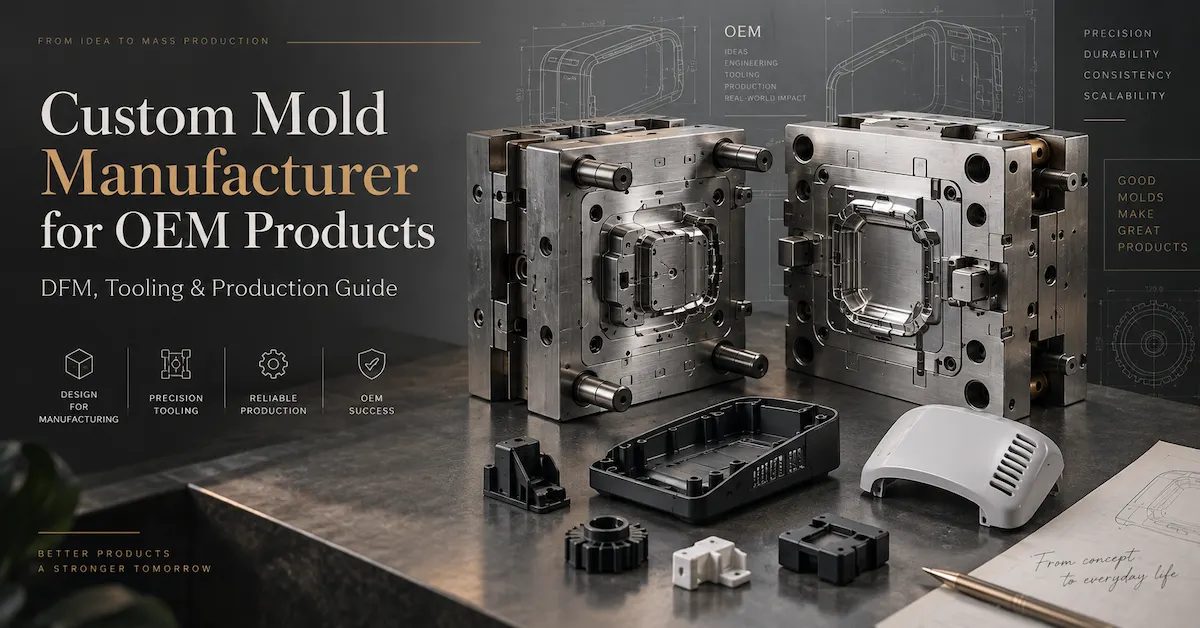
A custom mold manufacturer for OEM products should help turn an approved product design into a repeatable manufacturing process, not simply machine a cavity that resembles the CAD model. For OEM buyers, the real deliverable is a combination of engineering decisions, physical tooling, validated samples and a controlled route into production.
That difference becomes important when a product contains functional interfaces, visible surfaces, clips, ribs, bosses, connectors or multiple mating components. A mold can produce a visually acceptable sample and still leave unresolved questions about assembly, dimensional stability, maintenance or repeat orders.
DX Molding, operated by Shenzhen DongXin Technology Co., Ltd., supports plastic injection mold design and manufacturing, custom plastic molding, silicone tooling and OEM/ODM product development. Its current workflow places engineering review and manufacturing-risk assessment before mold production, then connects tooling with trials and production support.
For an OEM project, the purchasing question should therefore be:
Can this supplier connect our product requirement to a mold and production process that we can approve, document and reproduce?
Which OEM Buyers Need Custom Mold Manufacturing?
Custom tooling is relevant when a brand or manufacturer owns a product design that cannot be sourced as a standard catalog component. That may include consumer products, appliance components, electronics housings, equipment parts, industrial plastic components and other proprietary assemblies.
A mature OEM with released drawings normally needs DFM, mold design, tooling, samples and production validation. An early-stage product team may still need mechanical development before the mold can be frozen. A manufacturer with its own molding plant may want a transferable mold, while a brand without injection equipment may prefer tooling plus ongoing molded-part production.
Those are different purchasing models.
A custom mold manufacturer for OEM products should understand whether the customer needs:
| Project Requirement | What the Supplier Needs to Clarify | Why It Matters |
|---|---|---|
| Tool-only program | Mold destination and machine information | Determines transfer and interface requirements |
| Mold + molded parts | Forecast, QC and repeat-order requirements | Connects tooling with production |
| New OEM product | Product files, material and functional requirements | Establishes tooling scope |
| Early product development | Open design decisions and prototypes | Prevents premature steel cutting |
| Existing mold replacement | Current tool, samples and known problems | Helps separate product and tooling issues |
| Product revision | Old and new drawing revisions | Defines modification or new-tool scope |
If major dimensions, material, assembly or product function are still changing, it may be better to resolve those questions before investing in production tooling.
DX Molding’s OEM/ODM and custom manufacturing services cover product review, engineering, tooling and manufacturing support for projects at different development stages.
Start With the OEM Product, Not the Mold Quotation
A mold exists to reproduce a product. The RFQ should therefore begin with what the finished component must do.
Consider three illustrative OEM projects. An electronics housing may require PCB bosses, connector alignment and controlled exterior surfaces. An appliance component may need panel fit, screw locations and heat-related material requirements. An industrial component may prioritize mechanical interfaces and repeat dimensional stability.
All three could require injection molding, but the mold design priorities differ.
Before asking for a final tooling quotation, define the product application, material, mating components, critical dimensions, visible surfaces, expected volume and intended production location.
The supplier should also know which requirements remain open.
For example:
“The connector location is released, but the exterior texture is still under review.”
That statement is more useful than filling the RFQ with an unapproved specification simply to make it appear complete.
Build a Controlled OEM Mold RFQ
A controlled RFQ allows suppliers to quote the same project rather than different assumptions.
The following table is a buyer planning template, not a universal DX Molding specification.
| RFQ Item | Buyer Information | Supplier Decision |
|---|---|---|
| Product geometry | Current 3D CAD and 2D drawing | Manufacturability and mold concept |
| Resin | Exact grade or defined candidate | Shrinkage, steel and molding approach |
| Annual volume | Launch and repeat forecast | Cavity and tooling-life strategy |
| Critical dimensions | Tolerances, datums and measurement method | Machining and validation priorities |
| Cosmetic requirements | Visible areas, texture and acceptable marks | Parting, gate and ejection planning |
| Mating components | PCB, cover, frame, fasteners or other parts | Assembly validation |
| Undercuts | Clips, side holes or locking features | Slides, lifters or redesign decisions |
| Tool destination | Supplier plant or buyer factory | Machine compatibility and handover |
| Quality records | Dimensional, trial and inspection requirements | Validation package |
| Production expectations | Mold-only or molded-part supply | Commercial and manufacturing scope |
DX Molding’s current supplier-selection guidance recommends defining resin, quantity, tolerances, surface requirements, assembly conditions and intended production scope before comparing mold quotations.
Send DX Molding your CAD files and OEM project requirements when these inputs are available.
Use DFM Before Mold Design Is Frozen
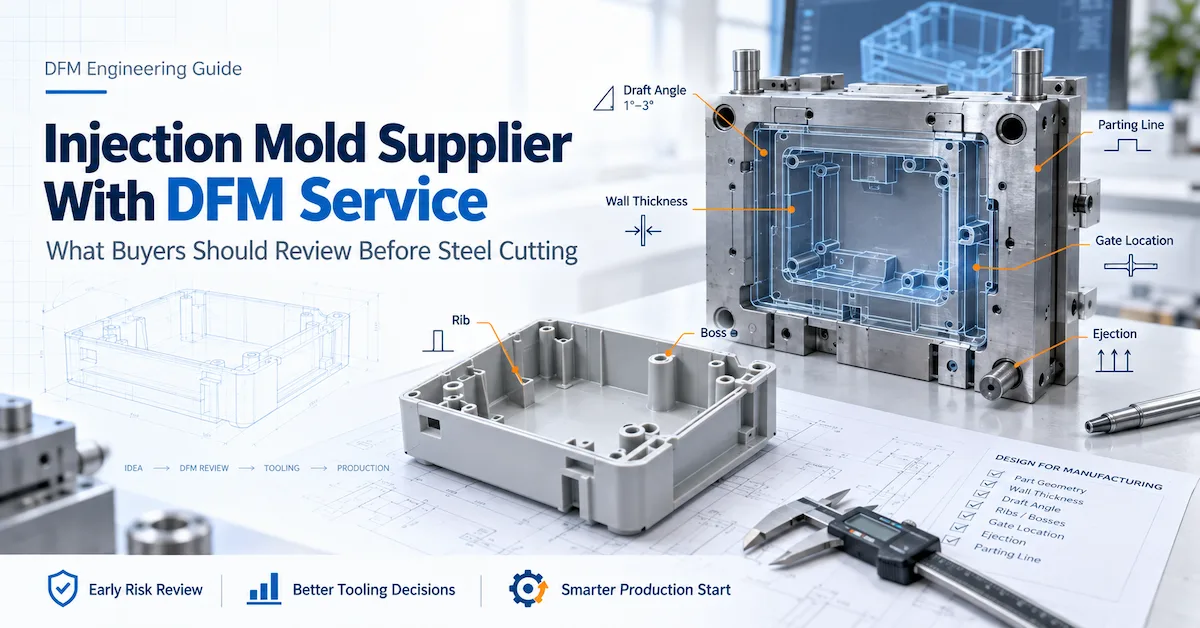
DFM—Design for Manufacturing—is one of the most important stages in custom OEM tooling because it is the point where product design and manufacturing reality meet.
A useful DFM review should examine more than whether the part can theoretically be molded. It should identify how geometry affects the proposed tool and finished part.
DX Molding’s published mold-sourcing guidance lists review areas including wall thickness, draft, ribs, bosses, fillets, undercuts, parting lines, gates, ejection, sink, warpage and assembly interference.
Review Ribs and Bosses With the Exterior Surface
Internal features can influence the visible side of a molded component. A screw boss located behind a cosmetic surface should therefore be evaluated together with the surrounding wall rather than treated as an isolated feature.
Resolve Undercuts Before Machining
A side hole or clip may require a slide, lifter or another moving mold feature. If the product can be redesigned without changing function, tooling may become simpler. If the undercut is essential, it should be engineered deliberately.
Check Draft and Surface Finish Together
Draft helps release the molded component from the tool. Surface texture can influence release requirements, so texture should not be added after mold design without reviewing its effect.
For OEM buyers, good DFM reduces the chance that a preventable product-design issue becomes an expensive mold modification later.
Approve Mold Structure, Gates, Cooling and Ejection
Once manufacturability is understood, the buyer should review the actual mold strategy.
DX Molding’s custom mold capabilities include single- and multi-cavity tooling, hot- and cold-runner configurations and project-specific mold construction.
Gate Strategy
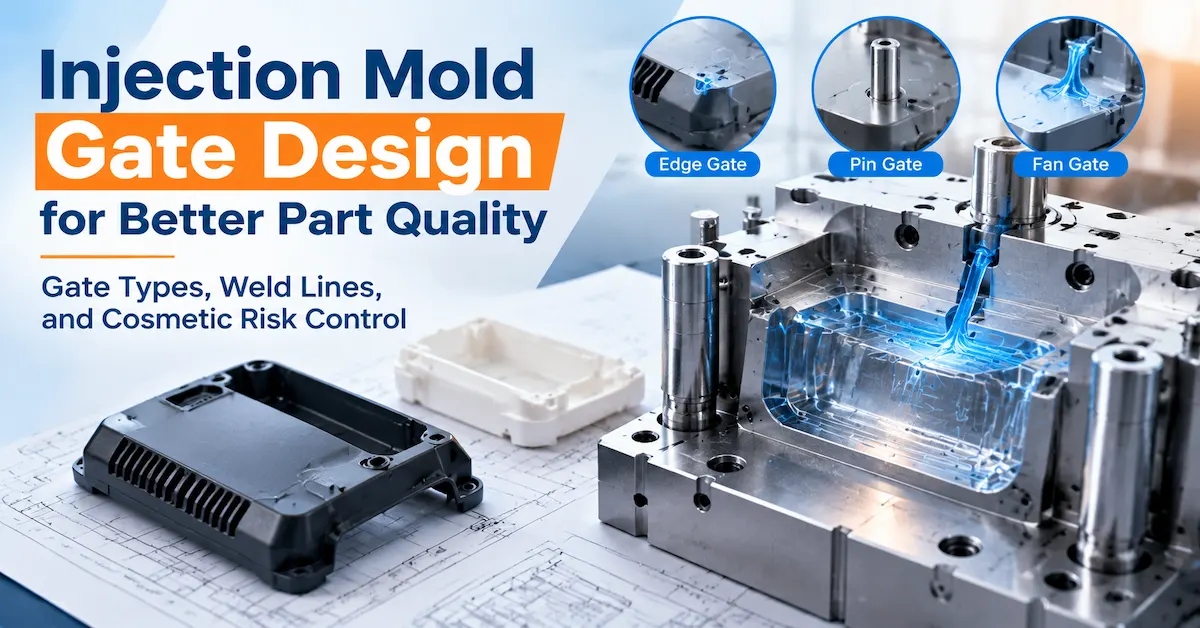
The gate controls where molten plastic enters the cavity. Its location can affect filling, weld lines, appearance and trimming.
Ask where the gate will be and why that location suits the product.
Parting Line
The parting line should be reviewed on the actual product geometry. For appearance-sensitive OEM products, a technically convenient parting line may still be commercially unacceptable.
Cooling
Cooling influences dimensional stability and production cycle. Ask how cooling relates to thick sections, large surfaces, cores and moving components.
Ejection
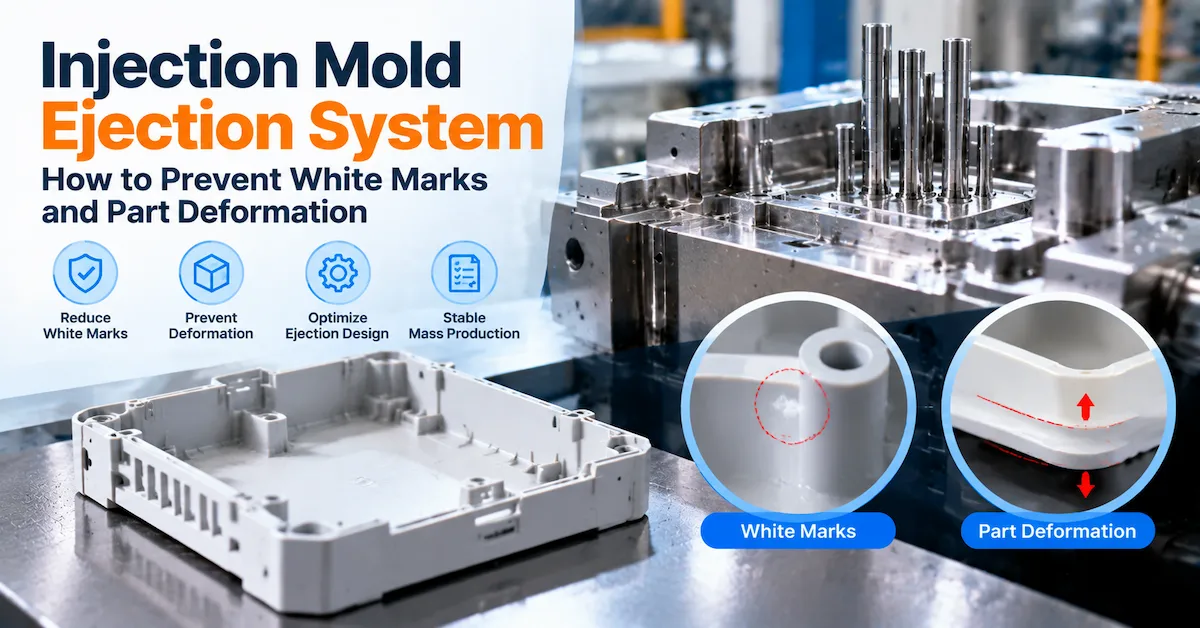
The part needs to leave the mold without unacceptable deformation or visible marks. Ejector locations should therefore be reviewed against cosmetic and functional surfaces.
A professional custom mold manufacturer for OEM products should be able to explain these choices instead of simply submitting a completed mold assembly for approval.
Select Tool Steel and Components Around the Production Program
Tool steel should be selected according to the actual production requirement rather than one universal “best” material.
DX Molding lists P20, H13 and S136 among its plastic injection mold options. The appropriate choice still depends on resin, expected production, finish, wear and project conditions.
For OEM buyers, ask:
Which steel is proposed for the cavity and core?
Which small features use inserts?
Which components will wear first?
Which spare parts should be prepared?
What maintenance assumptions support the proposed tool life?
A high production target may justify different tooling construction from a product with modest or uncertain demand.
Similarly, a resin containing fillers may create different wear considerations from a standard unfilled resin.
The point is not to demand the most expensive steel. It is to understand why the proposed construction fits the intended program.
Compare OEM Tooling Strategies Before Choosing One
Custom mold projects do not always have standard model numbers, so the following compares tooling strategies, not DX Molding catalog products.
| Tooling Strategy | Potential Advantage | Main Trade-Off | Suitable Discussion |
|---|---|---|---|
| Single-cavity mold | Lower initial complexity | Lower output | New or moderate-volume OEM products |
| Multi-cavity mold | Higher production output | Greater balance and inspection requirements | Stable repeat demand |
| Cold-runner mold | Relatively simple where appropriate | Runner waste and handling | Suitable resin and production economics |
| Hot-runner mold | Can reduce cold-runner material | More controls and maintenance | Higher-volume suitable projects |
| Replaceable inserts | Easier local repair or selected changes | Additional interfaces | Wear areas or localized variants |
| Slides/lifters | Enables necessary undercuts | More moving components | Side holes, clips and locking geometry |
The correct choice depends on volume, part geometry, resin, mold destination and production economics.
DX Molding’s supplier-selection guidance similarly emphasizes comparing mold specifications rather than comparing headline prices alone.
Validate the Mold With Actual OEM Product Requirements
A mold should not be approved simply because one sample looks good.
Validation should connect physical parts to the drawing and assembly requirement.
For an OEM program, consider separating approval into:
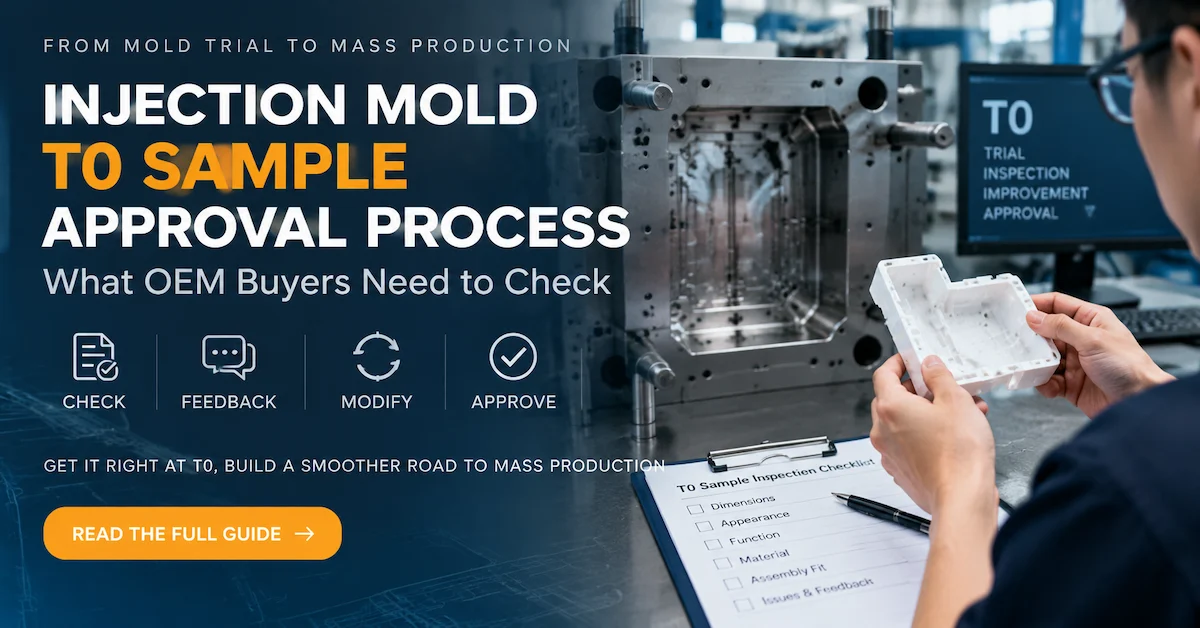
Dimensional approval — Are critical dimensions within the agreed acceptance range?
Assembly approval — Does the part fit its controlled mating components?
Cosmetic approval — Are visible surfaces, parting lines, gates and ejector marks acceptable?
Mold-operation approval — Do opening, ejection and moving mechanisms operate as intended?
Process evidence — Which resin, machine and process conditions produced the samples?
DX Molding’s supplier-evaluation guidance lists trial molding, dimensional reports, CMM data where applicable, process parameters and engineering-change records among documents that can form part of a structured quality package.
The precise reporting package should still be agreed for the individual project.
Do Not Confuse Certification With Product Approval
OEM buyers often ask about supplier certificates, material reports or compliance documents.
These should be reviewed according to their actual scope.
A company-level quality certificate does not automatically certify the finished OEM product. A material document does not automatically prove that the complete assembly meets the requirements of the buyer’s destination market.
For custom programs, define which documents are required, which product or process they cover and who is responsible for final product compliance.
Do not add certification requirements to the purchase order simply because another project used them.
This is especially important when custom geometry, materials or applications differ from a previously supplied product.
Plan Lead Time Around Approval Milestones
“Tooling lead time” can mean different things to different suppliers.
A better project schedule separates the major stages:
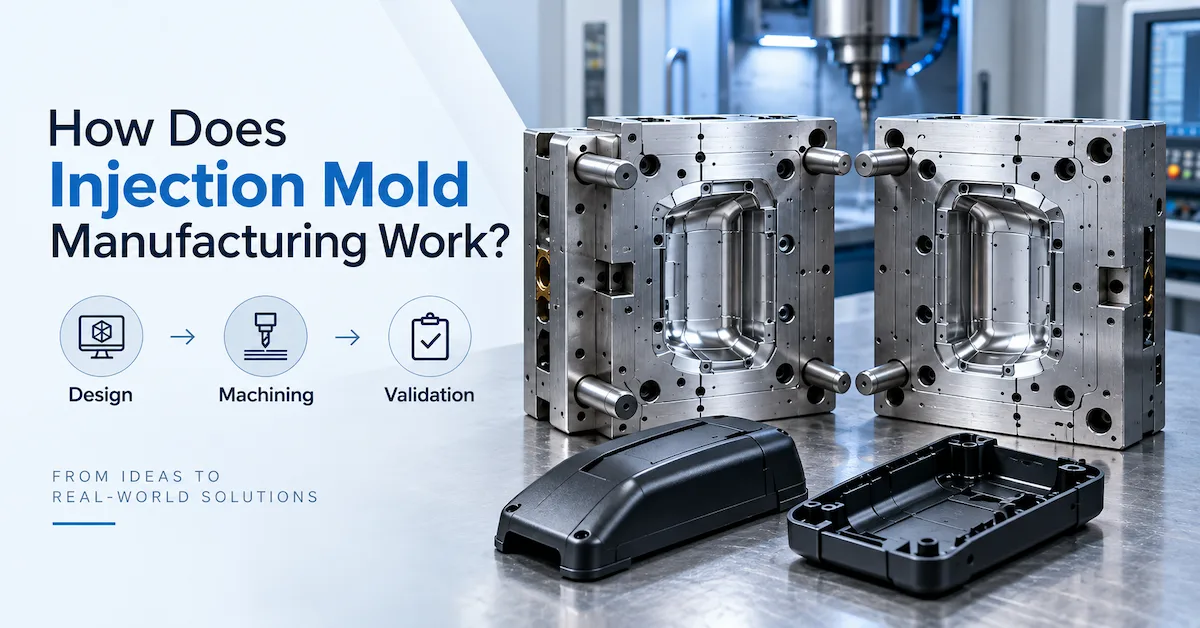
Requirements → DFM → product revision → mold design → design approval → machining → fitting → first trial → correction → re-trial → final sample approval → production or shipment.
DX Molding’s published workflow similarly moves from project review and DFM into mold design, machining, trials and production support.
For an OEM buyer, ask which event starts each phase and who must approve the next step.
A short first-trial date has little value if the quotation does not allow time for engineering correction and final validation.
Compare Custom Mold Cost at the Same Scope
Two mold quotations can have different prices because they describe different tools.
A meaningful commercial comparison should include:
| Cost Area | Buyer Question |
|---|---|
| Engineering | Is DFM and mold design included? |
| Mold construction | Which steel, cavities and mold base are proposed? |
| Runner system | Cold runner or hot runner? |
| Moving structure | Slides, lifters or manual inserts? |
| Trials | How many agreed trial stages are included? |
| Inspection | Which reports are supplied? |
| Corrections | What supplier corrections are included? |
| Customer changes | How are new design revisions charged? |
| Spare parts | Which components are included? |
| Production | Is molded-part pricing part of the program? |
| Transfer | Are drawings, packing and handover included? |
Imagine Supplier A quotes $14,000 and Supplier B quotes $17,000. If Supplier A excludes several required trials, a controller and documentation that Supplier B includes, the apparent $3,000 difference is not necessarily a real saving.
That example is illustrative, not DX Molding pricing.
The purpose is to compare like with like.
Connect Tooling With Repeat OEM Production
A successful OEM mold is usually not a one-time engineering project.
It becomes part of a supply chain.
The buyer should therefore decide how repeat production will be controlled after the first approved samples.
If DX Molding will continue producing the components, its plastic molding services provide a basis for connecting approved tooling with molded-part production. If the mold will be transferred, the handover package becomes more important.
DX Molding’s existing transfer guide recommends aligning tool specifications, trial results and handover documentation with the receiving production site before shipment.
For a repeat program, retain controlled records for drawing revision, material, approved sample, quality requirements and relevant process information.
This reduces the chance that later orders gradually move away from the product that was originally approved.
Define OEM and ODM Responsibilities Clearly
OEM and ODM are related but not identical project structures.
In a mature OEM project, the buyer usually provides the defined product and the manufacturer converts that design into manufacturable tooling and parts.
An ODM program may involve more supplier participation in appearance, mechanical design, prototypes and product-development decisions.
DX Molding publicly lists OEM/ODM product development from idea to production as one of its project areas.
Before development starts, agree who controls:
- Product geometry.
- Material selection.
- Critical dimensions.
- DFM changes.
- Prototype approval.
- Mold design.
- Engineering revisions.
- Trial acceptance.
- Production release.
A phrase such as “full-service OEM support” should not replace a responsibility matrix.
What Should You Send a Custom Mold Manufacturer for OEM Products?
The quality of the first technical discussion depends heavily on the information the buyer provides.
Prepare your current 3D CAD, 2D drawing, resin, quantity forecast, critical dimensions, surface requirements, assembly information and product application.
Also state:
whether you need only the mold or finished molded parts;
where the mold will operate;
which requirements remain undecided;
what problem concerns your engineering team most.
That final point can be especially useful.
Perhaps your concern is sink around a boss, a snap fit, a visible seam, dimensional stability or uncertainty about the required cavity count.
A specific concern allows the engineering team to focus on the decision that matters to the product.
Send DX Molding your OEM product drawings and project requirements to begin a drawing-based manufacturing review.
Frequently Asked Questions
1. What Is a Custom Mold Manufacturer for OEM Products?
A custom mold manufacturer develops tooling around a buyer’s proprietary product rather than supplying a standard catalog mold. The scope may include DFM, mold design, machining, assembly, mold trials, sample inspection and ongoing molded-part production.
2. What Files Are Needed for an OEM Mold Quote?
Provide the latest 3D CAD file and, where available, a controlled 2D drawing showing critical dimensions and tolerances. Include material, expected volume, surface requirements, assembly information and the intended production arrangement.
3. Should OEM Buyers Request DFM Before Mold Manufacturing?
Yes. DFM helps identify issues involving wall thickness, draft, ribs, bosses, undercuts, gates, ejection, sink, warpage and assembly before steel machining. The objective is to resolve avoidable manufacturing risk earlier.
4. Can DX Molding Design the Product as Well as the Mold?
DX Molding lists OEM/ODM product-development support along with plastic mold design and manufacturing. The actual design responsibility should be confirmed for the individual project so product development and mold-development deliverables are clearly separated.
5. How Should OEM Buyers Choose Mold Steel?
Connect the steel decision to resin, production volume, finish, wear and maintenance requirements. Ask the supplier to explain the proposed core, cavity and insert materials instead of requesting one steel grade for every project.
6. Is a Multi-Cavity Mold Always Better for OEM Production?
No. More cavities can increase output, but they also affect tooling cost, runner balance, machine size, inspection and maintenance. Select cavity count according to actual forecast and production economics.
7. How Should an OEM Mold Be Approved?
Use controlled acceptance requirements covering critical dimensions, appearance, assembly and mold operation. Link submitted samples to the relevant drawing revision, resin and trial information so approval can be traced later.
8. Can DX Molding Produce Parts After Making the Mold?
Yes. DX Molding supports plastic injection mold manufacturing and molded plastic-part production. Buyers should define whether the mold remains for continued production or will eventually transfer to another manufacturing site.
9. Who Owns the Custom OEM Mold?
Ownership, mold storage, drawings, maintenance and transfer terms should be stated in the purchasing agreement. Do not rely on assumptions created by tooling payment alone. DX Molding’s current supplier-selection guide also recommends clarifying ownership before placing the tooling order.
10. How Can I Get a More Accurate OEM Tooling Quote?
Provide complete drawings, material, production volume, critical dimensions, appearance and assembly requirements. Identify open engineering questions instead of forcing assumptions into the RFQ. This helps suppliers quote the actual scope rather than a generic mold.
Conclusion
Choosing a custom mold manufacturer for OEM products is both an engineering decision and a long-term supply-chain decision. The supplier should be able to understand the product, identify manufacturability risks before machining, define the mold specification, validate molded samples and maintain a controlled route from first approval into repeat production.
For OEM buyers, the most important sequence is:
product requirement → DFM → tooling specification → mold design → manufacturing → trial validation → production approval → repeat supply.
When those stages are clear, quotations become easier to compare and engineering changes become easier to control. The decision is no longer based only on who can machine a mold or offer the lowest headline price, but on who can support the actual product through its manufacturing lifecycle.
DX Molding supports custom plastic molds, molded parts and OEM/ODM product development. Send DX Molding your CAD files, resin, volume forecast and critical product requirements to start a project-specific review.